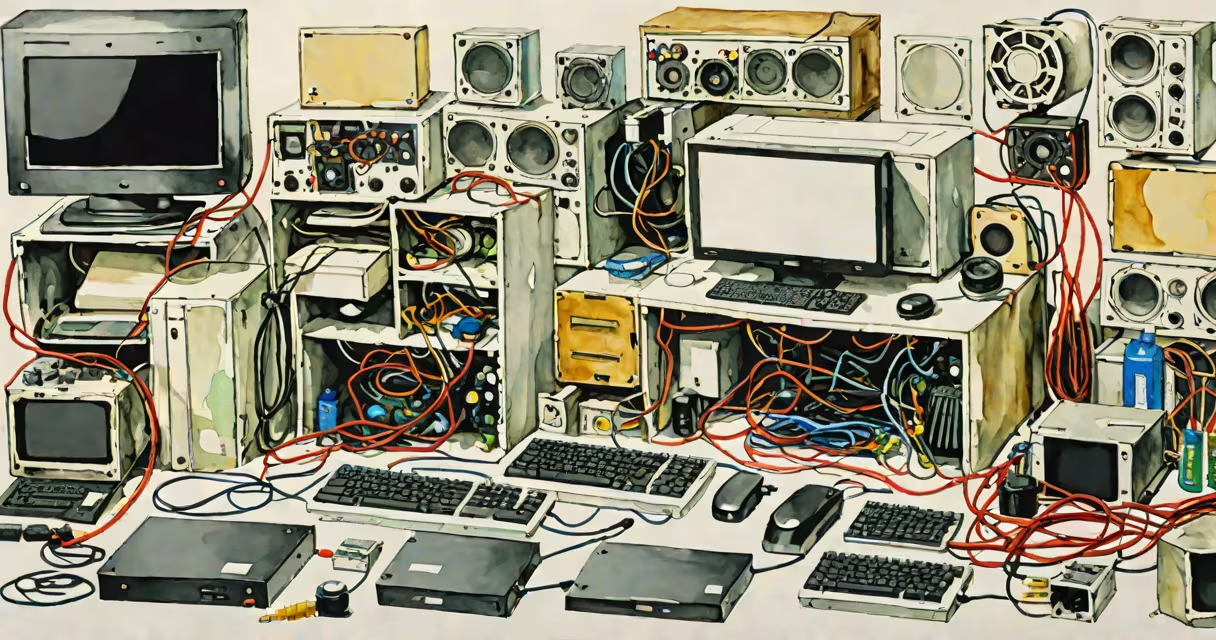
All computer parts are the individual physical components that work together to process data, store information, and deliver output in a computing device. These include the central processing unit (CPU), memory (RAM), storage drives, motherboard, graphics card (GPU), power supply, and cooling systems.
The CPU executes instructions from software, acting as the brain of the system. It performs arithmetic, logic, control, and input/output operations. Modern CPUs have multiple cores-typically 4 to 16-to handle parallel tasks efficiently. For example, Intel's Core i7-13700K has 20 cores (8 performance + 12 efficiency) and runs at speeds up to 5.4 GHz.
RAM stores data temporarily while the computer is running. It allows the CPU to access frequently used information quickly. A typical desktop uses 16 GB of DDR4 or DDR5 RAM. If a program requires more memory than available, the system uses a portion of the hard drive as virtual memory, which slows performance. Running a video editing application with 8 GB of RAM on a 16 GB system may cause lag due to excessive swapping.
Storage devices hold data permanently. Hard disk drives (HDDs) use spinning platters and magnetic heads. They offer large capacity-up to 18 TB-but slower speeds. Solid-state drives (SSDs) use flash memory and provide faster boot times and file access. A 1 TB NVMe SSD can read data at over 7,000 MB/s, compared to ~150 MB/s for a standard SATA HDD.
The motherboard connects all components. It houses the CPU socket, RAM slots, PCIe slots for GPUs and expansion cards, and ports for peripherals. Motherboards come in different form factors-ATX, micro-ATX, Mini-ITX-dictating size and compatibility. A full-size ATX board supports multiple RAM modules, high-end GPUs, and additional cooling options.
| Component | Function | Common Types | Typical Capacity/Speed |
|---|---|---|---|
| CPU | Executes program instructions | Intel Core, AMD Ryzen | 2.5-5.4 GHz clock speed |
| RAM | Temporary data storage for active processes | DDR4, DDR5 | 8-128 GB, 3200-6400 MT/s |
| Storage | Persistent data retention | HDD, SSD, NVMe | 250 GB-18 TB, 150-7,000 MB/s |
| Motherboard | Interconnects all components | ATX, micro-ATX | Supports specific CPU and RAM types |
| GPU | Processes graphics and parallel computations | NVIDIA GeForce, AMD Radeon | 8-48 GB VRAM, 10-30 TFLOPS |
Power supplies convert AC wall current into stable DC voltages for internal components. A 650W unit typically powers a mid-range gaming PC. Choosing a unit with 80 Plus Bronze certification ensures at least 85% efficiency under load. Poor power delivery can cause crashes during intensive tasks like rendering or gaming.
Cooling systems maintain safe operating temperatures. Air coolers use heat sinks and fans. Liquid cooling systems circulate coolant through tubes and radiators. Overheating reduces lifespan and causes thermal throttling-where the CPU slows down to avoid damage. During a 30-minute video render, a CPU without adequate cooling dropped from 4.8 GHz to 2.4 GHz due to overheating.
Peripherals such as keyboards, mice, monitors, and speakers are external components. While not essential for computation, they enable interaction. A USB-C monitor with 4K resolution draws 15 watts and supports daisy-chaining multiple displays via DisplayPort Alt Mode.
Some users mistake the GPU for being solely responsible for gaming performance. While it plays a major role, bottlenecks occur when other components limit throughput. In a test using a 1080p game, a high-end GPU paired with only 8 GB of RAM caused frame drops due to insufficient memory bandwidth. Upgrading to 16 GB resolved the issue.
A common misconception is that more cores always mean better performance. This isn't true for single-threaded applications like older games or certain productivity tools. A dual-core processor with high clock speed may outperform a six-core model in such cases. The Ryzen 5 5600X (6 cores, 12 threads) scored higher in single-thread benchmarks than the older Ryzen 3 3100 (4 cores, 8 threads).
When building a custom PC, selecting compatible parts is critical. For example, a motherboard with an LGA 1700 socket only accepts Intel 12th Gen and newer CPUs. Using a 13th Gen CPU on a 11th Gen motherboard fails due to mismatched pinouts. Always verify compatibility using tools like Intel's ARK database or AMD's product specifications.
I once assembled a system using a used GPU and a low-wattage PSU. The machine booted but crashed during startup. Diagnosing revealed the power supply couldn't deliver enough current to the GPU under load. Replacing it with a 750W 80 Plus Gold unit stabilized the system. This illustrates how hidden component interactions affect reliability.
Not all computer parts are interchangeable. Older motherboards lack support for newer RAM standards. DDR5 RAM won't fit in a DDR4-only motherboard. Similarly, M.2 NVMe SSDs require a compatible M.2 slot on the motherboard. A motherboard with only SATA III ports cannot take advantage of an NVMe SSD's speed unless a PCIe adapter is used.
All computer parts serve distinct roles in creating a functional, efficient system. Their synergy determines performance, stability, and longevity. Recognizing their differences and interdependencies avoids common mistakes and supports long-term usability.