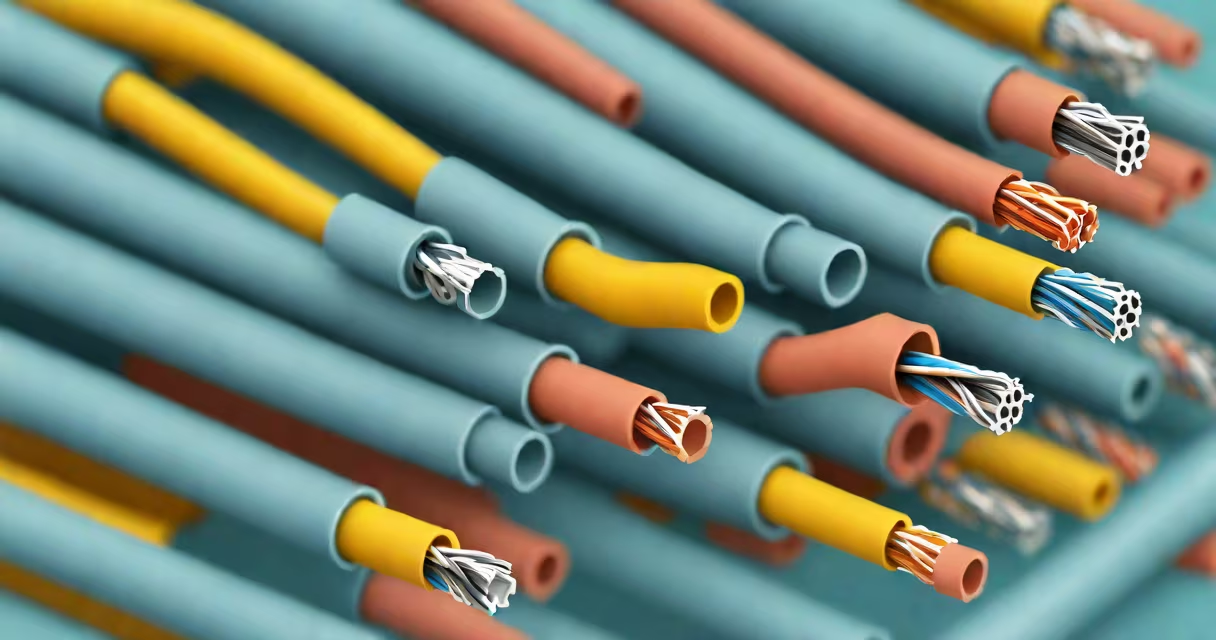
Category 6 wire is a standardized twisted-pair Ethernet cable designed for high-speed data transmission, supporting up to 10 gigabits per second over distances up to 55 meters. It features tighter twists, improved insulation, and often a spline separator between pairs to reduce crosstalk and electromagnetic interference.
Used in structured cabling systems for local area networks (LANs), Category 6 wire exceeds the performance requirements of earlier standards like Cat5e. It supports 10BASE-T, 100BASE-TX, and 1000BASE-T Ethernet protocols, and enables 10GBASE-T speeds within defined limits. The cable's construction includes four twisted pairs, each insulated with high-quality PVC or LSZH material, and typically rated for frequencies up to 250 MHz.
Manufacturers test Cat6 cables under controlled conditions to ensure compliance with TIA/EIA-568-C.2 and ISO/IEC 11801 standards. These benchmarks define minimum performance thresholds for attenuation, near-end crosstalk (NEXT), and return loss. A cable labeled "Cat6" must meet these values across all specified frequency bands to qualify as compliant.
Each Cat6 cable contains four pairs of copper wires, twisted together in specific patterns. The twist rate increases compared to Cat5e, reducing interference between adjacent pairs. A plastic spline runs through the center of the cable, separating the pairs and minimizing crosstalk-especially critical at higher frequencies.
When data travels through the cable, electrical signals propagate along the conductors. Signal degradation occurs due to resistance, capacitance, and electromagnetic radiation. Cat6's tighter twist and shielding reduce these losses. For example, at 100 MHz, Cat6 maintains a NEXT value of at least 49.5 dB, while Cat5e requires only 43.5 dB.
For 10GBASE-T applications, the cable must handle signals up to 55 meters. Beyond that distance, signal integrity drops below acceptable levels. This limitation is enforced by IEEE 802.3an, which specifies that 10 Gbps transmission over Cat6 is valid only within 55 meters.
There are two primary types of Category 6 wire: unshielded (UTP) and shielded (STP). UTP Cat6 is most common in residential and small office installations. STP Cat6 adds foil shielding around each pair and an braided shield, improving noise rejection in electrically noisy environments such as industrial facilities or server rooms.
| Type | Shielding | Best Use Case | Typical Cost Range |
|---|---|---|---|
| UTP Cat6 | None | Home networks, small offices | $0.30-$0.50 per foot |
| FTP Cat6 | Foil around each pair | Commercial buildings with moderate EMI | $0.50-$0.80 per foot |
| S/FTP Cat6 | Foil + braided shield | High-interference areas, data centers | $0.80-$1.20 per foot |
Some Cat6 cables are labeled "Cat6a" (augmented), which supports 10 Gbps up to 100 meters and operates at 500 MHz. Cat6a cables are thicker and require more careful handling during installation. They are not interchangeable with standard Cat6 in all scenarios due to physical size and connector compatibility.
Many assume that all Cat6 cables perform identically. This is false. A cable labeled "Cat6" may not meet the full specification if it lacks proper twist rates, inadequate insulation, or missing internal splines. Independent testing by organizations like Fluke Networks shows that up to 30% of low-cost Cat6 cables fail to meet TIA-568-C.2 standards in real-world conditions.
Another error is using Cat6 cables with older connectors like RJ11 or modular jacks not rated for 1000 Mbps. The connector must support 8P8C (RJ45) and be properly terminated with a punch-down tool. Improper termination causes signal reflection and increased crosstalk. For example, a loose connection at pin 1 can degrade bandwidth by up to 20%.
A lesser-known fact: Cat6 cables installed in conduits or bundled with power lines must maintain separation. The National Electrical Code (NEC) Article 800 mandates at least 6 inches of clearance between data cables and power cables to prevent interference. Violating this rule can cause intermittent network failures, especially in high-frequency transmissions.
In a mid-sized office with 40 workstations, a network engineer chose Cat6 UTP cables for all desktop connections. The building had no major EMI sources, so shielding was unnecessary. The cables were run through ceiling spaces and terminated with keystone jacks and patch panels.
After installation, the IT team ran a Fluke DTX-1800 cable tester. Results showed all cables met Cat6 specifications: NEXT above 49 dB at 100 MHz, return loss under -20 dB, and attenuation below 10 dB. The network achieved stable 1 Gbps speeds across all endpoints. When upgrading to 10GBASE-T for the finance department, the team confirmed that the existing Cat6 infrastructure supported 10 Gbps over 55 meters, eliminating the need for rewiring.
However, when a technician later added a new printer with a high-power motor near a cable run, signal degradation occurred. Re-testing revealed crosstalk spikes above 50 dB. The fix required rerouting the data cable away from the power line and adding a grounded metal conduit. This case illustrates that performance depends not just on cable quality but on installation environment.
Category 6 wire outperforms Cat5e in bandwidth, crosstalk reduction, and maximum data rate. While Cat5e supports up to 1 Gbps at 100 MHz, Cat6 handles 10 Gbps at 250 MHz. The difference becomes apparent in latency-sensitive applications like video conferencing or VoIP calls.
Compared to Cat7, Cat6 offers lower cost and easier installation. Cat7 uses shielded pairs and a single shield, enabling 10 Gbps over 100 meters. However, Cat7 connectors are larger and less compatible with standard patch panels. Cat6 remains the preferred choice for most commercial deployments due to balance of performance and practicality.
For outdoor or harsh environments, Cat6 cables with UV-resistant jackets and armored sheathing exist. These are not standard Cat6 but are marketed as "outdoor-rated Cat6." Always verify the manufacturer's environmental ratings before deployment.
During a site audit at a hospital network, a technician discovered that several Cat6 cables had been replaced with generic "Cat6-like" cables from a discount vendor. Testing revealed that these cables failed to meet the minimum NEXT requirement at 200 MHz. The network experienced packet loss during MRI data transfers. Replacing them with certified Cat6 cables restored full throughput. This incident highlights that certification matters-"Cat6" labeling alone doesn't guarantee performance.
Always purchase Cat6 cables from reputable vendors with traceable certifications. Look for labels indicating compliance with TIA/EIA-568-C.2 and ISO/IEC 11801. Avoid cables sold in bulk without documentation or testing reports.
Use proper tools during termination. A punch-down tool with a 110-style connector ensures consistent contact pressure. Poor termination leads to intermittent connectivity and higher error rates. For large-scale projects, consider using a cable certifier like the Fluke DSX-5000 to validate each run before deployment.
If you're installing or managing network infrastructure, using a compliance wire stryker ensures clean, precise cuts and prevents damage to internal conductors. This tool reduces fraying and improves termination reliability-especially important when working with multiple cables in tight spaces.
Category 6 wire is not obsolete. It remains a core component of modern LANs, especially where 10 Gbps is needed within short distances. Its performance, availability, and cost-effectiveness make it the default choice for most wired network deployments.