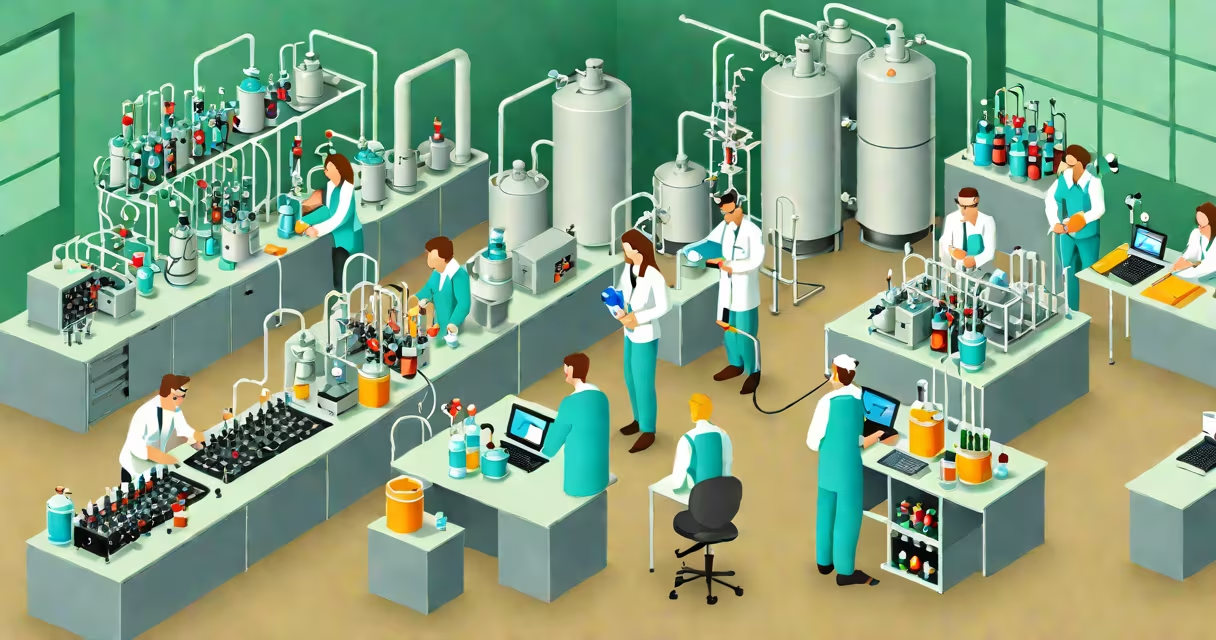
A chemical engineer major trains students to design, scale, and improve industrial processes that convert raw materials into valuable products such as fuels, pharmaceuticals, and polymers. This discipline combines principles of chemistry, physics, mathematics, and engineering to solve problems involving flow, heat transfer, reaction kinetics, and material balance.
Students in this major learn to model complex systems, manage safety risks, and improve efficiency across manufacturing environments. The field emphasizes quantitative analysis and system-level thinking, preparing graduates for roles in energy, biotechnology, environmental protection, and consumer goods industries.
According to the U.S. Bureau of Labor Statistics, employment of chemical engineers is projected to grow 4% from 2022 to 2032, with median annual pay of $108,700 in 2023. The National Academy of Engineering notes that chemical engineers are uniquely positioned to address global challenges such as sustainable energy and clean water access.
At its core, a chemical engineer major teaches how to turn small-scale laboratory reactions into large-scale production systems. This involves understanding mass and energy balances, thermodynamics, fluid mechanics, and reaction engineering. Students learn to calculate how much feedstock is needed, how long a reactor should run, and how to minimize waste.
Courses include transport phenomena (heat, mass, momentum), process dynamics and control, unit operations (distillation, filtration, mixing), and process simulation using software like Aspen Plus or MATLAB. These tools allow engineers to predict outcomes before building physical plants.
For example, designing a biodiesel plant requires calculating the optimal temperature and catalyst concentration to maximize yield while minimizing side products. A student might simulate a continuous stirred-tank reactor (CSTR) to determine residence time and conversion rate based on kinetic parameters derived from experimental data.
The curriculum typically spans four years and includes foundational science courses in organic chemistry, physical chemistry, and calculus-based physics. Advanced coursework centers on process design, safety, and sustainability.
Specializations within the major include:
| Type | Focus Area | Example Application |
|---|---|---|
| Energy | Fossil fuel processing, biofuels, hydrogen production | Designing a refinery upgrade to reduce carbon emissions |
| Bioprocessing | Pharmaceutical manufacturing, fermentation, cell culture | Scaling up insulin production from lab to commercial batch |
| Materials | Nanomaterial synthesis, polymer processing, semiconductor fabrication | Optimizing conditions for high-purity silicon wafers |
| Sustainability | Life cycle assessment, green chemistry, waste reduction | Redesigning a plastic packaging line to use recycled feedstocks |
Many programs require a capstone design project where teams develop a full process flow diagram, perform economic analysis, and present safety and environmental impact assessments. One group at the University of Michigan designed a pilot-scale process to extract lithium from brine using solvent extraction, achieving 92% recovery in simulations.
Chemical engineers work in industries ranging from petrochemicals to food and beverage. They design reactors, improve supply chains, ensure regulatory compliance, and troubleshoot production issues. Their expertise prevents failures that could lead to spills, explosions, or product recalls.
For instance, during the 2010 Deepwater Horizon oil spill, chemical engineers were involved in evaluating dispersant effectiveness and modeling oil dispersion patterns. While not all engineers worked on the disaster response, the field's analytical foundation enables rapid assessment of complex fluid behavior under extreme conditions.
Another common application is in drug development. Pharmaceutical companies rely on chemical engineers to scale up synthesis routes from milligram-scale research to tonne-per-year production. A single change in solvent or temperature can alter crystallization behavior and affect drug stability, requiring precise control.
Chemical engineering is often mistaken for chemistry or chemical biology. While chemistry focuses on molecular structure and reactions, chemical engineering applies those principles to real-world systems. A chemist may discover a new compound; a chemical engineer determines how to produce it efficiently and safely at scale.
For example, a team at MIT developed a new catalyst for ammonia synthesis that reduces energy use by 30%. The chemists identified the material's composition; the chemical engineers modeled reactor performance, assessed durability under industrial pressure, and designed a system to integrate it into existing plants.
Unlike mechanical or electrical engineering, which focus on structures and circuits, chemical engineering centers on material transformation. It deals with phase changes, chemical equilibria, and changing systems that evolve over time. This makes it distinct from process control in other fields, where variables are often static or linear.
One non-obvious difference: chemical engineers don't just design machines-they design processes. A distillation column isn't just metal pipes and trays; it's a system governed by vapor-liquid equilibrium, heat exchange, and mass transfer. The success of the entire operation hinges on accurate modeling of these interactions.
I spent a summer working in a pilot plant at a Midwest chemical company, helping to scale up a new adhesive formulation. The lab team had synthesized a polymer with excellent bonding strength, but when we tried to produce it in a 100-liter reactor, viscosity spiked and the mixer stalled. We traced the issue to shear-thinning behavior not captured in small-scale tests. After adjusting the agitation speed and adding a co-solvent, we achieved stable flow. That experience showed me how theoretical models must account for real-world fluid dynamics.
Understanding these differences ensures students choose a path aligned with their goals. Someone interested in gene editing or protein folding should consider chemical biology. Those drawn to large-scale manufacturing, energy systems, or environmental engineering should pursue chemical engineering.
Graduates with a chemical engineer major enter diverse sectors including energy, healthcare, electronics, agriculture, and advanced materials. They may work in research and development, operations, regulatory affairs, or consulting. Some transition into business roles, using technical skills in product management or investment analysis.
With a strong foundation in math, science, and systems thinking, the chemical engineer major prepares individuals to innovate, solve pressing global challenges, and build efficient, safe, and sustainable industrial processes.