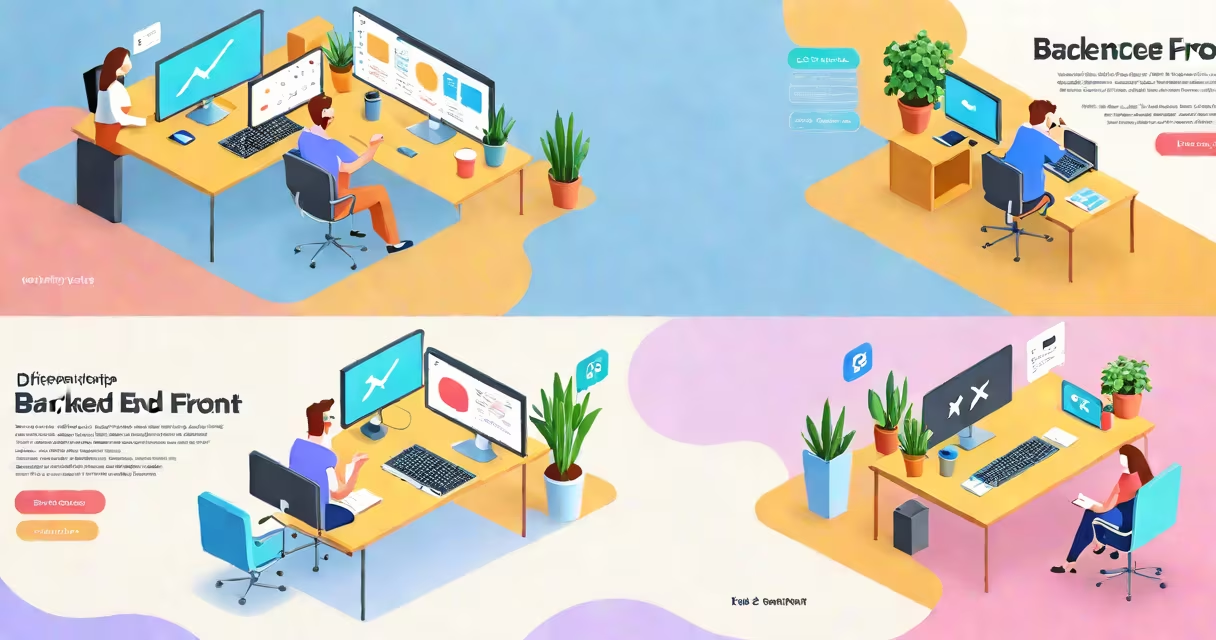
The difference between backend and front end defines how web applications are built: front end controls what users see and interact with, while backend manages data processing, server operations, and database interactions.
Front end development focuses on the visual and interactive elements of a website or app. This includes layout, color schemes, animations, buttons, forms, and navigation. It runs entirely in the user's browser using languages like HTML, CSS, and JavaScript. A well-designed front end ensures a site loads quickly, works across devices, and feels intuitive.
Backend development handles everything behind the scenes. It manages user authentication, processes form submissions, stores data in databases, and connects to external services like payment gateways or APIs. Backend systems use server-side languages such as Python, Ruby, PHP, Node.js, or Java, and rely on database systems like PostgreSQL, MySQL, or MongoDB.
A user visiting an e-commerce site illustrates the interaction. On the front end, they browse products with images, filters, and a shopping cart icon. When they click "Add to Cart," the front end sends a request through JavaScript to the backend.
The backend receives the request, checks inventory via a database, confirms the product is available, updates the user's session, and returns a success message. The front end then updates the cart display instantly-without reloading the page.
This smooth exchange happens in milliseconds. Without both components working together, websites fail. A stunning front end with no backend cannot process orders. A useful backend with no front end cannot be accessed by users.
Front end relies on frameworks and libraries such as React, Vue.js, or Angular. These tools manage changing content efficiently. For example, React allows developers to build reusable UI components-like a product card that updates when a user changes quantity.
Backend systems use frameworks like Express (Node.js), Django (Python), or Laravel (PHP). These provide structure for handling routes, authentication, and database queries. A backend route like /api/orders might return JSON data listing recent purchases when called by the front end.
Databases store structured data. A PostgreSQL query like SELECT * FROM users WHERE email = '[email protected]'; retrieves user details during login. The backend executes this, then sends the result to the front end for display.
| Aspect | Front End | Back End |
|---|---|---|
| Primary language | HTML, CSS, JavaScript | Python, Ruby, PHP, Node.js, Java |
| Execution environment | User's browser | Server or cloud infrastructure |
| Key responsibility | Visual presentation and user interaction | Data management, business logic, security |
| Example tool | React, Tailwind CSS | Express.js, Django REST Structure |
Many assume front end is simpler because it involves visuals. In reality, modern front end requires deep understanding of state management, responsive design, accessibility standards, and performance optimization.
For example, a single-page application built with React may have hundreds of components managing complex user flows. Developers must prevent memory leaks, ensure consistent rendering across browsers, and improve load times-even with minimal changes.
Another myth is that backend work is purely technical and disconnected from users. But backend engineers define how data is validated, secured, and delivered. A poorly designed API can cause slow response times, broken features, or data exposure-even if the front end looks perfect.
According to Mozilla Developer Network, 70% of web performance issues originate from client-side rendering problems. Yet 60% of developers still prioritize backend logic over front end speed. This imbalance leads to sites that function but frustrate users.
Consider a ride-hailing service like Uber. The front end shows a map, driver location, fare estimates, and booking buttons. Users tap "Request Ride" and see real-time updates.
Behind the scenes, the backend performs several tasks:
When a driver accepts, the backend updates the trip status and begins tracking the process. All this happens within seconds, coordinated between multiple servers and databases.
Without the backend, the front end would show a blank map. Without the front end, users couldn't initiate rides. Both layers are essential.
Understanding the difference between backend and front end helps in hiring, project planning, and learning paths. A full stack developer can handle both areas, but most teams assign specialists.
For instance, a startup building a fitness tracker might hire a front end developer to create a dashboard showing workout history. Meanwhile, a backend developer builds the system that logs workouts, syncs with wearables, and generates weekly reports.
Both fields demand continuous learning. Front end evolves rapidly with new frameworks and browser capabilities. Backend faces challenges like distributed systems, microservices architecture, and compliance with privacy laws like GDPR.
As noted by the World Wide Web Consortium (W3C), modern web applications require tight integration between front end and backend systems. Their separation enables independent testing, deployment, and scaling-key to maintaining reliability under high traffic.
Developers who master both domains gain a competitive edge. They understand how decisions in one layer affect the other. For example, changing a backend endpoint format breaks the front end unless both sides are updated simultaneously.
The difference between backend and front end is not just technical-it's foundational to how digital experiences are created.