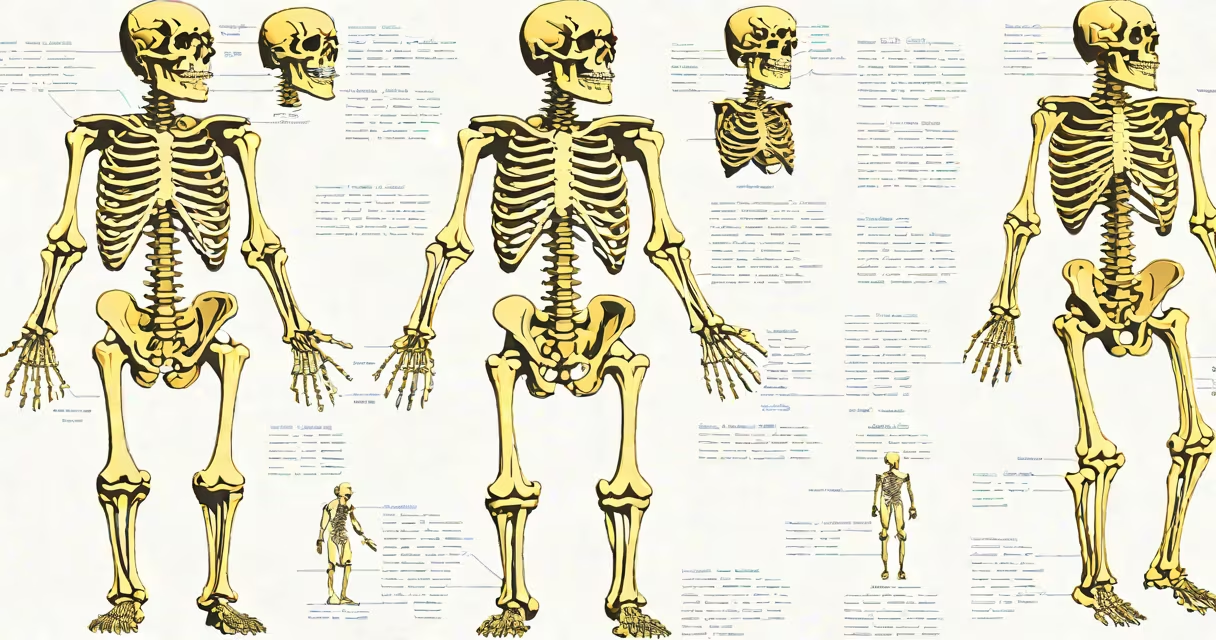
The four components of the skeletal system are bones, cartilage, ligaments, and tendons. These structures work together to provide structural support, enable movement, protect important organs, and store minerals.
Bones form the rigid structure of the body. They are composed primarily of calcium phosphate and collagen, giving them both strength and flexibility. The adult human skeleton contains 206 bones, ranging from the tiny ossicles in the ear to the large femur in the thigh. Bones also serve as reservoirs for calcium and phosphorus, essential minerals for nerve function and energy production.
Cartilage is a flexible connective tissue found in joints, the rib cage, the nose, and the ears. Unlike bone, cartilage lacks blood vessels and nerves. It acts as a cushion between bones, reducing friction and absorbing shock during movement. For example, the articular cartilage covering the ends of bones in synovial joints prevents bone-on-bone contact and minimizes wear.
Ligaments are dense bands of fibrous connective tissue that connect bone to bone. They stabilize joints and limit excessive motion. The anterior cruciate ligament (ACL) in the knee is a well-known example. It prevents the tibia from sliding forward relative to the femur. Ligaments are rich in collagen fibers, which give them high tensile strength.
Tendons attach muscle to bone. Made of tightly packed collagen fibers, they transmit force from muscles to bones, enabling movement. The Achilles tendon, connecting the calf muscles to the heel bone, is one of the strongest tendons in the body. It withstands forces up to 3.3 times body weight during running.
In daily activities like walking, the skeletal system functions as an integrated unit. As the foot strikes the ground, bones absorb impact through their mineralized matrix. Cartilage in the ankle joint distributes pressure evenly. Ligaments prevent the joint from twisting beyond safe limits. Tendons transfer the contraction force from leg muscles to the foot, propelling the body forward.
A specific example is the shoulder joint. The humerus (upper arm bone) articulates with the scapula. Articular cartilage reduces friction between these bones. The glenohumeral ligaments stabilize the joint during overhead movements. Rotator cuff tendons connect the shoulder muscles to the humerus, allowing controlled rotation and lifting.
Without any one component, coordinated movement fails. A torn ACL destabilizes the knee. Degenerated cartilage leads to osteoarthritis. Damaged tendons cause tendonitis. Bone fractures impair load-bearing capacity. All four elements must remain intact for optimal function.
Different regions of the skeleton rely on varying proportions of these components. The spine, for instance, uses intervertebral discs-fibrocartilage pads between vertebrae-to absorb vertical stress. The skull features sutures, fibrous joints held together by connective tissue, allowing minimal movement during birth and growth.
Here's a comparison of the four components:
| Component | Primary Function | Material Composition | Example Location |
|---|---|---|---|
| Bones | Support, protection, mineral storage | Calcium phosphate, collagen | Femur, skull, ribs |
| Cartilage | Cushioning, flexibility | Chondrocytes, collagen, proteoglycans | Knee meniscus, nasal septum |
| Ligaments | Joint stability | Collagen fibers, low elasticity | ACL, posterior cruciate ligament |
| Tendons | Muscle-to-bone force transmission | High-density collagen | Achilles tendon, patellar tendon |
One non-obvious fact: cartilage heals poorly because it lacks blood supply. In contrast, bone regenerates efficiently due to vascularization. This difference explains why joint injuries involving cartilage often lead to long-term degeneration, while fractures heal within weeks to months under proper care.
Many assume that bones are inert and static. In reality, they are metabolically active. Osteoblasts build new bone, and osteoclasts resorb old bone. This constant remodeling maintains mineral balance and repairs microdamage. The process takes about 10 years to fully renew the entire skeleton.
Another misconception is that tendons and ligaments are interchangeable. They are not. Tendons connect muscle to bone; ligaments connect bone to bone. Confusing them leads to incorrect injury descriptions. For example, a sprained ankle involves ligament damage, while a pulled hamstring involves tendon strain.
I once observed a patient with chronic knee pain who believed his issue was "tendonitis." Imaging revealed severe cartilage loss and a partially torn ACL. He had misattributed symptoms from multiple tissue failures to a single cause. Correct diagnosis required distinguishing between cartilage wear, ligament instability, and tendon inflammation.
Understanding the four components of the skeletal system is critical in orthopedic medicine. Surgeons repair torn ligaments using grafts, replace worn cartilage with implants, fix broken bones with plates and screws, and reconstruct damaged tendons. Rehabilitation focuses on restoring function to each component.
For example, after ACL reconstruction, patients undergo physical therapy to rebuild ligament strength and improve joint proprioception. Recovery typically takes 6 to 9 months. Without addressing all four components, outcomes remain suboptimal.
Each component plays a distinct role in maintaining mobility and structural integrity. Bones bear weight. Cartilage absorbs shock. Ligaments stabilize. Tendons transmit force. Together, they form a changing system capable of supporting complex movement and enduring mechanical stress.
When evaluating musculoskeletal health, clinicians assess all four components. A fracture may involve bone, but healing depends on cartilage regeneration at the joint surface, ligament stability, and tendon function for mobility recovery.
Knowing the four components of the skeletal system clarifies how the body supports itself, moves, and adapts to physical demands. This foundational knowledge applies to injury prevention, rehabilitation, and surgical intervention.