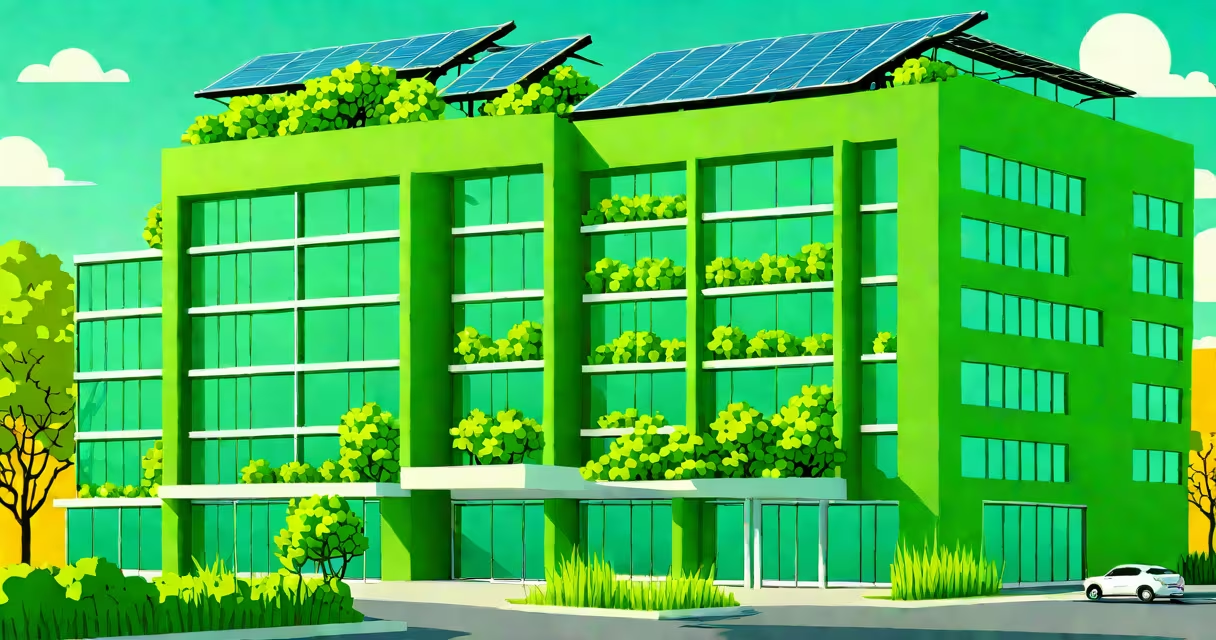
Green building benefits refer to measurable improvements in energy efficiency, environmental sustainability, and human health achieved through environmentally responsible design, construction, and operation of buildings. These advantages stem from strategies like optimized insulation, renewable energy integration, water conservation systems, and low-emission materials.
Buildings account for nearly 40% of global energy-related carbon emissions, according to the International Energy Agency (IEA). Green building practices counter this by reducing operational energy demand. A 2022 study by the U.S. Department of Energy found that certified green buildings consume 25% less energy on average than conventional structures. This reduction translates into lower utility bills and decreased reliance on fossil fuels.
These benefits extend beyond energy. Green buildings often feature enhanced ventilation, natural lighting, and non-toxic materials, which improve indoor air quality and occupant comfort. The American Lung Association notes that poor indoor air quality contributes to respiratory issues in up to 30% of office workers. Buildings meeting LEED or WELL standards show significant reductions in sick days and increased productivity among occupants.
Green building benefits emerge from systematic design choices. High-performance windows reduce heat loss by up to 50% compared to standard glazing. Reflective roofing materials can lower rooftop temperatures by 30°C (54°F), reducing cooling loads. Rainwater harvesting systems cut potable water use by 40% in commercial facilities.
One example is the Bullitt Center in Seattle, a six-story office building designed to meet the Living Building Challenge. It generates all its electricity via rooftop solar panels, captures and treats rainwater for drinking, and uses composting toilets. Over five years, the building produced 106% of its annual energy needs on-site, demonstrating net-positive performance.
Another case is the Edge in Amsterdam, recognized as one of the most sustainable office buildings globally. Its smart lighting system adjusts based on occupancy and daylight levels, using 70% less electricity than typical offices. Sensors track room usage, automatically adjusting HVAC settings. The result: 70% fewer CO₂ emissions per square meter than comparable buildings.
Green building benefits fall into four core categories: environmental, economic, health, and social. Each category includes specific outcomes tied to design decisions.
| Type | Specific Benefits | Real-World Impact |
|---|---|---|
| Environmental | Reduced carbon footprint, lower water consumption | LEED-certified buildings use 30% less water than standard ones (U.S. EPA) |
| Economic | Lower operating costs, higher asset value | Green buildings command 7% higher rental rates (Urban Land Institute) |
| Health & Wellbeing | Better air quality, reduced noise, access to nature | Employees in green-certified offices report 26% fewer health complaints (Harvard T.H. Chan School of Public Health) |
| Social | Improved community resilience, equitable access to healthy spaces | Low-income housing with green features sees 35% fewer asthma-related ER visits (CDC) |
A common misconception is that green building benefits come solely from high-tech solutions. In reality, passive design principles-such as strategic window placement for natural light, cross-ventilation, and thermal mass-deliver substantial gains at minimal cost. A 2020 study in *Energy and Buildings* showed that buildings relying on passive strategies achieved 20% better energy performance than those depending only on mechanical systems.
Many assume green building benefits apply only to large commercial projects. That's incorrect. Residential homes, schools, and small retail spaces also see tangible returns. A 2021 analysis by the National Institute of Building Sciences found that retrofitting older homes with insulation, efficient windows, and heat pumps yields a 3:1 return on investment over 20 years.
Another misunderstanding is equating green building benefits with green building certification. While certifications like LEED or BREEAM validate performance, they don't guarantee outcomes. A building can earn points for using recycled steel but still fail to reduce energy use if the HVAC system is oversized. Certification measures compliance, not effectiveness.
I once observed a newly constructed school in Portland that earned LEED Gold despite having a poorly designed HVAC layout. Indoor temperatures fluctuated wildly during winter months, leading to student discomfort and absenteeism. The project met documentation requirements but failed in real-world function. This highlights that green building benefits depend on execution, not just paperwork.
Climate change intensifies the urgency behind green building benefits. Cities face rising heat island effects, stormwater overflow, and energy grid strain. Green infrastructure-like vegetated roofs and permeable pavements-reduces runoff by up to 80%, easing pressure on drainage systems during heavy rainfall.
Green building benefits support long-term resilience. After Hurricane Sandy, buildings with green features experienced faster recovery times. Those with backup power from solar arrays maintained operations when the grid failed. The Federal Emergency Management Agency (FEMA) now recommends green design elements in disaster-prone zones.
For developers, the financial upside is clear. A 2023 report by the World Green Building Council found that green-certified properties have 15% lower vacancy rates and attract tenants willing to pay premiums. In New York City, a green-certified apartment complex saw 95% occupancy within three months of leasing, while nearby non-green units remained half-empty.
Understanding green building benefits isn't just about environmental virtue. It's about smarter economics, healthier lives, and stronger communities. These outcomes are proven, documented, and scalable.