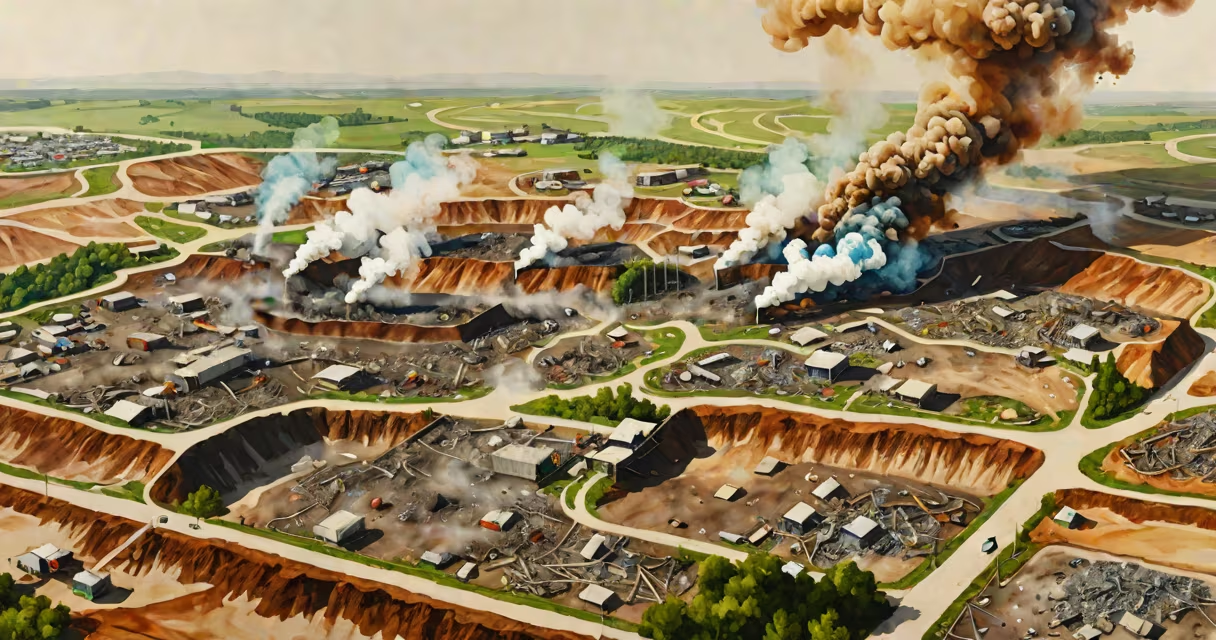
Landfills and pollution refer to the release of harmful substances-such as methane gas, toxic leachate, and microplastics-into the environment from improperly managed solid waste sites. These pollutants degrade soil, contaminate groundwater, and contribute to climate change. Landfills are a major source of human-caused pollution in urban and rural areas alike.
When organic waste decomposes in landfills, it produces methane-a greenhouse gas 25 times more potent than carbon dioxide over a 100-year period. This gas escapes into the atmosphere unless captured. Simultaneously, rainwater seeps through buried trash, dissolving heavy metals, pesticides, and industrial chemicals. The resulting liquid, called leachate, can migrate into nearby aquifers and surface water bodies.
The U.S. Environmental Protection Agency (EPA) estimates that landfills account for nearly 15% of all U.S. methane emissions. In 2021, the EPA reported that over 1,000 landfill sites had documented leachate violations affecting drinking water supplies. These figures show that landfills are not passive storage sites-they are active pollution sources requiring strict monitoring and mitigation.
Landfills operate in layers. Waste is dumped, compacted, and covered daily with soil or synthetic liners. But decomposition continues beneath the surface. Anaerobic bacteria break down organic matter in oxygen-free conditions, producing methane and carbon dioxide. Without gas collection systems, these gases escape into the atmosphere.
Leachate forms when precipitation infiltrates waste piles. Water passes through plastics, batteries, electronics, and household cleaners, extracting contaminants. A single ton of municipal waste can produce up to 150 liters of leachate. This liquid contains ammonia, phenols, and trace elements like lead and mercury-substances regulated under the Clean Water Act.
Modern landfills use composite liners made of clay and high-density polyethylene (HDPE) to reduce leachate migration. However, liner failures occur. A 2019 study published in *Environmental Science & Technology* found that 12% of monitored landfills in the U.S. experienced liner breaches within 10 years of operation. Once leachate breaches the barrier, cleanup costs exceed $1 million per site.
Landfill pollution manifests in three primary forms: gaseous emissions, liquid leachate, and airborne particulates. Each poses distinct risks to ecosystems and human health.
| Pollutant Type | Primary Sources | Health and Environmental Risks | Regulatory Standard (U.S.) |
|---|---|---|---|
| Methane (CH₄) | Decomposing food, paper, yard waste | Climate warming, explosion hazard, respiratory irritation | EPA's Greenhouse Gas Reporting Program |
| Leachate | Rainwater passing through buried waste | Groundwater contamination, toxicity to aquatic life | Safe Drinking Water Act (SDWA) |
| Particulate Matter (PM10/PM2.5) | Wind-blown debris, mechanical sorting operations | Respiratory disease, reduced visibility | NAAQS (National Ambient Air Quality Standards) |
One overlooked pollutant is microplastics. Research from the University of Plymouth shows that landfills release up to 2.5 million microplastic particles per ton of plastic waste annually. These particles enter soil and water systems, where they bioaccumulate in fish and birds.
Many assume that modern landfills are safe because they're lined and monitored. This is incorrect. A 2020 audit by the Government Accountability Office (GAO) revealed that 40% of inspected landfills failed to meet minimum leachate testing frequency requirements. Some sites went months without sampling despite known contamination risks.
Another misconception is that recycling eliminates landfill dependence. While recycling reduces volume, it doesn't eliminate waste. The EPA reports that only 32% of U.S. municipal solid waste was recycled in 2022. The remaining 68% still ends up in landfills or incinerators. Even recyclable materials like mixed plastics often degrade in quality after one cycle, becoming unrecyclable.
A third error is equating landfill closure with environmental safety. Closure involves capping the site with soil and vegetation. But cap failure rates average 15% over 20 years, according to a 2021 study in *Waste Management*. Once caps fail, rainwater re-enters the waste layer, restarting leachate production and methane generation.
Once the largest landfill in the world, Fresh Kills on Staten Island, New York, operated from 1948 until 2001. It received over 150 million tons of waste during its lifetime. After closure, the site was capped with 10 feet of soil and planted with native grasses and trees.
Despite this, methane emissions persisted. In 2017, sensors detected 1.2 million cubic feet of methane released daily from the site. The city installed a gas recovery system in 2019, capturing 70% of emissions. The project now powers 1,200 homes annually. This case proves that even closed landfills remain active pollution sources for decades.
Another example is the Love Canal neighborhood in Niagara Falls, New York. In the 1970s, residents reported rashes, birth defects, and respiratory issues. Investigations traced the symptoms to toxic chemicals leaking from a former landfill filled with industrial waste. The area was declared a federal emergency zone, and over 800 families were relocated. This incident led to the creation of the Superfund program under the Complete Environmental Response, Compensation, and Liability Act (CERCLA).
Reducing landfill-related pollution requires systemic changes. Cities must prioritize waste reduction at the source. The European Union's Circular Economy Action Plan mandates that member states achieve 65% recycling and reuse rates by 2035. Countries like Germany and South Korea have reached over 60% diversion rates through extended producer responsibility laws and mandatory sorting programs.
For individuals, reducing single-use packaging, composting food scraps, and supporting businesses with take-back programs cuts the amount of waste sent to landfills. In Seattle, a 2020 policy requiring residents to separate organics reduced landfill volume by 37% in five years.
Landfills and pollution are not isolated problems. They represent a failure to manage resources sustainably. Addressing them demands technical innovation, regulatory enforcement, and behavioral change. The solution lies not in better containment-but in preventing waste from being generated in the first place.