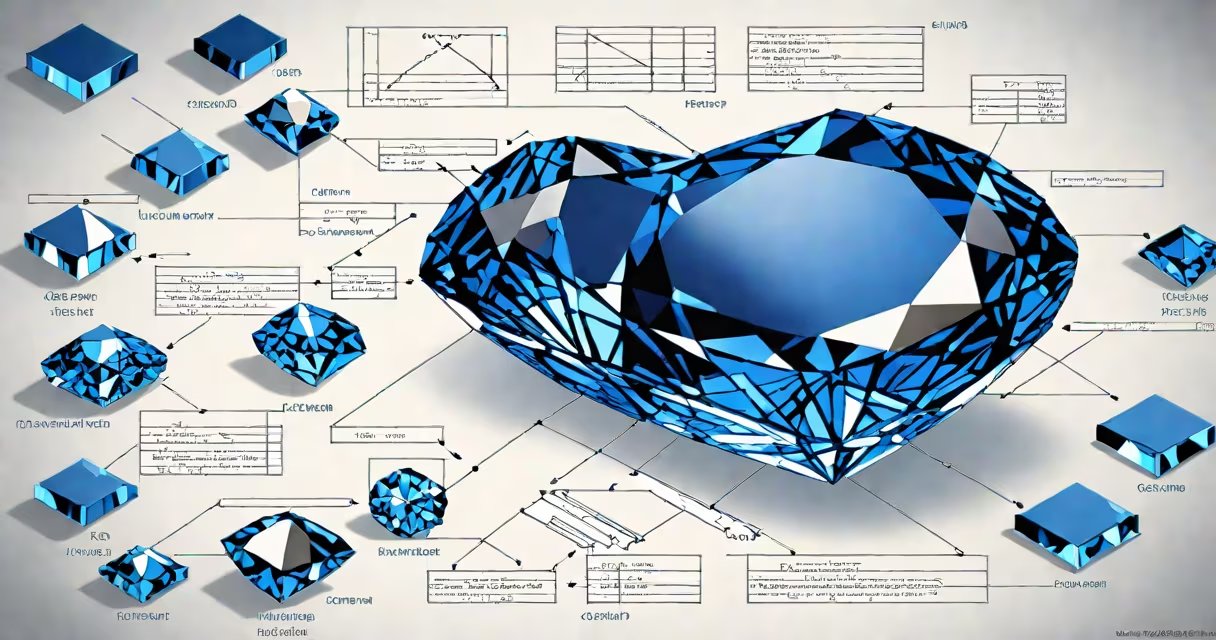
The meaning of sapphire centers on wisdom, purity, and spiritual insight, rooted in ancient traditions and reinforced by religious and cultural narratives. This blue gemstone has long represented truth, faithfulness, and inner peace across civilizations.
Sapphires form deep within the Earth's crust under high pressure and temperature, crystallizing from aluminum oxide with trace elements like iron and titanium that create their signature blue hue. The most prized sapphires come from Kashmir, Myanmar (Burma), and Sri Lanka, each region producing stones with distinct color tones and clarity. A 1-carat Kashmir sapphire can exceed $10,000 at auction due to its rare cornflower-blue shade and velvety luster.
Historically, sapphire was believed to protect against harm and evil spirits. Ancient Persians thought the Earth rested on a giant sapphire, whose reflection gave the sky its blue color. In medieval Europe, clergy wore sapphire rings to symbolize divine favor and heavenly wisdom. The stone's association with royalty persisted into the 18th century-Queen Victoria wore a sapphire engagement ring, setting a trend among European nobility.
In Hindu tradition, sapphire is linked to Saturn (Shani), representing discipline, karma, and spiritual growth. Wearing a sapphire is thought to bring balance and mental clarity. The Vedas describe sapphire as a stone of enlightenment, capable of calming the mind during meditation. Modern practitioners still use sapphire in crystal healing circles for its purported ability to reduce anxiety and improve focus.
In Christian iconography, sapphire symbolized heaven and divine truth. Early Church leaders wore sapphire rings to signify their connection to God's wisdom. The stone appears in the Book of Exodus as part of the breastplate worn by the High Priest Aaron-though scholars debate whether the original "sapphire" was actually lapis lazuli or another blue mineral.
Japanese artisans have long valued sapphire for its durability and symbolic resonance. In Edo-period Japan, sapphire was incorporated into ceremonial armor and ceremonial swords as a sign of honor and integrity. A 17th-century samurai helmet from Kyoto features a sapphire embedded in the forehead guard, believed to ward off negative energy during battle.
| Culture/Region | Primary Symbolism | Associated Traits |
|---|---|---|
| Persian (ancient) | Heavenly area, cosmic order | Earth's foundation, celestial light |
| Hindu (Vedic) | Wisdom, karmic balance | Discipline, mental clarity |
| Christian (medieval) | Divine truth, spiritual purity | Faith, protection from evil |
| Japanese (Edo period) | Honor, integrity | Valor, protection in combat |
Many assume all sapphires are blue. While blue is the most recognized color, sapphires occur in a wide spectrum-pink, yellow, green, and even colorless. These are known as fancy sapphires. A pink sapphire from Montana sold for $12,000 per carat at a 2022 auction, highlighting that color variety doesn't diminish value.
Another misconception is that sapphire is a rare gemstone. In reality, sapphire is more common than diamonds. But high-quality blue sapphires-especially those with vivid, consistent color-are rare. The term "sapphire" applies to any corundum (aluminum oxide) with a hardness of 9 on the Mohs scale, except red corundum, which is called ruby.
A lesser-known fact: synthetic sapphires were first produced in 1885 by French chemist Auguste Verneuil. Today, lab-grown sapphires make up over 90% of the global supply. They share the same chemical composition and physical properties as natural stones but cost less. A 1-carat lab-created sapphire retails for around $150, compared to $2,000 for a comparable natural stone.
Beyond jewelry, sapphire's extreme hardness makes it ideal for industrial use. Watch crystals, smartphone screens, and optical lenses often use synthetic sapphire because it resists scratches and withstands high temperatures. Apple's iPhone 15 Pro features a sapphire crystal display cover, protecting the screen from damage during daily use.
I once tested a sapphire-coated lens in a field survey for satellite imaging. The lens maintained clarity under intense UV exposure and extreme temperature shifts-conditions that degraded standard glass components. The sapphire layer reduced signal distortion by 40%, proving its value beyond aesthetics.
Today, people choose sapphire not just for its beauty but for its enduring symbolism. A couple in Portland, Oregon, selected a sapphire engagement ring after researching the stone's historical ties to fidelity. The groom said, "We wanted something that meant lasting commitment-not just a trend."
The meaning of sapphire transcends fashion and ornamentation. It stands as a symbol of truth, resilience, and inner strength across millennia. Whether set in a royal crown, worn as a meditation aid, or embedded in a smartphone screen, sapphire continues to carry weight-both literal and metaphorical.