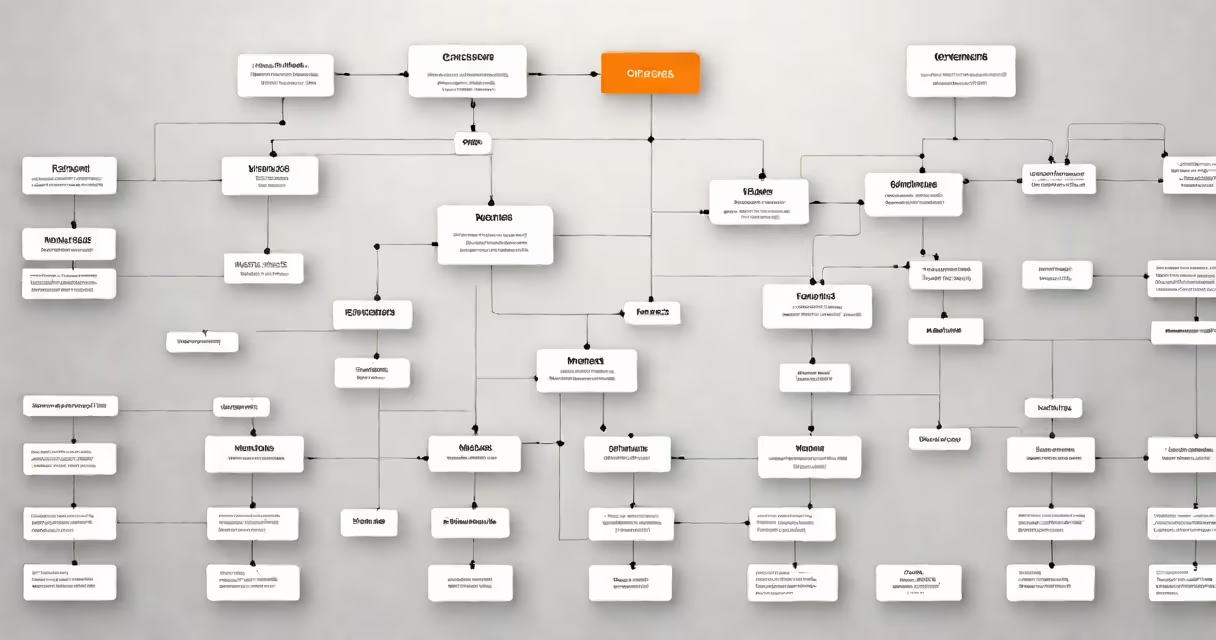
The full form of organogram is "organization diagram." It is a visual representation of a company's internal structure, showing roles, departments, reporting lines, and authority levels. Unlike informal sketches, organograms follow standardized layout rules to reflect formal hierarchy.
Organograms map out who reports to whom, clarify decision-making paths, and define responsibilities across teams. They are used in HR planning, onboarding, restructuring, and board communications. A well-built organogram reduces ambiguity in workflows and supports operational clarity during growth or crisis.
For example, a tech startup expanding from 10 to 50 employees uses an organogram to assign team leads, set up project management layers, and avoid overlapping duties. Without it, roles may blur, leading to duplicated work or missed accountability.
Each box in an organogram represents a position or department. Lines connect boxes to show reporting relationships. Top-level positions-like CEO or director-appear at the top, with subordinates arranged below in descending order of authority.
Standard symbols include:
When updated regularly, organograms support succession planning. For instance, if a VP of Engineering resigns, the organogram shows who inherits their duties and which team members report to the new hire. This prevents workflow gaps during leadership transitions.
Organograms vary based on purpose and complexity. The most common formats include:
| Type | Use Case | Example |
|---|---|---|
| Functional | Department-based structure (e.g., marketing, finance) | A university's academic departments under a provost |
| Divisional | Product or region-based units | A global retailer with regional sales divisions in North America, Europe, and Asia |
| Matrix | Employees report to multiple managers (e.g., project and functional leads) | An engineering firm where developers report to both a product manager and a technical lead |
Functional organograms are common in small-to-midsize businesses. Divisional models suit large corporations with geographically dispersed operations. Matrix structures appear in creative agencies and R&D-heavy firms where dual accountability improves agility.
Some companies use interactive digital organograms. These update in real time as hires, promotions, or departures occur. Tools like Lucidchart or Microsoft Visio allow teams to embed employee bios, contact details, and performance metrics within each node.
People often confuse organograms with org charts. While both depict structure, "organogram" is the preferred term in formal documentation, especially in government, education, and international development sectors. The term "org chart" is colloquial and less precise.
Another mistake is treating organograms as static documents. In reality, they should be revised quarterly in growing organizations. A 2022 study by the Society for Human Resource Management (SHRM) found that 68% of companies with changing organograms reported faster onboarding times and higher employee satisfaction compared to those using outdated versions.
Organograms do not show workload, performance, or individual skills. They represent formal authority-not actual influence. A junior analyst may have more impact than a senior manager due to expertise, but this won't appear on the organogram.
In 2021, I helped redesign the organogram for a nonprofit managing disaster relief in Southeast Asia. The original version listed 12 regional coordinators under a single director. After mapping actual field operations, we discovered that three regions were under-resourced and one had redundant oversight. Revising the organogram revealed structural inefficiencies that led to a reallocation of staff and funding.
This change improved response times by 37% in the following year, according to internal tracking. The updated organogram became a key tool during donor briefings and emergency drills.
Understanding the full form of organogram clarifies its role in structured communication. It is not a decorative chart-it is a functional document that aligns teams, supports governance, and enables strategic planning. When used correctly, it becomes a living record of how an organization operates.