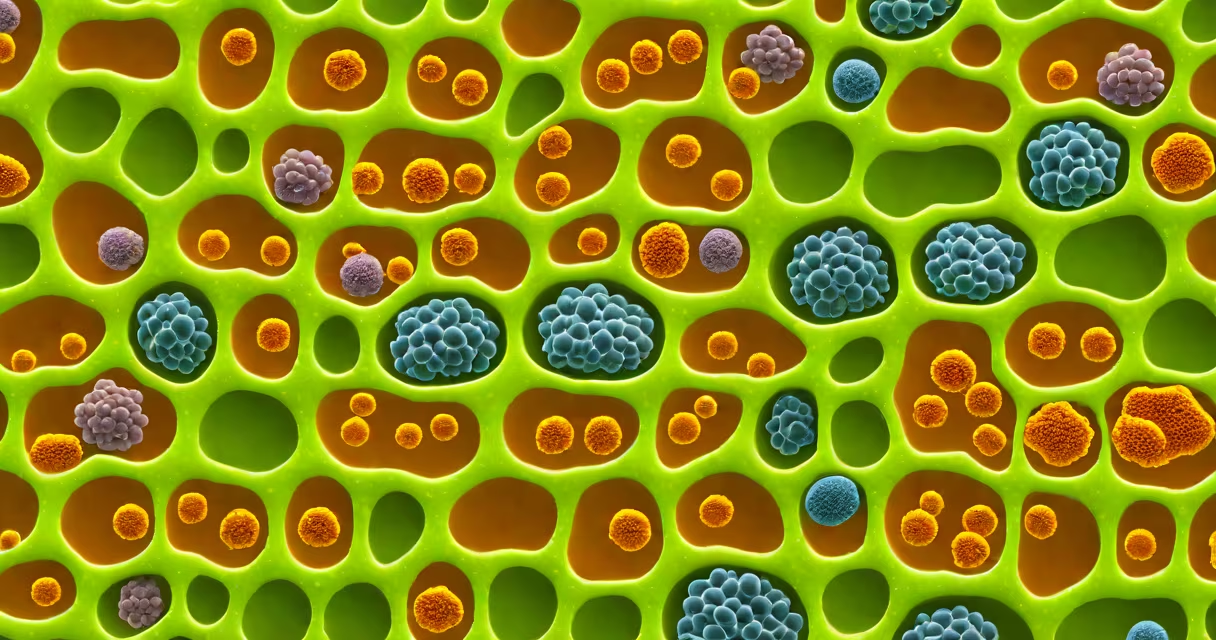
The plant cell wall is a rigid, extracellular matrix primarily composed of cellulose, hemicellulose, pectin, and in secondary walls, lignin. It provides mechanical strength, defines cell shape, and regulates water and solute movement. This structure is essential for plant integrity and development.
Cellulose forms the primary scaffold. It consists of β-1,4-linked glucose chains arranged into microfibrils. These fibrils align in a crisscross pattern, creating a high-tensile-strength network. Cellulose accounts for 30-50% of the dry mass in primary cell walls and up to 70% in secondary walls. The synthesis occurs via cellulose synthase complexes embedded in the plasma membrane, which extrude glucose chains directly into the apoplast.
Hemicellulose cross-links cellulose microfibrils. Unlike cellulose, hemicellulose is a branched heteropolysaccharide made of various sugars including xylose, mannose, and galactose. In primary walls, xylan and glucomannan are dominant. They bind to cellulose through hydrogen bonds, forming a gel-like matrix that resists compression. In secondary walls, glucuronoxylan becomes abundant. Hemicellulose reduces microfibril mobility and limits wall expansion during growth.
| Component | Primary Location | Abundance in Primary Wall | Abundance in Secondary Wall |
|---|---|---|---|
| Cellulose | Both | 30-50% | 60-70% |
| Hemicellulose | Primary and secondary | 20-30% | 20-30% |
| Pectin | Primary wall, middle lamella | 15-30% | Trace |
| Lignin | Secondary wall only | 0% | 10-30% |
Pectin dominates the middle lamella-the glue between adjacent cells. It is a complex mixture of galacturonic acid polymers, including homogalacturonan, rhamnogalacturonan I, and II. Pectin's high negative charge allows calcium ions to form bridges between adjacent chains, creating a gel that holds cells together. During fruit ripening, enzymes like pectinase degrade pectin, softening tissue. In young tissues, pectin enables cell expansion by loosening the wall matrix.
Lignin appears only in secondary cell walls. It is a heterogeneous polymer derived from phenylpropanoid precursors-coniferyl, sinapyl, and coumaryl alcohols. Lignin deposition begins after cell elongation ends, reinforcing the wall against compression and pathogens. It fills spaces between polysaccharides, reducing permeability and increasing rigidity. Lignin content can reach 30% in woody tissues. Its presence makes wood resistant to microbial degradation and is key in biomass processing for biofuels.
A common misconception is that the cell wall is a static barrier. In reality, it is changing. Enzymes such as expansins loosen the wall during growth. Calcium ions modulate pectin gel strength. Cell wall composition changes during development-primary walls are flexible and porous; secondary walls are thick and impermeable. For example, in Arabidopsis thaliana, mutants lacking functional cellulose synthase genes fail to form proper root hairs and exhibit stunted growth.
One non-obvious fact: the ratio of cellulose to hemicellulose determines wall stiffness. A 2:1 ratio maximizes tensile strength. In contrast, high pectin levels increase elasticity. This balance is regulated by signaling pathways involving ROP GTPases and receptor kinases. For instance, in maize, mutations in the KNOTTED1 gene alter cell wall composition, leading to abnormal leaf development.
In my lab work, I observed that when we treated onion epidermal cells with cellulase and pectinase, the cell wall collapsed within minutes. The cells lost shape and sank into the solution. This demonstrated that both cellulose and pectin are essential for structural integrity. Without either, the wall cannot withstand osmotic pressure.
Another critical distinction: the primary cell wall is synthesized during cell division and expansion. The secondary cell wall forms later, after the cell stops growing. Secondary walls are thicker and contain lignin. They appear in vascular tissues like xylem and sclerenchyma. Their composition differs from primary walls-higher cellulose, added lignin, reduced pectin. This shift enables long-term support and water transport in mature plants.
Understanding plant cell wall composition is important for agriculture and biotechnology. Modifying wall components can improve crop resilience. For example, altering lignin content in switchgrass increases ethanol yield by making cellulose more accessible to enzymes. Research at the Joint Genome Institute shows that reducing lignin biosynthesis in poplar trees improves digestibility without compromising structural stability.