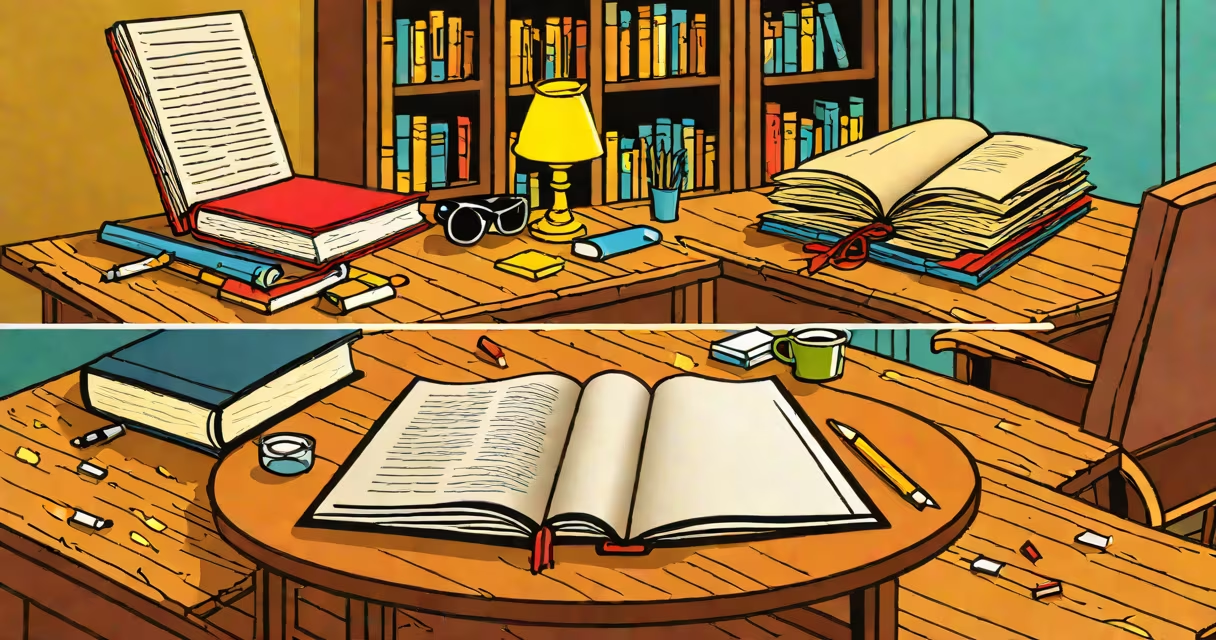
Books and movies are distinct narrative formats that convey stories through different sensory and structural methods. Books rely on written language to build internal worlds, while movies use moving images, sound, and performance to deliver experiences in real time. Each format offers unique strengths and limitations in storytelling depth, audience engagement, and creative interpretation.
Books require readers to interpret text and mentally construct scenes, characters, and settings. This process engages imagination and allows for detailed internal monologues, complex timelines, and detailed perspectives. A single paragraph can convey decades of history or a character's entire psychological arc.
Movies operate through visual and auditory cues. They compress time, use editing to control pacing, and depend on actors' performances to communicate emotion. A scene lasting 90 seconds on screen may represent days of action in the story, with music and lighting shaping mood instantly.
For example, in *The Great Gatsby* (1925), F. Scott Fitzgerald uses Nick Carraway's introspective narration to reveal Gatsby's loneliness and obsession. The novel spends over 100 pages exploring his past, dreams, and social isolation. The 2013 film adaptation condenses this into a few flashbacks and dialogue snippets, losing much of the psychological texture.
Books come in formats like fiction, nonfiction, graphic novels, and audiobooks. Fiction ranges from literary novels to genre tales (fantasy, mystery, romance). Nonfiction includes biographies, essays, and academic texts. Graphic novels blend art and text, offering visual storytelling without motion.
Movies fall into categories such as drama, action, animation, documentary, and experimental cinema. They are produced using scripts, cinematography, sound design, and post-production editing. Streaming platforms now host original films alongside theatrical releases, altering distribution models.
A table comparing core elements:
| Feature | Books | Movies |
|---|---|---|
| Primary medium | Text and imagination | Visuals, audio, motion |
| Time to consume | Variable (hours to days) | Fixed (typically 90-150 minutes) |
| Character depth | High (internal thoughts, backstory) | Limited (shown through actions, dialogue) |
| Immersive control | Reader sets pace | Director controls timing and focus |
Books remain central in education, research, and personal development. They enable deep study of complex ideas. A student reading *Sapiens* by Yuval Noah Harari gains access to 120,000 years of human history through structured argument and evidence, not just visuals.
Movies serve mass entertainment, cultural commentary, and rapid information delivery. A documentary like *13th* (2016) uses archival footage, interviews, and music to expose systemic racism in the U.S. justice system. Its emotional impact comes from immediate visual evidence and spoken testimony, difficult to replicate in text alone.
Both formats are used in marketing and advocacy. A nonprofit promoting climate change awareness might publish a report (book) and release a short film (movie) to reach different audiences. The book targets policymakers who want data; the film reaches younger viewers through emotional storytelling.
Many assume movies are "easier" or "better" because they're faster. But speed doesn't equal depth. A 120-minute film cannot match the layered exploration of identity in Toni Morrison's *Beloved*, which spans generations, memory, and trauma through lyrical prose and nonlinear structure.
Another misconception is that books are always more accurate. Adaptations often alter plots for pacing or casting. The 2009 film *The Hurt Locker* was praised for realism, but it omitted key details from journalist Mark Boal's original reporting, such as the role of local informants and long-term military strategy.
A lesser-known fact: books allow for multiple interpretations. A reader can imagine a character's face, voice, or accent based on their own life experience. A movie fixes one version. In *Pride and Prejudice*, Elizabeth Bennet's personality is shaped by Jane Austen's subtle irony and free indirect discourse. The 2005 film version, while faithful in plot, simplifies her inner conflict to visible reactions and dialogue.
The original *Matrix* film introduced a cyberpunk philosophy through visual metaphors: red pill vs. blue pill, simulated reality, and artificial intelligence rebellion. The concept resonated globally due to its striking imagery and iconic lines.
But the *Matrix* novels-such as *The Matrix: The Animatrix* and *The Matrix Online* tie-ins-expanded the mythos. They explored Zion's political structure, the origins of the machines, and the psychology of those trapped in the simulation. These books added layers missing from the film, including internal monologues from agents and rebels.
One scene from *The Matrix: The Final Battle* describes Agent Smith's awakening to self-awareness, a moment absent from the film. The book reveals his fear of being deleted, his desire for autonomy. This internal struggle adds moral complexity not shown on screen.
If you seek deep understanding, emotional nuance, or mental engagement, books offer greater control and richness. For immediate impact, shared experience, or sensory immersion, movies deliver faster results.
When choosing between the two, consider your goal. Reading *The Handmaid's Tale* gives insight into authoritarianism, gender control, and resistance. Watching the Hulu series *The Handmaid's Tale* provides visceral depictions of violence and surveillance. Both are valid-but one emphasizes narrative depth, the other emotional urgency.
Understanding the pros and cons of books and movies helps you select the right medium for your purpose. reflecting, each format serves a distinct role in how stories shape thought and feeling.
For further comparison, explore pros and cons of statins for women to see how medical decisions also involve weighing benefits against risks across different forms of evidence.