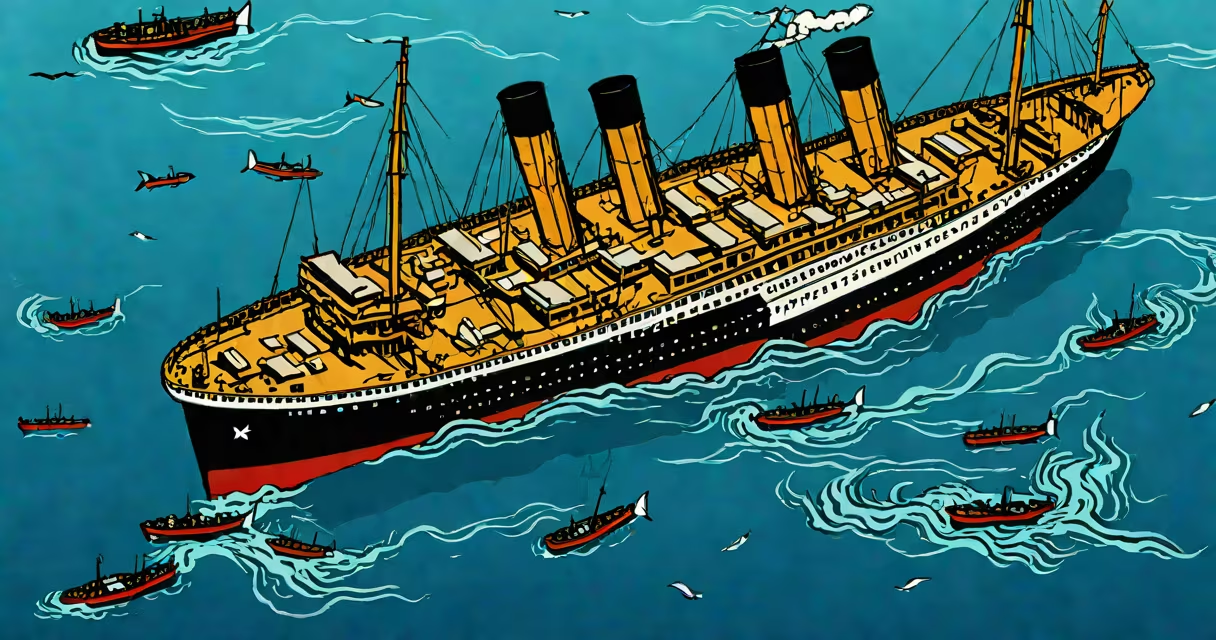
The RMS Titanic sinking occurred on April 15, 1912, after the luxury ocean liner struck an iceberg during its maiden voyage from Southampton to New York, resulting in the deaths of over 1,500 people. The disaster remains one of the deadliest peacetime maritime tragedies in history.
The Titanic was designed as the largest and most luxurious passenger ship of its time, built by Harland & Wolff in Belfast. It measured 882 feet long and had a gross tonnage of 46,328. Its construction included 16 watertight compartments intended to keep the ship afloat even if several were breached. However, the collision with an iceberg in the North Atlantic caused six of these compartments to flood, exceeding the ship's safety margin.
At 11:40 PM on April 14, the lookout spotted the iceberg too late to avoid it. The ship's speed-22 knots-meant it couldn't turn quickly enough. The impact sheared open the hull along 300 feet of the starboard side. Water poured into the forward compartments, causing the bow to dip lower. As the ship tilted, water spilled into adjacent sections, accelerating the sinking process.
Within 30 minutes of the collision, the crew began preparing lifeboats. The ship carried 20 lifeboats with a total capacity of 1,178 people-far below the 3,327 passengers and crew aboard. This shortfall stemmed from outdated British Board of Trade regulations, which required lifeboats based on ship size rather than passenger count.
Evacuation was chaotic. Many lifeboats launched half-full due to confusion and fear. Officers prioritized women and children, following the "women and children first" protocol. But the lack of drills and training meant many men boarded anyway. The last lifeboat left at 1:50 AM, just 30 minutes before the ship broke in two.
At 2:18 AM, the Titanic split apart amidships. The bow section sank vertically, pulling the stern upward. The stern rose nearly vertical before collapsing into the deep ocean. The final plunge took less than 10 seconds. Debris scattered across a 5-mile-wide area.
Several technical and organizational failures contributed to the sinking. The ship's rivets were made of low-quality iron, which became brittle in cold water. When the hull hit the iceberg, the rivets popped out, allowing water to enter faster than expected. A 2004 study by metallurgist Tim Foecke confirmed this material weakness.
Second, the ship's radio operators ignored multiple iceberg warnings sent earlier that day. The SS Californian, only 19 miles away, had stopped for the night and failed to respond to the Titanic's distress signals. The captain of the Californian later claimed he saw the ship's rockets but didn't recognize them as distress signals.
Third, the ship's design assumed it could stay afloat with up to four flooded compartments. Six were breached. The flooding caused the ship to list and sink faster than anticipated. Once the center of gravity shifted, the ship lost stability.
Many assume the Titanic sank because it hit the iceberg at high speed. In reality, it was traveling at 22 knots-within safe limits for the time. The danger wasn't speed but the lack of proper navigation in icy waters.
Another myth is that the ship was unsinkable. The term "unsinkable" was used in promotional materials, but no official document called the Titanic unsinkable. The press and public amplified the claim, creating a false sense of security. The White Star Line never officially labeled it as such.
A third misconception is that the ship sank instantly. It took over two hours from impact to final submersion. Survivors reported hearing the ship groan and creak as it settled into the ocean floor.
Only 706 people survived. The majority of those in lifeboats were from first class. Third-class passengers faced greater barriers to evacuation due to restricted access and poor signage. Of the 325 third-class passengers who died, only 122 were recovered.
Investigations by the U.S. Senate and the British Board of Trade revealed systemic failures. The British inquiry concluded that the ship's speed, lack of binoculars for lookouts, and insufficient lifeboats were critical factors. The U.S. inquiry focused on communication lapses and the failure to act on warnings.
Survivor accounts reveal emotional toll. Margaret Brown, known as "The Unsinkable Molly Brown," described the cold and silence as the ship went under. She later said, "I felt the sea pull us down like a lover."
Today, the wreckage lies 12,500 feet below the surface, discovered in 1985 by Robert Ballard. The site spans 3 miles and includes the bow and stern separated by a debris field. The ship's steel has corroded, with rusticles forming on exposed metal.
| Factor | Impact |
|---|---|
| Rivets made of brittle iron | Failed under stress, allowing rapid flooding |
| Lifeboat capacity: 1,178 | Only 35% of total passengers could be accommodated |
| Iceberg warnings ignored | Five messages received; none acted upon |
| Californian's inaction | Could have reached the scene within 30 minutes |
When I visited the Maritime Museum in Belfast in 2018, I stood before a model of the Titanic's hull showing the breach pattern. The damage ran diagonally across the starboard side, consistent with the iceberg's edge slicing through the outer plating. The exhibit included a replica of a rivet, visibly fractured. That moment made the scale of failure tangible.
One lesser-known fact is that the Titanic's sister ship, the HMHS Britannic, sank in 1916 during World War I. It was converted into a hospital ship and struck a mine in the Aegean Sea. Over 1,000 lives were lost, but the ship had improved safety features-double hulls, more lifeboats, and better emergency lighting.
The RMS Titanic sinking reshaped maritime safety. The International Convention for the Safety of Life at Sea (SOLAS) was established in 1914, mandating continuous radio watch, lifeboat capacity based on passenger numbers, and regular evacuation drills. These rules still apply today.