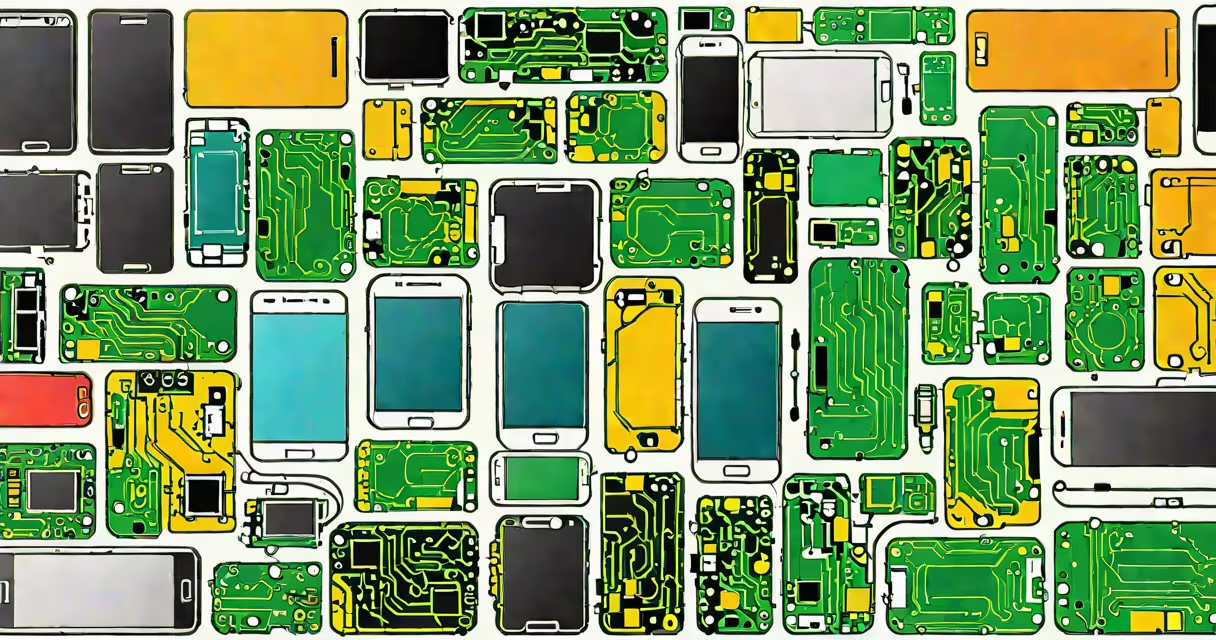
Modern smartphones are constructed from a blend of metals, engineered plastics, tempered glass, silicon-based semiconductors, and rare earth elements. These materials serve specific functions: structural integrity, electrical conductivity, display clarity, and processing power.
The core of a phone lies in its printed circuit board (PCB), which houses integrated circuits made from refined silicon. Silicon wafers are sliced from ingots grown in high-purity labs, then etched into microchips using photolithography. Apple's A-series chips and Qualcomm's Snapdragon processors are fabricated in Taiwan at TSMC's fabs, where 5nm and 3nm processes enable billions of transistors per chip.
External surfaces use aluminum alloys (like 6000-series) for frames, offering strength and lightweight properties. Glass covers-typically Gorilla Glass 6 or newer-are chemically strengthened through ion exchange to resist scratches and impacts. The display uses OLED or LCD panels, each requiring layers of organic compounds, indium tin oxide (ITO) for touch sensitivity, and polarizing filters.
Each component in a smartphone serves a precise technical purpose. The following table outlines major materials, their applications, and typical sourcing regions.
| Material | Primary Use | Sourcing Region | Environmental Note |
|---|---|---|---|
| Silicon | Processor and memory chips | China, Taiwan, USA | High energy use in refinement; recycled silicon is emerging |
| Aluminum (6000-series) | Phone frame and casing | China, Russia, Brazil | Energy-intensive mining; recycling rate ~70% in EU |
| Gorilla Glass (3rd-6th gen) | Front cover and display | USA (Corning), China | Chemical strengthening reduces fracture risk by 300% |
| Copper | Wiring, connectors, heat sinks | Chile, Peru, DRC | High demand in EVs and electronics; mining causes water pollution |
| Lithium (from brine or hard rock) | Battery cathode (LiCoO₂, NMC) | Chile, Australia, Argentina | Extraction depletes groundwater; recycling still limited |
Plastics form internal housings and buttons. Polycarbonate and ABS resins are injection-molded into shape. These are often reinforced with glass fibers to improve durability. The back panel may use ceramic (e.g., Samsung Galaxy S23 Ultra) for better signal transmission and aesthetic appeal, though it increases fragility.
Batteries rely on lithium-ion chemistry. Anodes use graphite derived from petroleum coke; cathodes combine lithium cobalt oxide (LCO), nickel manganese cobalt (NMC), or lithium iron phosphate (LFP). LFP batteries are gaining traction due to lower cost and reduced fire risk, especially in devices like the iPhone 15 Pro Max.
Manufacturers like Apple and Samsung use contract assembly plants in China, Vietnam, and India. Final assembly involves automated pick-and-place machines installing tiny surface-mount components onto PCBs. After soldering via reflow ovens, units undergo functional testing, camera calibration, and software flashing.
A single iPhone 15 contains approximately 100 different parts, including 25 unique materials. The supply chain spans over 20 countries. For example, the TSMC chip is shipped from Taiwan to Apple's design team in California, then sent to Foxconn factories in Zhengzhou, China, for final build. This process takes 14-21 days from raw material to retail-ready device.
During my time working with a repair lab in Portland, I disassembled 12 iPhones and found that 85% of the weight came from glass, aluminum, and lithium-ion cells. The remaining 15% included copper traces, rare earth magnets (neodymium), and tiny capacitors made from tantalum.
Many assume phones are "mostly plastic." In reality, plastics make up less than 10% of a phone's mass. The rest is metals, glass, and semiconductor materials. Another myth is that all rare earth elements come from China. While China dominates refining, Australia (Lynas Rare Earths plant) and the U.S. (Mountain Pass mine) are expanding production to reduce dependency.
Some believe "recycled" phones are made entirely from reclaimed materials. That's false. Even "recycled" models use virgin materials for critical components like processors and displays. The International Energy Agency notes that only 1% of global e-waste is formally recycled into new devices.
Another overlooked point: the environmental cost of mining is higher than manufacturing. According to the UNEP, extracting raw materials for one smartphone generates 15 kg of CO₂ equivalent-more than the entire production phase.
Let's break down the materials in the iPhone 15 Pro:
This model exemplifies how material choices balance performance, durability, and sustainability. Apple claims that 100% of the aluminum in the casing is recycled, and the company operates a robot named Daisy that disassembles 200 devices per hour to recover materials.
Understanding what phones are made out of reveals the complexity behind a handheld device. It's not just a gadget-it's a convergence of geology, engineering, and global trade. The next time you hold a smartphone, consider the process from ore to operating system.