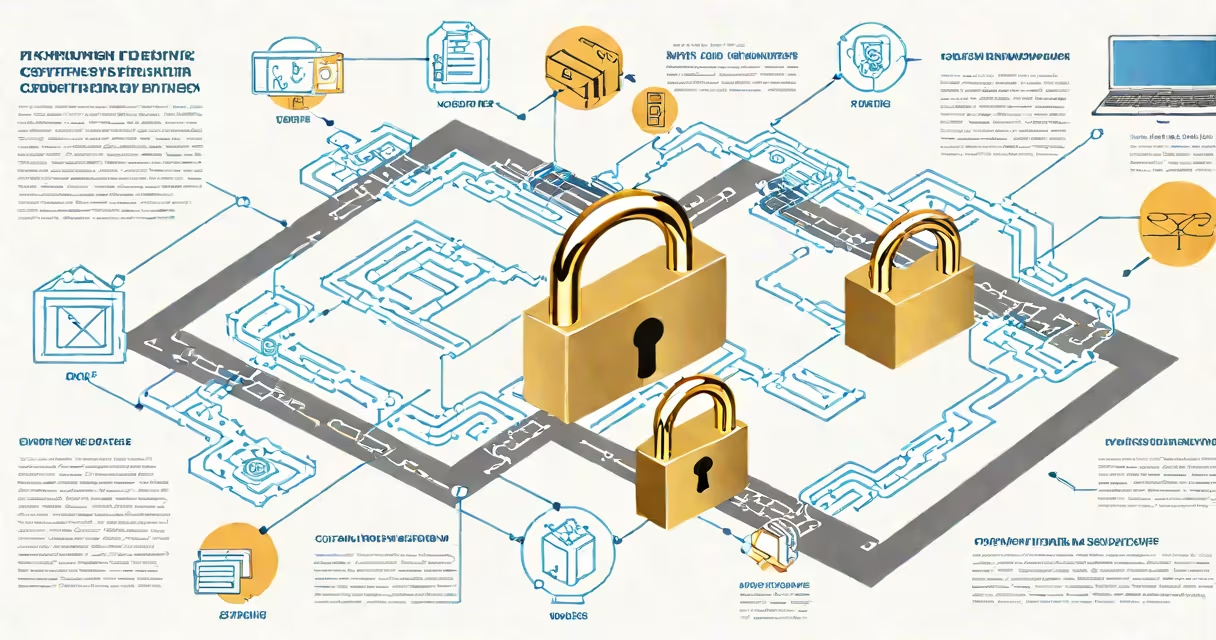
PKI certificates are digital credentials that bind a public key to an entity's identity, enabling secure communication over untrusted networks. They are issued by trusted Certificate Authorities (CAs) and form the foundation of encrypted internet traffic, including HTTPS, email encryption, and code signing.
These certificates function as electronic IDs. When a browser connects to a website, it checks the site's PKI certificate to confirm the server's authenticity and establish an encrypted connection. Without PKI certificates, verifying who you're talking to online would be nearly impossible.
For example, when you visit https://www.google.com, your browser receives a certificate from Google's CA. It validates the certificate's signature, checks the domain name, and confirms the chain of trust-all within milliseconds. This process prevents man-in-the-middle attacks and ensures data integrity.
PKI certificates rely on asymmetric cryptography. Each entity has a pair: a private key (kept secret) and a public key (shared openly). The certificate contains the public key, identity details (like domain name or organization), expiration date, and a digital signature from a trusted CA.
The CA signs the certificate using its private key. When a client receives the certificate, it verifies the CA's signature using the CA's public key. If the signature matches, the certificate is trusted. This creates a chain of trust from root CAs to end-entity certificates.
Modern browsers maintain a list of trusted root CAs. If a certificate isn't signed by one of these roots, the browser displays a warning. For example, in 2023, Let's Encrypt issued over 150 million certificates annually, all validated through automated checks and trusted root programs.
Not all PKI certificates serve the same purpose. Different types exist based on use case and validation level.
| Type | Validation Level | Use Case | Example |
|---|---|---|---|
| Domain Validated (DV) | Basic domain ownership check | Personal websites, test servers | Let's Encrypt DV cert for example.org |
| Organization Validated (OV) | Verifies business registration | Internal services, corporate websites | Company-issued certificate for bank.example.com |
| Extended Validation (EV) | Extensive legal and operational checks | High-security sites like banks and government portals | Bank of America's EV certificate with green address bar |
| Code Signing | Developer identity verification | Software updates, drivers | Microsoft signs Windows updates with a code-signing certificate |
| Email Encryption (S/MIME) | Individual or organizational identity | Secure email communication | Google Workspace users encrypt emails via S/MIME certs |
Each type balances security, cost, and deployment complexity. DV certificates can be issued in seconds. EV certificates require weeks of documentation review and cost hundreds of dollars annually.
Many assume PKI certificates are only for websites. That's incorrect. They underpin many systems: secure messaging apps, IoT devices, API authentication, and even blockchain wallets.
A frequent error is thinking that a certificate's presence guarantees safety. A valid certificate only confirms identity-not content quality. Malicious sites can obtain DV certificates. Always check the URL and look for the padlock icon, not just the green bar.
Another misconception: PKI certificates expire and must be renewed manually. In practice, automated tools like Certbot (used with Let's Encrypt) renew certificates automatically every 90 days. This reduces human error and maintains continuous protection.
I once set up a home server with a self-signed certificate. Browsers flagged it as "not secure." After switching to a Let's Encrypt certificate via Certbot, the site loaded without warnings. Automation made the difference between usability and distrust.
Consider a small e-commerce store at shop.example.com. To enable HTTPS:
After setup, visitors see a padlock in the address bar. Data transmitted between browser and server is encrypted. The certificate's validity is checked in real time during each session.
This process protects customer data, builds trust, and improves search rankings. Google ranks HTTPS sites higher. A 2022 study by Mozilla found that 97% of page loads on Chrome now use HTTPS, driven largely by PKI-based encryption.
PKI certificates are not the same as passwords, tokens, or biometrics. They are cryptographic artifacts, not secrets. A password can be guessed. A token can be stolen. A PKI certificate is tied to a key pair and cannot be forged without breaking math.
Also, PKI certificates differ from SSL/TLS protocols. SSL and TLS are transport-layer encryption standards. PKI certificates are the identity layer that enables TLS to work securely. You can't have TLS without PKI for server authentication.
Finally, not all PKI implementations are equal. Some organizations use internal CAs for intranet services. These are not publicly trusted. Devices must be configured to accept the internal CA's root certificate. This is common in enterprise environments but risky if mismanaged.
According to the National Institute of Standards and Technology (NIST), PKI is critical for securing digital transactions. NIST Special Publication 800-57 outlines best practices for key management and certificate lifecycle operations.
Verizon's 2023 Data Breach Investigations Report found that 61% of breaches involved compromised credentials. PKI certificates reduce reliance on passwords by enabling certificate-based authentication in systems like OAuth 2.0 and SAML.
When you connect to a banking app, your device checks the server's PKI certificate. If the certificate is invalid or expired, the app blocks the connection. This prevents attackers from impersonating financial institutions.
Every encrypted connection, every verified login, every secure update depends on them. They're not flashy-but they're essential.