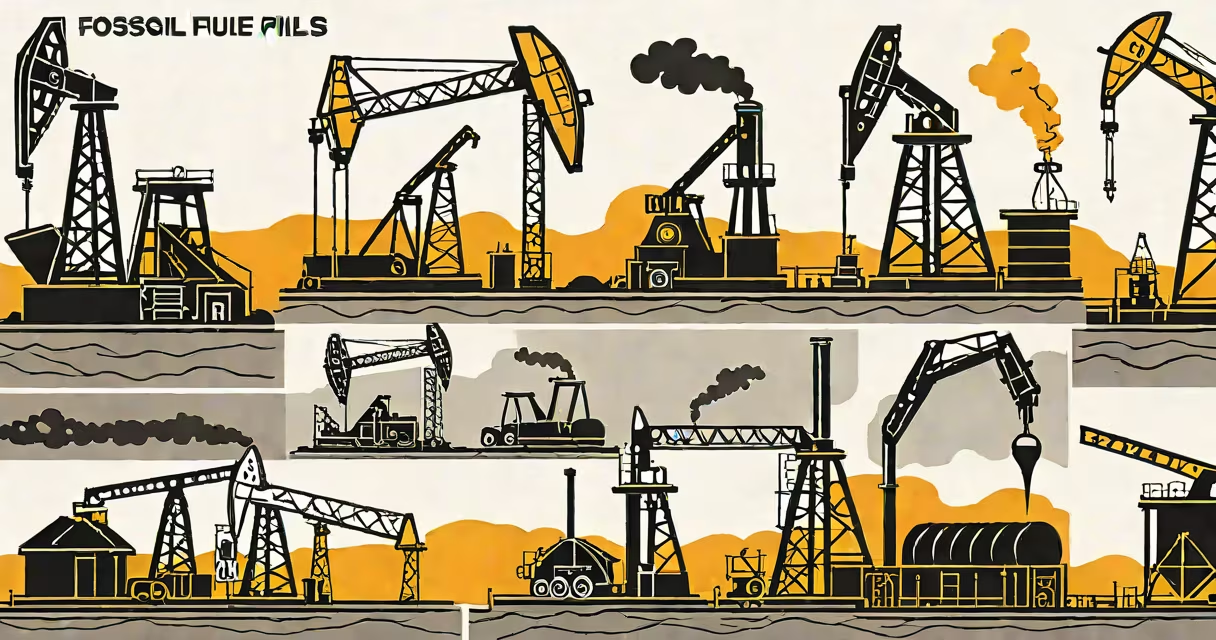
Fossil fuels are hydrocarbon-rich materials formed from the remains of ancient plants and microorganisms buried under sediment over millions of years. Coal, oil, and natural gas are the three primary examples, each extracted through distinct methods and burned to produce energy.
Coal forms from plant material compressed under heat and pressure in swamps during the Carboniferous period, roughly 359 to 299 million years ago. Oil originates from marine plankton and algae deposited in ocean basins, where low-oxygen conditions preserved organic matter. Natural gas develops alongside oil deposits or separately through thermal breakdown of organic material at depth. All three release carbon dioxide when combusted, contributing to atmospheric greenhouse gas levels.
The International Energy Agency (IEA) reports that fossil fuels supplied 82% of global energy demand in 2022, with coal accounting for 27%, oil for 31%, and natural gas for 24%. These percentages reflect long-standing reliance on fossil-based systems despite growing climate concerns.
When burned, fossil fuels undergo exothermic oxidation reactions that release stored chemical energy as heat. This heat generates steam in power plants, driving turbines connected to generators. The mechanical energy from turbine rotation converts into electrical current via electromagnetic induction.
For example, a typical coal-fired power station burns pulverized coal in a boiler at temperatures exceeding 1,000°C. The resulting steam expands through a turbine, spinning a shaft connected to a generator. Each kilogram of bituminous coal releases approximately 24 megajoules of energy upon complete combustion, equivalent to about 6.7 kWh.
Natural gas, primarily methane (CH₄), burns cleaner than coal or oil. When ignited, it produces water vapor and carbon dioxide with minimal particulate emissions. A gas turbine in a combined-cycle power plant achieves 55-60% efficiency, higher than older coal plants, which average around 33%.
Each fossil fuel type differs in origin, composition, and extraction method. The table below outlines key differences:
| Fuel Type | Primary Source | Extraction Method | Typical Energy Density |
|---|---|---|---|
| Coal | Terrestrial plant debris | Surface mining or underground drilling | 24 MJ/kg (bituminous) |
| Oil | Marine microorganisms | Drilling wells, offshore platforms | 42 MJ/kg (crude oil) |
| Natural Gas | Thermal decomposition of organic matter | Hydraulic fracturing, directional drilling | 50 MJ/kg (methane) |
Coal is mined from seams in sedimentary rock layers, often using surface strip mines or deep shaft operations. Oil is extracted via drilled wells, sometimes from underwater reservoirs using floating rigs. Natural gas is recovered through fracking, where high-pressure fluid fractures shale formations to release trapped gas.
A non-obvious distinction: while coal and oil are typically classified as solid and liquid fossil fuels, natural gas is gaseous at standard temperature and pressure. This affects storage and transport-gas requires pressurized pipelines or liquefaction into LNG (liquefied natural gas) for shipping.
Some assume all fossil fuels come from dinosaurs. This is incorrect. Most coal formed during the Carboniferous and Permian periods, long before dinosaurs appeared. Oil and gas deposits originated from microscopic organisms in ancient seas, not large vertebrates.
Another misconception is that fossil fuels are renewable. They are not. The formation process takes tens of millions of years. Global consumption exceeds natural replenishment rates by a factor of 10,000. The U.S. Energy Information Administration estimates that known recoverable reserves of oil will last about 50 years at current usage levels.
There's also confusion between fossil fuels and biofuels. Biofuels like ethanol or biodiesel are derived from recent biomass-such as corn or algae-and are considered renewable. Fossil fuels, by contrast, originate from prehistoric organic matter and cannot be renewed within human timescales.
Coal powers over 30% of electricity generation in China, where the country operates more than 1,000 coal plants. In 2023, China consumed 4.5 billion metric tons of coal annually, according to the IEA. This level of use contributes to severe air pollution in cities like Beijing and Xi'an.
Oil drives transportation globally. The average passenger vehicle consumes about 1,300 liters of gasoline per year. In the United States, road vehicles account for 70% of petroleum demand. Crude oil is refined into multiple products: gasoline, diesel, jet fuel, and petrochemical feedstocks.
Natural gas heats homes and generates electricity in many countries. In the U.S., natural gas supplied 40% of electricity generation in 2023. The state of Texas uses gas-fired plants for nearly half its grid supply. During winter storms, such as the 2021 freeze in Texas, gas infrastructure failures led to widespread blackouts due to frozen pipelines and equipment.
I once observed a coal mine in Wyoming during a site visit. The conveyor belt moved dark, brittle coal from a tunnel mouth to a processing facility. Dust coated the workers' faces. The sound was constant-grinding metal, clanking chains, and distant explosions from controlled blasts. That experience confirmed how physically demanding and hazardous fossil fuel extraction remains.
Burning fossil fuels releases carbon dioxide, methane, nitrogen oxides, and sulfur dioxide. The Intergovernmental Panel on Climate Change (IPCC) states that cumulative CO₂ emissions from fossil fuel combustion since 1750 have increased atmospheric concentrations from 280 ppm to over 420 ppm, driving global warming.
Health impacts are measurable. A 2021 study published in *The Lancet Planetary Health* estimated that air pollution from fossil fuels causes 8.7 million premature deaths annually worldwide. In India, PM2.5 levels in Delhi exceed WHO safety limits by sixfold during winter months, largely due to coal burning and vehicle emissions.
Despite risks, fossil fuels remain central to global economies. The World Bank reports that fossil fuel subsidies totaled $7 trillion globally in 2022, with major oil-producing nations like Saudi Arabia and Russia relying heavily on export revenues. Transitioning away from these systems involves complex trade-offs in energy security, job markets, and infrastructure.
Understanding what are three examples of fossil fuels-coal, oil, and natural gas-is essential for evaluating energy policy, climate action, and technological alternatives. Each plays a distinct role in modern energy systems, with lasting environmental consequences.