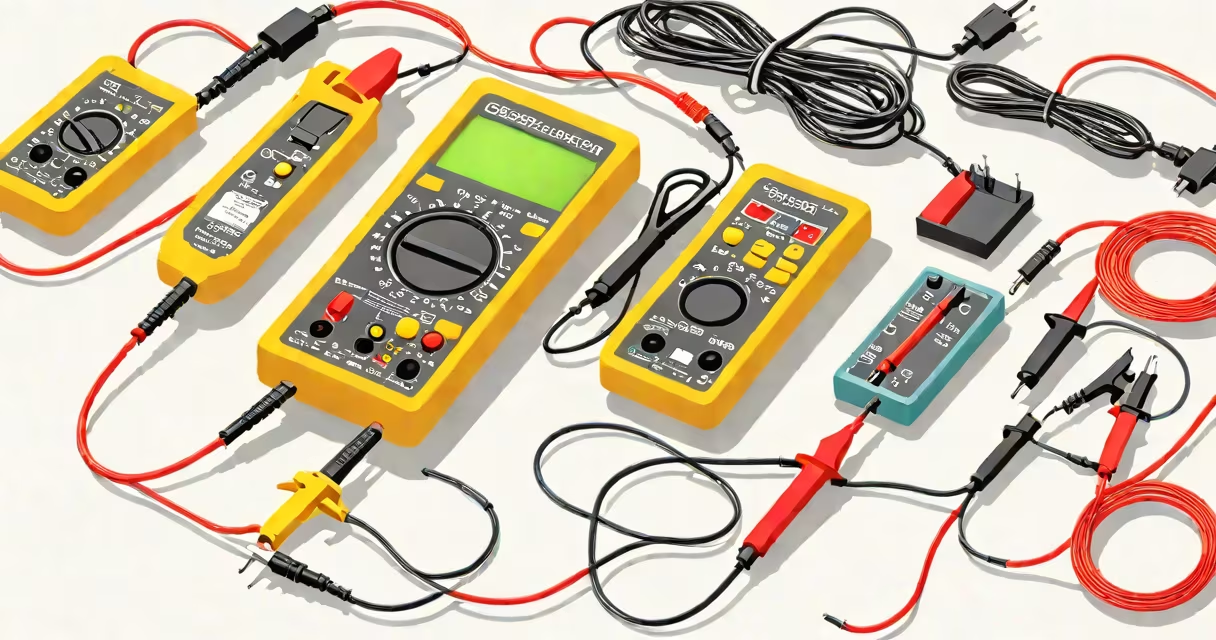
A multimeter measures voltage, current, resistance, continuity, and diode function in electrical circuits. It's a handheld tool used to diagnose problems in wiring, batteries, motors, and electronic devices.
Modern multimeters combine multiple functions into one device. They display readings in volts (V), amps (A), ohms (Ω), and sometimes frequency or capacitance. These tools are essential for electricians, technicians, and DIYers working with anything from household wiring to automotive systems.
The most common measurements include DC voltage, AC voltage, DC current, resistance, continuity, and diode test mode. Each setting serves a specific diagnostic purpose. For example, measuring voltage reveals whether power is reaching a component. Testing resistance identifies open or shorted circuits.
A multimeter uses internal circuitry to sample electrical signals and convert them into readable values. When you select a measurement type, the device routes the signal through calibrated components like shunt resistors (for current) or voltage dividers (for voltage).
For voltage, the multimeter connects in parallel across two points in a circuit. It draws minimal current to avoid affecting the circuit's behavior. For current, it must be connected in series-breaking the circuit and inserting the meter so electrons flow through it.
Resistance measurement applies a small known voltage and measures the resulting current. Ohm's Law (R = V/I) lets the meter calculate resistance. This method ensures accurate readings even in low-power circuits.
Here's what each function detects and where it's used:
| Measurement Type | Unit | Use Case | Real-World Example |
|---|---|---|---|
| DC Voltage | V (volts) | Battery health, low-voltage circuits | Checking a 9V battery shows 8.6V-within tolerance. |
| AC Voltage | V (volts) | Household outlets, wall power | Measuring a U.S. outlet gives 120V ± 10%. |
| DC Current | A (amps) | Power draw, circuit load | Testing a LED strip shows 0.15A under load. |
| Resistance | Ω (ohms) | Open/short detection, component integrity | Measuring a 1kΩ resistor returns 998Ω-acceptable. |
| Continuity | Beep or no beep | Wiring checks, fuse testing | Probes touch both ends of a fuse-beep confirms it's good. |
| Diode Test | Forward voltage drop | Checking diodes, transistors | Testing a silicon diode shows ~0.6V forward bias. |
Some advanced models also measure capacitance (in farads), frequency (in hertz), and temperature (via probe). But these are less common in basic models.
Many users assume a multimeter can measure everything. It cannot. For example, it doesn't measure power in watts directly-even though power equals voltage times current. You must calculate watts manually.
Another mistake: connecting the multimeter in parallel to measure current. This causes a short circuit. A typical multimeter has a 10A fuse for high-current settings. If you exceed the rating, the fuse blows-sometimes permanently damaging the device.
Also, analog multimeters are outdated. Digital ones offer better accuracy and auto-ranging. The National Institute of Standards and Technology (NIST) states that digital multimeters have improved precision since the 1990s, with error margins below 0.5% for professional-grade units.
I once repaired a child's flashlight that wouldn't turn on. I used a multimeter to isolate the issue. Here's how:
This took under five minutes. Without the multimeter, I'd have replaced the entire unit. The tool identified the fault precisely.
A multimeter cannot measure power factor, phase angle, or waveform shape. Oscilloscopes do that. It also can't detect electromagnetic interference or noise spikes unless paired with a spectrum analyzer.
It doesn't measure inductance directly. You can estimate it using a known capacitor and timing, but that's indirect. For such tasks, specialized LCR meters exist.
Even experienced users sometimes misread the dial. The "COM" port must connect to black probe. The "VΩ" port handles voltage and resistance. The "A" port is for current-but only use it with the correct fuse and current limit.
Always start with the highest range setting. For unknown voltage, begin at 600V AC. If the reading is low, switch down to avoid overload.
Never measure voltage while changing ranges. This risks arcing. Always remove probes before adjusting settings.
According to the Occupational Safety and Health Administration (OSHA), improper multimeter use causes 15% of electrical injuries in maintenance work. Using the wrong setting can lead to burns or equipment damage.
When testing live circuits, wear insulated gloves and use probes with safety ratings (CAT III or CAT IV). These ratings indicate protection against transient voltages in industrial environments.
A multimeter measures voltage, current, resistance, continuity, and diode function. These are the core capabilities used in diagnosing electrical issues. It's not a universal tool-it can't measure power directly or analyze complex waveforms-but it's indispensable for troubleshooting.
If you're working with electronics, wiring, or appliances, understanding what can be measured using a multimeter saves time and prevents costly mistakes. fixing a wall switch, the multimeter is your first diagnostic step.