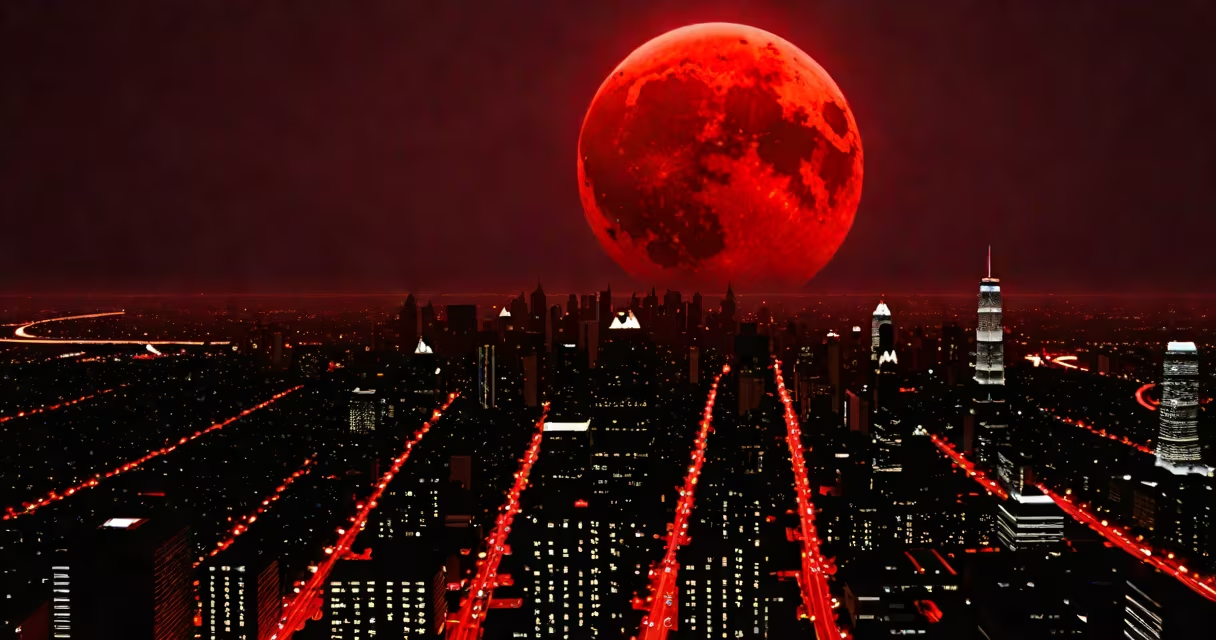
A blood red moon is the visual effect seen during a total lunar eclipse, when Earth passes directly between the Sun and the Moon, casting a shadow that turns the Moon deep red due to Rayleigh scattering of sunlight through Earth's atmosphere.
This phenomenon happens only during a total lunar eclipse, which occurs when the Sun, Earth, and Moon align precisely in a straight line. The Moon moves into Earth's umbral shadow-the darkest part-where no direct sunlight reaches it. Yet the Moon still glows faintly, often appearing coppery or blood red.
The color results from atmospheric refraction: sunlight bends around Earth's edge and filters through our atmosphere. Blue wavelengths scatter out, while longer red wavelengths pass through and explain the Moon. This is the same reason sunsets appear red.
Lunar eclipses occur only during a full moon phase, but not every full moon produces one. The Moon's orbit is tilted about 5 degrees relative to Earth's orbit around the Sun, so most full moons miss Earth's shadow entirely.
For a total lunar eclipse to happen, the alignment must be precise enough for the Moon to enter Earth's umbra. The duration of totality-the time the Moon is fully within the umbra-can last up to 1 hour and 47 minutes, depending on orbital positions.
During totality, the Moon doesn't vanish. Instead, it takes on a reddish hue because Earth's atmosphere acts like a lens, bending sunlight into the shadow zone. The exact shade depends on atmospheric conditions: volcanic ash, pollution, or high-altitude clouds can deepen the red or make it darker.
There are three types of lunar eclipses, each differing in how much of the Moon enters Earth's shadow:
| Type | Shadow Zone | Appearance | Duration |
|---|---|---|---|
| Partial | Penumbra and partial umbral | Half-Moon appears darkened, unevenly | 30-60 minutes |
| Penumbral | Only penumbra | Subtle dimming, hard to see | 1-2 hours |
| Total | Entirely in umbra | Deep red or coppery glow | Up to 1h 47m |
Only total eclipses produce the iconic blood red moon. Partial and penumbral eclipses don't create the same dramatic effect.
Throughout history, blood red moons have inspired awe, fear, and myth. Ancient civilizations often interpreted them as omens. The Babylonians recorded lunar eclipses as warnings from gods. Chinese astronomers believed the Moon was being eaten by a celestial dragon, and drumming was used to scare it away.
In medieval Europe, a red moon was sometimes seen as a sign of war, plague, or divine judgment. The Bible references a blood moon in Revelation 6:12: "And I beheld when he had opened the sixth seal, and, lo, there was a great earthquake; and the sun became black as sackcloth of hair, and the moon became as blood."
Modern science confirms these were not supernatural signs. NASA states that lunar eclipses are predictable and regular. The next total lunar eclipse visible from North America will occur on March 13-14, 2025, with visibility across the U.S., Canada, and parts of South America.
Many people believe a blood red moon signals disaster or global change. This is false. There is no scientific evidence linking lunar eclipses to earthquakes, political upheaval, or personal health changes.
Another misconception is that the Moon turns red because of fire or lava. The Moon has no active volcanoes. The red color comes solely from sunlight filtered through Earth's atmosphere.
A lesser-known fact: the Moon's brightness during a total eclipse varies widely. Some total eclipses appear very dark, almost black, especially if Earth's atmosphere contains dust from recent eruptions. After the 1991 eruption of Mount Pinatubo, lunar eclipses appeared unusually dark due to increased stratospheric aerosols.
On May 26, 2021, a total lunar eclipse occurred during a supermoon-a full moon near its closest point to Earth. This combination created a rare event known as a "super blood moon."
Observers across the western U.S., Hawaii, and parts of Asia saw the Moon turn a vivid red. The eclipse lasted 1 hour and 12 minutes in totality. Scientists used the event to study atmospheric composition: the deeper the red, the more particulates were present in Earth's upper atmosphere.
During this eclipse, the Moon's apparent size was 14% larger than average due to the supermoon proximity. The combined effect made the red Moon appear dramatically larger and more intense than usual.
No special equipment is needed to view a blood red moon. Unlike solar eclipses, lunar eclipses are safe to watch with the naked eye. Binoculars or a telescope improve detail, showing the Moon's surface features even in shadow.
Timing matters. Totality begins when the Moon fully enters Earth's umbra. For the 2025 eclipse, totality will start at 2:24 AM EDT and last until 4:11 AM EDT. The entire event spans several hours, with the Moon passing through penumbral, partial, and total stages.
Use tools like NASA's Eclipse Website or apps such as Stellarium to track local times and visibility. Always check weather forecasts-cloud cover can block the view.
While some astrologers assign symbolic meaning to a blood red moon-such as transformation, endings, or emotional release-these interpretations are not supported by evidence. Astronomy treats eclipses as physical events governed by orbital mechanics.
Still, the psychological impact is real. People report feeling heightened awareness or introspection during eclipses. A 2019 study published in *Frontiers in Psychology* found that participants exposed to images of lunar eclipses reported increased feelings of wonder and reflection, though no measurable behavioral changes followed.
A blood red moon is not a warning or a miracle. It is a natural, recurring astronomical event caused by Earth's position between the Sun and Moon, and the filtering of sunlight through our atmosphere. It is a reminder of the precision of celestial mechanics and the beauty of physics in action.
When you see a blood red moon, you're witnessing light bent by Earth's atmosphere-light that traveled 93 million miles from the Sun, passed through our skies, and finally lit up the Moon. It's not magic. It's science. And it's breathtaking.