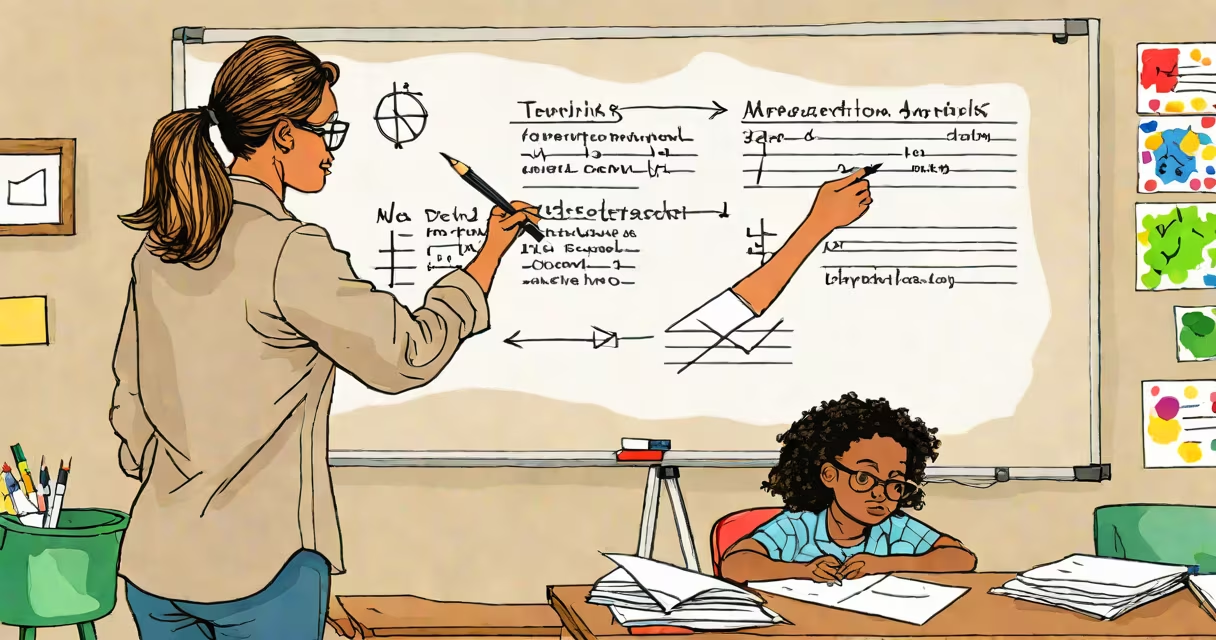
An interventionist teacher identifies specific academic or behavioral challenges in students and provides structured, evidence-based support to close skill gaps. They work alongside general education teachers to deliver targeted instruction, monitor progress, and adjust strategies based on data. This role is central in schools using Response to Intervention (RTI) frameworks.
Interventionist teachers typically focus on literacy and math, though some specialize in social-emotional learning or executive function skills. Their work begins with diagnostic assessments-standardized tools like DIBELS for reading fluency or AIMSweb for math computation-to pinpoint where a student falls behind. Once identified, they create individualized plans with measurable goals, such as increasing reading accuracy from 65% to 85% within eight weeks.
These educators don't replace core instruction. Instead, they supplement it during designated time blocks-often 30 minutes daily-using small-group or one-on-one sessions. For example, a fifth grader struggling with fractions might receive three sessions per week using visual models and hands-on fraction tiles. Progress is tracked weekly through brief checks, and adjustments are made if benchmarks aren't met.
Interventionist teachers follow a cycle of assessment, planning, delivery, and evaluation. They start by analyzing data from universal screening tools administered to all students in grades K-5. If a student scores below the 25th percentile in reading comprehension, the interventionist conducts a more detailed diagnostic test to isolate the issue-such as decoding, vocabulary, or inference skills.
Once the gap is confirmed, they select research-backed strategies. For instance, the Orton-Gillingham method is used for dyslexic learners, while the Concrete-Representational-Abstract (CRA) sequence supports students with math processing difficulties. These methods are not random-they're validated by the National Center on Intensive Intervention (NCII), which reports that structured literacy programs improve reading outcomes by up to 30% for struggling readers.
They also collaborate closely with classroom teachers, special educators, and parents. Weekly team meetings ensure alignment between classroom content and intervention goals. During one session, I observed an interventionist use a "think-aloud" strategy with a fourth grader who hesitated to begin writing essays. By modeling her own internal dialogue-"First, I'll pick a topic. What interests me?"-the student began drafting independently within five minutes.
Interventionist teachers do not reteach entire units. They focus on isolated skills that are prerequisites for grade-level success. A student who can't identify main ideas in a passage won't benefit from rereading the whole chapter. Instead, the interventionist teaches how to locate topic sentences, show supporting details, and summarize in one sentence.
Another misconception is that interventionists only work with students labeled as "at-risk." In reality, they serve all students who show temporary setbacks-like a sixth grader who lost three months of math due to prolonged absences. The goal is early detection, not remediation after failure.
They also don't assign homework. Their sessions are time-limited and designed to build confidence and competence quickly. Homework is left to the general education teacher unless it's part of a coordinated plan involving parents.
| Responsibility | Description | Example |
|---|---|---|
| Diagnose skill gaps | Use formal and informal assessments to identify root causes of struggle | Administer a running record to assess reading fluency and error patterns |
| Design targeted plans | Create short-term goals tied to standards and student data | Set a goal: "Read 100 words per minute with 95% accuracy by March 15" |
| Deliver small-group instruction | Use evidence-based methods in 20-30 minute sessions | Teach phonemic awareness using sound blending cards |
| Track progress | Update charts weekly and adjust instruction accordingly | Plot weekly fluency scores on a graph to visualize improvement |
This role is most common in elementary and middle schools using multi-tiered systems of support (MTSS). Schools with high poverty rates or large ELL populations often employ interventionists to reduce achievement gaps. According to the U.S. Department of Education's 2022 report, schools with dedicated intervention staff saw a 22% increase in proficiency rates in reading and math over three years compared to those without.
They are not limited to public schools. Charter networks like Success Academy and KIPP have embedded interventionists into their instructional models. At a KIPP middle school in Houston, interventionists reduced the number of students needing special education referrals by 41% over two years by catching issues early.
A lesser-known fact: many interventionist teachers hold dual certification in special education and general education. This allows them to bridge communication between IEP teams and classroom teachers. Without this overlap, coordination delays can extend intervention timelines by up to six weeks, according to a 2021 study published in *The Journal of Educational Research*.
Consider Maya, a third grader who scored in the 10th percentile on a district-wide math benchmark. Her general education teacher reported she "just doesn't get multiplication." The interventionist reviewed her recent math journal and found she struggled with skip counting and number patterns.
Over four weeks, the interventionist used a number line and color-coded counters to teach skip counting by 3s and 4s. Sessions were held twice a week for 25 minutes. After two weeks, Maya could count to 60 by 3s without errors. By week four, she solved 12 out of 15 multiplication problems using repeated addition.
Her teacher then integrated similar activities into whole-class lessons. Maya's confidence grew, and she began volunteering answers. Her math benchmark score improved to the 45th percentile by the end of the semester.
Interventionist teachers are not miracle workers. But they are skilled professionals who apply research, data, and consistent practice to help students overcome barriers. Their work helps no child falls through the cracks due to a lack of timely, precise support.