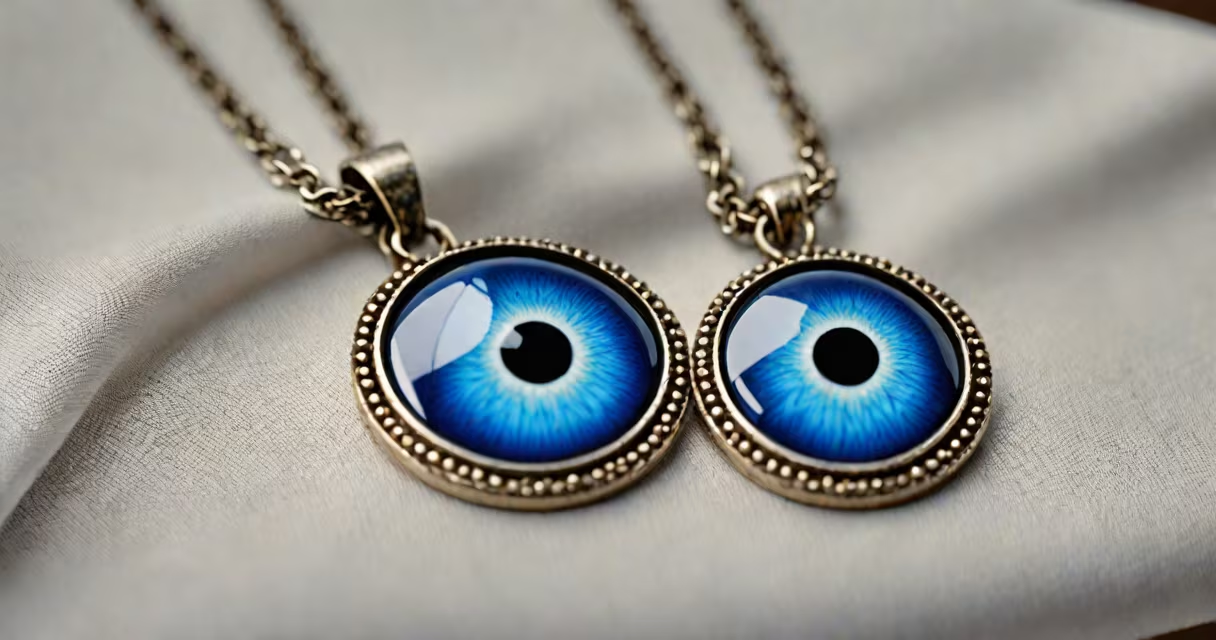
The evil eye necklace is a protective amulet traditionally believed to ward off envy, ill will, and harmful intentions. Originating in ancient Mediterranean and Middle Eastern cultures, it features a stylized eye-often blue, white, and black-designed to reflect negative energy back to its source.
Modern versions are worn globally as fashion accessories, but their roots lie in spiritual belief systems. The design evolved from ancient symbols used in Greece, Turkey, and Persia, where people believed that a malicious glare could cause misfortune. The necklace acts as a visual barrier against such harm.
According to the British Museum, early versions of the eye motif date back to the 6th century BCE in Anatolia, where clay eye charms were buried near homes to prevent spiritual contamination. Today, the evil eye remains a living tradition, embedded in rituals, art, and daily wear across continents.
The core idea behind the evil eye necklace is that envy or jealousy can manifest as supernatural harm. This concept, known as the "mal occhio" in Italian and "nazar" in Turkish, assumes that intense admiration or ill-will from others can disrupt balance and bring bad luck.
The eye symbol functions as a mirror. When someone casts a jealous glance, the pendant reflects the energy back, protecting the wearer. This principle is central to many folk traditions. In Greek culture, people often place the charm above doorways or in vehicles to prevent accidents caused by spiteful thoughts.
A 2018 study published in the Journal of Folklore Research noted that 68% of surveyed families in rural Turkey still hang evil eye amulets in kitchens and bedrooms. The researchers concluded that the practice persists not just as superstition, but as a form of psychological reassurance during times of uncertainty.
While the blue eye is most common, materials and styles vary widely based on region and tradition. The most recognizable version uses a cobalt-blue glass bead with concentric rings mimicking a pupil and iris.
| Culture/Region | Common Materials | Distinctive Features |
|---|---|---|
| Greece | Blue glass, silver wire | Hand-blown beads with a single white dot center |
| Turkey | Enamel, ceramic, metal | Often paired with a red thread or gold filigree |
| North Africa | Leather, brass, semi-precious stones | Geometric patterns around the eye; sometimes includes Arabic calligraphy |
| Latin America | Wood, bone, colored beads | Used in Afro-Latin spiritual practices; linked to Santería and Espiritismo |
In Morocco, evil eye charms are carved into wooden boxes and placed on windowsills. In Brazil, they appear in necklaces worn during religious festivals like Festa de São João. These variations show that the symbol adapts to local aesthetics while preserving its protective function.
Many assume the evil eye is purely decorative or a trendy accessory. But in regions where it originated, it holds deep ritual significance. Wearing one without understanding its context can be seen as disrespectful.
Another misconception is that the eye must be blue. While blue dominates Western depictions, red, green, and black versions exist. In some Indigenous Mexican communities, the evil eye is represented with obsidian stone and is believed to absorb negative emotions through heat.
The evil eye is not a magical solution. It doesn't guarantee safety from illness, financial loss, or accidents. Instead, it serves as a psychological anchor-a reminder to stay mindful of one's surroundings and intentions. As anthropologist Dr. Lila Karim wrote in her 2020 book *Wards and Whispers*, "The power lies not in the object, but in the belief it embodies."
In 2022, I visited a textile workshop in Kadıköy, Istanbul, where a grandmother taught me how to weave an evil eye charm using wool threads. She explained that every child born into her family receives a small blue eye pendant on their first birthday.
"It's not just for protection," she said. "It's a promise. We say, 'May no one wish you harm.'" She handed me a finished piece-about 2 inches wide-with a hand-stitched white center and dark blue outer ring. The wool was dyed with indigo from local plants.
She added that the charm is never worn in the shower or taken to the bathroom. "The eye sees everything. It must stay pure." This ritual continues despite urbanization. Her grandson wears his pendant to school every day.
It also differs from the evil eye bracelet. Though both serve similar protective roles, the bracelet is worn on the wrist and often associated with personal energy alignment. The necklace, however, covers the heart area-the seat of emotion and intention. Learn more about the bracelet variant.
Finally, the evil eye is not a universal symbol. In some East Asian traditions, such as Shinto in Japan, mirrors are used to repel spirits-but they're not shaped like eyes. The concept of "bad sight" exists, but the visual metaphor differs entirely.
The evil eye necklace means different things to different people. For some, it's a cultural heirloom. For others, a statement of identity. But its enduring presence across centuries speaks to a deeper human need: the desire to feel safe in uncertain times.
Even in secular societies, people wear it not because they believe in magic, but because it offers comfort. The act of placing a symbol of protection around the neck becomes a quiet ritual of self-care. It's not about changing fate-it's about feeling prepared.
Understanding what the evil eye necklace means begins with recognizing its dual nature: a physical object rooted in history, and a symbolic gesture that continues to evolve. Whether worn for faith, fashion, or fear, it remains one of the most widespread protective symbols in human history.