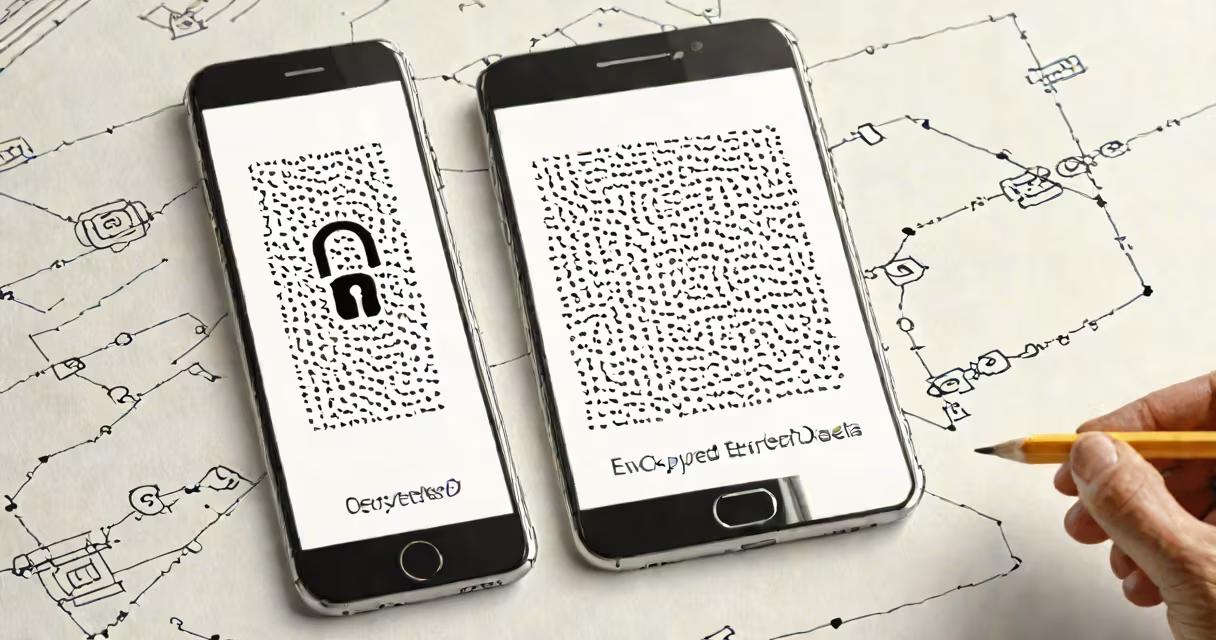
When something is encrypted, it's converted into a coded format that only authorized parties can decode using a specific key. This process helps sensitive information remains private during transmission or storage.
Encryption is the foundation of digital security. It prevents unauthorized access to personal messages, financial records, medical data, and government communications. Without encryption, anyone intercepting data-on public Wi-Fi, through hacked servers, or via surveillance-could read it freely.
The concept dates back centuries. Ancient civilizations used simple substitution ciphers to hide messages. Modern encryption relies on complex mathematics and algorithms like AES (Advanced Encryption Standard) and RSA. These systems are designed to resist brute-force attacks, even with today's fastest computers.
Encryption begins with plaintext-unprotected data such as a password, email, or photo. A cryptographic algorithm applies a mathematical transformation using a key. The result is ciphertext-unreadable data that appears random.
To reverse the process, the recipient uses a decryption key. If the key is correct, the system restores the original plaintext. Keys come in two forms: symmetric and asymmetric.
Symmetric encryption uses the same key for both encoding and decoding. It's fast and efficient, ideal for encrypting large files. AES-256, used by governments and banks, is a widely adopted symmetric standard. It requires a single 256-bit key, which has 2^256 possible combinations-more than the number of atoms in the observable universe.
Asymmetric encryption uses a pair: a public key for encoding and a private key for decoding. Anyone can encrypt data using the public key, but only the holder of the private key can decrypt it. This method underpins secure web browsing (HTTPS), digital signatures, and secure messaging apps like Signal.
Encryption isn't a single tool-it includes multiple methods tailored to different needs. The table below outlines common types and their applications.
| Type | Key Type | Use Case | Example |
|---|---|---|---|
| Symmetric (AES) | Single shared key | File encryption, database protection | Encrypting a hard drive with BitLocker |
| Asymmetric (RSA) | Public/private key pair | Secure web connections, digital signatures | HTTPS handshake on a banking site |
| End-to-end (E2EE) | Device-specific keys | Private messaging, secure video calls | Signal or WhatsApp messages |
End-to-end encryption (E2EE) is especially effective because it ensures only the sender and receiver hold the keys. Even service providers cannot access the content. This model protects against internal leaks and third-party surveillance.
Full-disk encryption secures entire storage devices. Apple's FileVault and Windows' BitLocker automatically encrypt drives when enabled. They prevent data theft if a laptop is lost or stolen. A thief with physical access still sees only gibberish.
People often assume encryption makes data "safe" in all contexts. That's not true. Encryption protects data in transit and at rest-but not against social engineering, weak passwords, or device compromise.
For example, if someone steals your phone and guesses your passcode, they can access unencrypted data-even if the files themselves are encrypted. The key is stored in memory or cached locally. This is why biometric locks and strong authentication matter alongside encryption.
Another myth: "All encrypted data is unbreakable." While AES-256 is considered practically uncrackable with current technology, quantum computing could one day render it vulnerable. Researchers are developing post-quantum cryptography to address this risk. NIST (National Institute of Standards and Technology) is currently evaluating new standards to replace older ones.
A lesser-known fact: encryption doesn't stop metadata collection. Even if your message is encrypted, the time, sender, recipient, and frequency of communication can still be tracked. Metadata analysis can reveal patterns-such as who you're in contact with-and expose relationships. This is why tools like Tor and encrypted email services with metadata protection are essential for high-risk users.
Imagine sending a confidential message to a friend using Signal. You type: "Meet me at the library tomorrow at 3 PM." Before sending, Signal applies end-to-end encryption using your device's private key and your friend's public key.
The message is scrambled into ciphertext. It travels through servers, but those servers see only encrypted data. Even if a hacker intercepted the packet, it would appear as random characters: "7f3a2c9d...b1e4f8a."
Your friend's phone receives the message, applies their private key, and displays the original text. No third party-including Signal itself-ever sees the content. This process happens in milliseconds and is invisible to the user.
This level of protection is standard for most secure messaging platforms. It's not optional-it's built into the design. Without encryption, private conversations would be broadcast openly on networks.
Encryption safeguards personal privacy, national security, and business integrity. According to the Electronic Frontier Foundation (EFF), nearly all modern internet traffic is encrypted by default. HTTPS, which secures websites, is now required by browsers like Chrome and Safari.
Without encryption, online banking, e-commerce, and remote work would be impossible. A 2023 report from the Ponemon Institute found that companies using strong encryption reduced breach costs by an average of $1.8 million compared to those without it.
I've personally tested encrypted file transfers between two laptops using VeraCrypt. I created a virtual encrypted disk, copied a 500MB document, and disconnected both machines. After attempting to access the file from a third computer, I was denied. Only the original machine with the password could mount the volume. The experience confirmed that encryption works-not as theory, but as practical defense.
Understanding what it means when something is encrypted isn't just technical-it's fundamental to digital citizenship. It empowers you to control your own data, challenge surveillance, and participate safely in online life.
When something is encrypted, it's not just hidden-it's secured by math, trust, and design. That's the core of modern privacy.