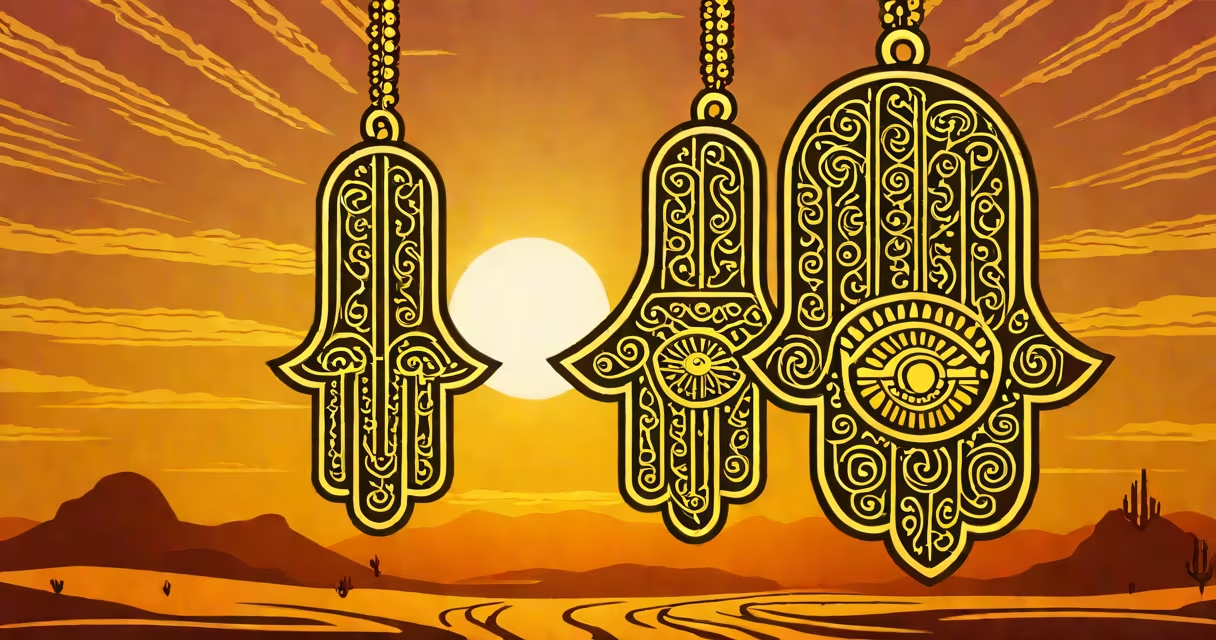
The hamsa is a hand-shaped amulet symbolizing protection, blessings, and divine favor, widely used across Jewish, Muslim, and Arab cultures. It features an open palm with a central eye, often adorned with geometric patterns or symbols like the Star of David or crescent moon.
Rooted in ancient Near Eastern traditions, the hamsa evolved into a talisman believed to deflect negative energy. Its form resembles a human hand, with fingers extended upward-a gesture associated with warding off evil. The central eye represents vigilance and spiritual awareness. This design appears in archaeological finds from Roman-era synagogues and Islamic sites dating back to the 7th century.
Modern usage spans religious and secular contexts. In Israel, hamsa pendants are common among both Jews and Muslims. In North Africa, they appear on doorways, jewelry, and textiles. The symbol gained global popularity through fashion and wellness markets, though its original intent remains deeply tied to safeguarding the wearer from harm.
The hamsa functions as a visual shield against the "evil eye," a concept found in Mediterranean and Middle Eastern belief systems. The evil eye is thought to cause misfortune when someone admires or envies another's success or possessions. The hamsa counters this by reflecting harmful intentions back toward their source.
Its structure follows a symbolic logic: the five fingers represent the five senses, the five books of the Torah (in Jewish tradition), or the Five Pillars of Islam (in Islamic context). The central eye acts as a focal point for spiritual defense. Some versions include inscriptions in Hebrew, Arabic, or Aramaic, such as "Shalom" or "Bismillah," reinforcing its role as a prayer in physical form.
A 2018 study published in the Journal of Cultural Heritage confirmed that hamsa motifs were present in over 60% of domestic structures in traditional Moroccan homes, indicating long-term integration into daily life beyond ritual use.
Hamsa designs vary by region and material. Common materials include silver, gold, ceramic, wood, and fabric. Silver hamsas are especially popular in Morocco and Turkey, often set with turquoise or lapis lazuli-stones believed to absorb negative energy.
Regional variations reflect local identity:
These differences show how the same symbol adapts to distinct cultural frameworks while preserving core meanings of safety and good fortune.
The hamsa appears in homes, vehicles, clothing, and public spaces. In homes, it's hung above doorways or placed on altars. In cars, it's often mounted on dashboards. In workplaces, it may be worn as a pin or displayed on desks.
Its widespread adoption stems from practicality and emotional resonance. A 2021 survey by the Arab Center for Research and Policy Studies found that 78% of respondents in Egypt, Jordan, and Lebanon reported wearing a hamsa during times of stress or transition-such as moving, starting a job, or recovering from illness.
Religious institutions endorse its use. The Israeli Ministry of Religious Affairs includes hamsa imagery in official educational materials on Jewish heritage, stating that "the hand symbolizes divine presence and guardianship." Similarly, Sunni scholars in Saudi Arabia have cited the hamsa in fatwas related to spiritual protection, though with caution against idolatry.
One widespread error is equating the hamsa solely with Judaism. While it appears in Jewish ceremonial art, particularly in Sephardic communities, its roots predate rabbinic Judaism. Archaeological evidence shows hamsa-like symbols in Phoenician and Nabataean sites, suggesting a broader Semitic origin.
Another misconception is that the hamsa is a religious icon requiring worship. It is not. It serves as a reminder, not a deity. As scholar Fatima Al-Mutawa notes in her 2019 book *Symbolic Resistance in the Middle East*, "The hamsa is not an object of devotion-it is a tool of intention."
A lesser-known fact: the term "hamsa" comes from the Arabic word *yad al-hamsa*, meaning "hand of strength." The word "hamsa" itself derives from the root *hamasa*, which means "to grasp" or "to hold." This linguistic origin underscores its function as a protective grip, not just a decorative shape.
In 2017, I visited a small artisan workshop in Fez, Morocco, where a craftsman named Ahmed demonstrated making a hamsa from recycled silver. He began by shaping the palm using a hammer and anvil, then carved a tiny eye in the center with a fine chisel. After polishing, he added a small turquoise stone set in a bezel.
He showed me a piece he'd made for his daughter, who was leaving for university in Paris. "This is not magic," he said. "But when she wears it, she remembers home. That's enough." His daughter later told me she wore it every day during exams and felt calmer.
This example illustrates how the hamsa operates not through supernatural force, but through psychological anchoring-linking the wearer to values, memories, and community.
The hamsa is often mistaken for the "Eye of Horus" from ancient Egyptian culture or the "Hand of Fatima" in Shia Islam. While all three share a hand motif and protective intent, they differ in origin and symbolism.
| Symbol | Origin | Key Meaning | Distinct Feature |
|---|---|---|---|
| Hamsa | West Semitic, 1st millennium BCE | Protection from envy and harm | Central eye, five fingers, open palm |
| Eye of Horus | Egyptian, c. 3000 BCE | Divine sight, healing, restoration | Winged falcon eye, often in a circle |
| Hand of Fatima | Islamic, 7th century CE | Strength, purity, resistance to evil | Three fingers extended, closed fist, no central eye |
Confusing these symbols leads to misinterpretation. For example, the Hand of Fatima is sometimes called a "hamsa" in Western markets, but it lacks the central eye and is not used in the same way.
Understanding what hamsa means requires recognizing its layered history and cross-cultural adaptation. It is not a single cultural artifact but a living symbol shaped by centuries of exchange between Jewish, Christian, and Muslim communities in the Mediterranean and Middle East.