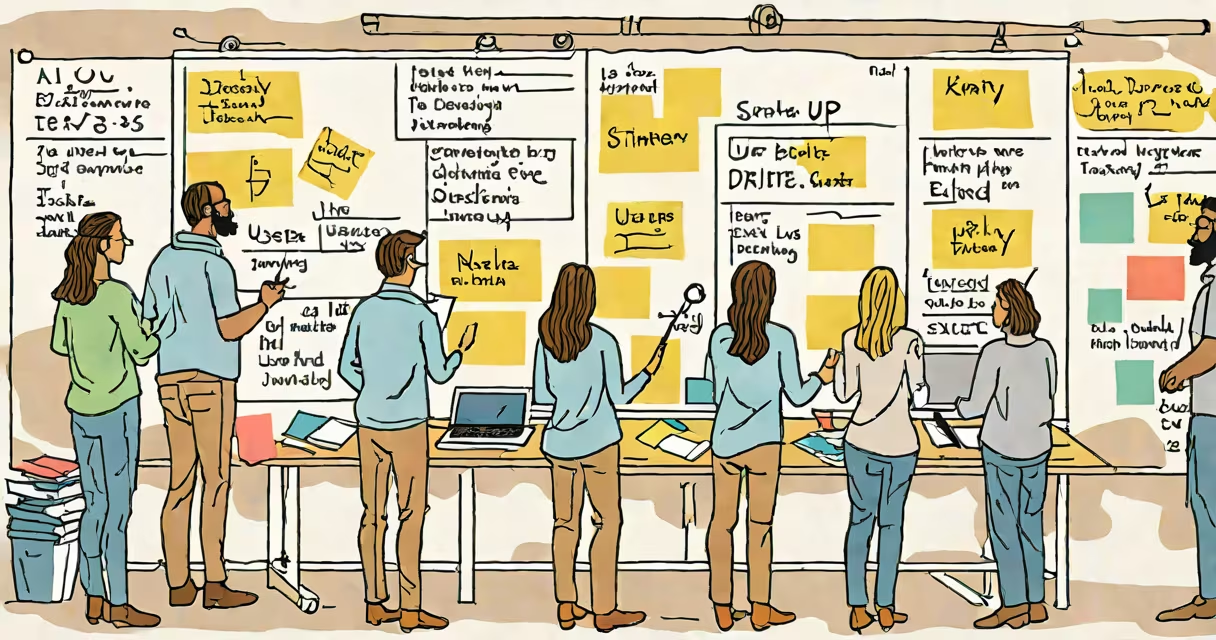
The agile model is a project management and software development approach that delivers work in small, incremental cycles called iterations or sprints. It prioritizes flexibility, continuous feedback, and cross-functional teamwork over rigid planning and documentation. This method enables teams to respond quickly to changing requirements and deliver functional software faster.
Agile emerged in response to the limitations of traditional waterfall models, which required complete specification upfront and offered little room for change during execution. The agile model instead focuses on delivering working software early and often, validating assumptions through real user interaction rather than theoretical design.
According to the Agile Manifesto-created by 17 software developers in 2001-the core values include individuals and interactions over processes and tools, working software over complete documentation, customer collaboration over contract negotiation, and responding to change over following a plan. These principles form the foundation of all agile practices.
Agile operates through time-boxed iterations, typically lasting one to four weeks. Each iteration begins with a planning session where the team selects tasks from a prioritized backlog-a list of features, enhancements, and bug fixes ordered by business value. During the sprint, developers build, test, and integrate the selected work.
At the end of each cycle, the team demonstrates the completed functionality to stakeholders. Feedback is collected, and the backlog is updated based on new insights. This creates a continuous loop of delivery, evaluation, and adaptation. Teams hold daily stand-up meetings-15-minute syncs-to track progress, identify blockers, and align efforts.
A real-world example: A fintech startup building a mobile banking app uses two-week sprints. In Sprint 1, they deliver login and account balance display. After user testing, customers report confusion with the balance layout. The team adjusts the design in Sprint 2, adds a visual chart, and releases it within two weeks. This rapid response prevents costly redesigns later.
While the agile model is a philosophy, several frameworks implement it in practice. Scrum is the most widely adopted. It defines roles (Product Owner, Scrum Master, Development Team), events (Sprint Planning, Daily Stand-up, Sprint Review, Retrospective), and artifacts (Product Backlog, Sprint Backlog, Increment).
Kanban is another structure that emphasizes visual workflow management. Teams use boards with columns like "To Do," "In Progress," and "Done." Work items move across the board as they're completed. Unlike Scrum, Kanban doesn't use fixed-length sprints. Instead, it focuses on limiting work in progress (WIP) to improve flow and reduce bottlenecks.
| Structure | Iteration Type | Key Roles | Best For |
|---|---|---|---|
| Scrum | Fixed-length sprints (1-4 weeks) | Product Owner, Scrum Master, Dev Team | Projects with evolving requirements and clear goals |
| Kanban | Continuous flow, no fixed duration | Team members manage workflow | Support, maintenance, or steady demand environments |
| SAFe (Scaled Agile Structure) | Sprints across multiple teams | Release Train Engineer, Product Managers | Enterprise-scale projects with interdependent teams |
Teams often combine frameworks. For example, a company may use Scrum for product development while applying Kanban principles to monitor deployment pipelines. This hybrid approach allows teams to benefit from both structure and flexibility.
Agile is most common in software development, where requirements frequently evolve and speed-to-market matters. Major tech firms like Spotify, Amazon, and Google use agile practices internally. Spotify's engineering culture, for instance, relies on autonomous squads using agile rituals to release features rapidly.
Outside tech, agile has expanded into marketing, HR, education, and government. NASA applied agile methods to develop mission-critical software for Mars rovers, reducing risk by validating components early. The U.S. Department of Veterans Affairs used agile to rebuild its healthcare portal, cutting delivery time by 60% compared to previous attempts.
A non-obvious distinction: Agile is not synonymous with "fast" or "unstructured." It requires disciplined planning, regular reflection, and clear communication. Teams that skip retrospectives or fail to maintain a prioritized backlog often see productivity decline. According to a 2022 report by VersionOne, 64% of agile teams cite poor backlog management as a top obstacle to success.
Many assume agile means "no documentation" or "no planning." This is incorrect. Agile encourages just enough documentation-such as user stories, acceptance criteria, and meeting notes-to support understanding and continuity. The goal is clarity, not elimination.
Another myth: Agile only works for small teams. While smaller groups adopt it more easily, large organizations can scale it. SAFe and LeSS (Large-Scale Scrum) provide structures for coordinating 50+ people across departments. A study by McKinsey & Company found that scaled agile implementations improved time-to-market by 30-50% in global enterprises.
I once observed a healthcare IT team struggling with agile adoption. They held daily stand-ups but skipped sprint reviews. Stakeholders weren't involved until launch, leading to feature misalignment. After reintroducing stakeholder demos and refining their backlog grooming process, they reduced rework by 40% and increased user satisfaction scores.
Agile is not a replacement for project management-it complements it. Traditional PM skills like risk assessment, budget tracking, and resource allocation remain essential. Agile shifts focus from predicting outcomes to adapting to them.
Traditional waterfall models follow a linear sequence: requirements → design → implementation → testing → deployment. Once a phase ends, teams rarely revisit it. This makes changes expensive and late-stage defects hard to fix.
In contrast, agile breaks work into manageable chunks. Changes can be incorporated mid-cycle. A 2021 survey by PwC found that 71% of companies using agile reported higher project success rates than those using waterfall. Projects delivered on time were 2.5 times more likely in agile environments.
When comparing agile to Kanban, the difference lies in timing and structure. Kanban allows continuous delivery without sprints. Agile uses time-boxed cycles to enforce discipline and rhythm. Teams choosing Kanban often do so to reduce overhead; those choosing Scrum want structure and accountability.
The agile model is a structured yet flexible approach to managing complex projects. It enables teams to deliver value incrementally, respond to change, and improve continuously. Its success depends on consistent practice, team buy-in, and adherence to core principles-not just adopting ceremonies.
Understanding what is agile model involves recognizing it as a mindset, not just a set of tools. It's about embracing uncertainty, valuing people, and iterating toward better solutions. Whether in software, operations, or innovation, agile provides a proven path to resilience and results.