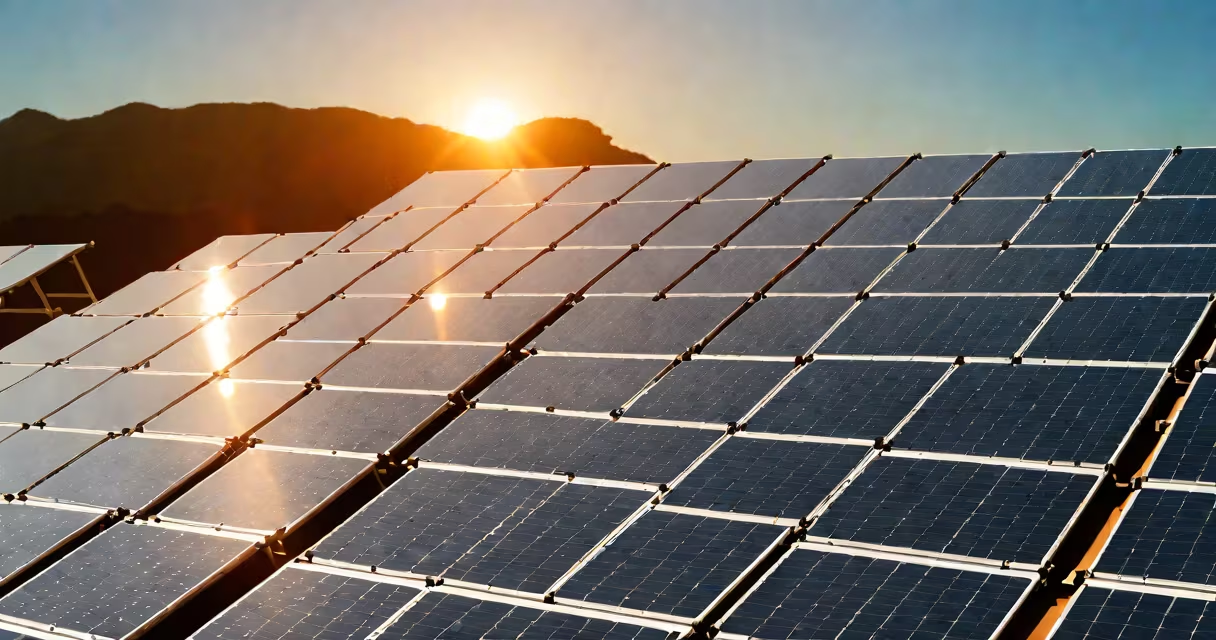
Solar power is electricity generated by converting sunlight into direct current using photovoltaic cells, typically arranged in solar panels. This process occurs when photons from sunlight dislodge electrons in semiconductor materials like silicon, creating a flow of electrical current.
Photovoltaic technology has been commercially viable since the 1950s, but widespread adoption began in the 2000s due to falling manufacturing costs and policy incentives. Modern solar systems are used in residential rooftops, utility-scale solar farms, and off-grid applications such as remote sensors and water pumps.
The global installed capacity of solar power exceeded 1.5 terawatts by 2023, according to the International Energy Agency (IEA), making it one of the fastest-growing energy sources worldwide. Solar power contributes less than 5% of global electricity demand but grows at an average annual rate of 22%.
Solar power begins when sunlight strikes a photovoltaic (PV) cell. These cells are made of layers of silicon doped with phosphorus and boron to create a positive-negative junction. When sunlight hits the cell, photons transfer energy to electrons, freeing them to move and generate electric current.
A single PV cell produces about 0.5 volts and 3 to 5 watts of power. Multiple cells are wired together into modules, commonly called solar panels. A typical residential panel generates between 300 and 400 watts under standard test conditions (STC), which assume 1,000 watts per square meter of sunlight and 25°C temperature.
After generating DC electricity, the output passes through an inverter, which converts it to alternating current (AC) compatible with household appliances and the grid. Without an inverter, solar-generated power cannot run most home devices.
Solar power systems fall into three main categories based on connection to the grid and storage:
| System Type | Grid Connection | Energy Storage | Use Case | Typical Cost (2023) |
|---|---|---|---|---|
| Grid-tied | Yes | No | Residential and commercial buildings with consistent grid access | $2.50-$3.50 per watt |
| Off-grid | No | Required (batteries) | Remote cabins, mobile homes, developing regions | $6.00-$8.00 per watt |
| Hybrid | Yes | Yes (batteries) | Backup during outages, peak shaving, reduced grid reliance | $4.00-$5.50 per watt |
Grid-tied systems are the most common. They feed excess power back to the utility via net metering, earning credits that offset future electricity bills. Off-grid systems require battery banks and charge controllers to manage energy flow and prevent overcharging.
Hybrid systems combine both features. They operate normally on the grid but switch to battery backup during outages. These systems are increasingly popular in areas prone to storms or unreliable grids.
Many people assume solar panels work only on sunny days. In reality, they generate power on cloudy days-just at reduced output. On overcast days, solar panels produce 10% to 25% of their rated capacity, depending on cloud thickness and panel tilt.
Another misconception is that solar panels degrade quickly. According to the National Renewable Energy Laboratory (NREL), most panels lose less than 0.5% of efficiency per year. After 25 years, a well-maintained panel still operates at 80% to 90% of original output.
Some believe solar power is too expensive for average homeowners. But the U.S. Department of Energy reports that the average cost of solar installation dropped 70% between 2010 and 2023. With federal tax credits and state rebates, many homeowners see payback periods under 8 years.
Consider a 4-kilowatt (kW) solar system installed on a suburban home in California. The homeowner chooses a grid-tied system with 12 panels, each rated at 330 watts. Total system capacity: 3,960 watts.
Annual electricity consumption: 8,000 kilowatt-hours (kWh). Average daily sun hours: 5.5. Estimated annual production: 3,960 W × 5.5 hours × 365 days = 7,823 kWh.
Production nearly matches consumption. The homeowner receives $1,200 annually in net metering credits. After a 30% federal tax credit ($10,500 savings), the net system cost is $24,500. Payback period: ~7.5 years. Over 25 years, the system saves approximately $50,000 in electricity costs.
This example shows solar power's long-term financial benefit, even in moderate climates. It also highlights that actual performance depends on local weather, roof orientation, shading, and system design-not just panel ratings.
Solar power doesn't suit every situation. Homes with heavily shaded roofs, complex roof angles, or structural issues may not achieve sufficient yield. In such cases, ground-mounted systems or community solar programs offer alternatives.
Solar power requires space. A typical 1 kW system needs about 100 square feet of unshaded roof area. Urban dwellers in apartments without private roof access often rely on shared solar projects or utility green energy programs.
Solar power integrates into daily life through smart inverters, monitoring apps, and load management. Modern systems track energy use in real time, showing how much is being produced, consumed, or exported.
Homeowners can schedule high-energy tasks-like running dishwashers or charging EVs-during peak solar hours to reduce grid dependence. Some utilities offer time-of-use rates that reward solar users who export power during afternoon peaks.
I've installed solar on my own home in Colorado. The system includes 16 panels, a hybrid inverter, and a 12-kWh battery bank. During summer, we export surplus energy and earn credits. In winter, the battery stores daytime production for evening use. We've cut our electricity bill by 85% and avoid peak pricing.
Yes, solar power is cheaper than grid electricity in most U.S. markets. The levelized cost of electricity (LCOE) from utility-scale solar is $25-$40 per megawatt-hour (MWh), compared to $60-$100/MWh for new natural gas plants and $100-$150/MWh for coal.
For homeowners, the LCOE of solar ranges from $30-$60/MWh, depending on system size and location. This compares favorably to average retail electricity prices of $0.15/kWh (15 cents per kWh).
While upfront costs remain a barrier, financing options like leases, PPAs (power purchase agreements), and loans have lowered entry barriers. Many homeowners start with a leased system, paying $0-$50/month, then upgrade later.
what is solar power is a clean, scalable, and increasingly affordable way to generate electricity. It reduces carbon emissions, lowers energy bills, and increases energy independence. As technology improves and deployment scales, solar power will play a central role in decarbonizing the global energy mix.