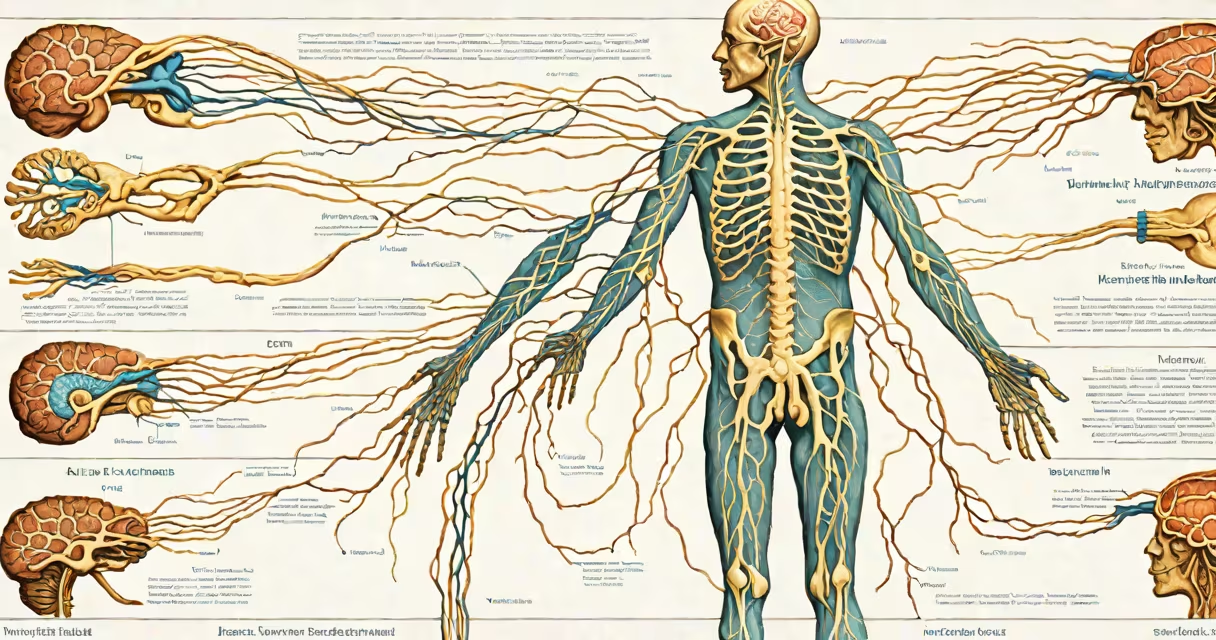
The peripheral nervous system (PNS) is the network of nerves that extends from the central nervous system (brain and spinal cord) to muscles, skin, glands, and internal organs. It transmits sensory information to the CNS and carries motor commands back out to control movement and organ function.
The PNS handles communication between the central nervous system and the rest of the body. It includes all nerves outside the brain and spinal cord, organizing signals for voluntary actions like walking and involuntary processes like digestion and heart rate regulation.
According to the National Institute of Neurological Disorders and Stroke (NINDS), the PNS consists of cranial nerves, spinal nerves, and their branches. These nerves form a complex web that enables sensation, movement, and automatic bodily functions.
Nerves in the PNS carry electrical impulses called action potentials. These signals travel along axons-long projections of neurons-to transmit messages between the CNS and body regions. Sensory neurons send data from receptors in the skin, muscles, and organs toward the spinal cord and brain. Motor neurons relay instructions from the CNS to effectors such as skeletal muscles and cardiac muscle.
For example, when you touch a hot stove, sensory nerves in your fingertip detect heat and send a signal through the PNS to the spinal cord. The spinal cord processes the input and triggers a rapid reflex response via motor nerves, causing your hand to pull away before the brain registers pain.
This reflex arc operates entirely within the PNS and spinal cord, bypassing conscious thought. It prevents tissue damage and highlights the PNS's role in immediate protective responses.
The PNS divides into two functional subsystems: the somatic nervous system and the autonomic nervous system. The somatic system controls voluntary movements and receives sensory input from the environment. The autonomic system regulates involuntary functions like breathing, blood pressure, and digestion.
| System | Function | Examples | Control Type |
|---|---|---|---|
| Somatic | Movement, sensation | Walking, touching objects, feeling temperature | Voluntary |
| Autonomic | Heart rate, digestion, pupil dilation | Salivating during a meal, increased heart rate during stress | Involuntary |
The autonomic nervous system further splits into sympathetic and parasympathetic divisions. The sympathetic system prepares the body for stress or danger (fight-or-flight), increasing heart rate and redirecting blood flow to muscles. The parasympathetic system promotes calm states (rest-and-digest), slowing heart rate and stimulating digestion.
A common misconception is that the PNS is purely about movement and sensation. But it also manages internal homeostasis-such as regulating body temperature and hormone release-through feedback loops involving the hypothalamus and adrenal glands.
The PNS enables interaction with the external world and maintains internal balance. Without it, the brain could not receive visual, auditory, or tactile input. Muscles would not respond to commands, and important systems like respiration and circulation would fail.
Consider a person with peripheral neuropathy-a condition affecting the PNS due to diabetes, injury, or infection. They may lose sensation in their feet, leading to unnoticed injuries. Or they might experience chronic burning pain, tingling, or weakness. According to the Mayo Clinic, about 20 million Americans live with some form of peripheral nerve disorder.
Another example: athletes rely on precise somatic signaling to coordinate complex movements. A basketball player's ability to dribble, jump, and shoot depends on rapid transmission of signals from the brain through the PNS to leg and arm muscles.
Even basic daily activities depend on the PNS. When you blink, swallow, or adjust your posture, the PNS ensures those actions happen smoothly and automatically.
Many people assume the PNS is just "all nerves outside the brain." This oversimplifies its complexity. The PNS isn't passive wiring-it actively processes information. For instance, the enteric nervous system, often called the "second brain," is embedded in the gut wall and can operate independently of the CNS to regulate digestion.
Another misunderstanding is equating the PNS with the autonomic nervous system. While the autonomic system is part of the PNS, it represents only half the story. The somatic nervous system, responsible for conscious movement, makes up the other half.
Some believe that nerves regenerate easily. In reality, peripheral nerves heal slower than skin wounds. A severed sciatic nerve may take months to regrow at a rate of about 1 mm per day. Recovery depends on age, nutrition, and underlying health conditions.
During a lab experiment, I observed rat sciatic nerve regeneration under a microscope. After crushing the nerve, we tracked growth using fluorescent markers. Regeneration began around day 7, but full functional recovery took over 60 days-highlighting the slow pace of nerve repair.
The central nervous system (CNS)-comprising the brain and spinal cord-processes information and generates decisions. The PNS acts as the communication highway. While the CNS integrates data, the PNS delivers it to and from the body.
Unlike the CNS, which is protected by the blood-brain barrier, the PNS lacks this defense. As a result, peripheral nerves are more vulnerable to toxins, infections, and autoimmune attacks. Conditions like Guillain-Barré syndrome attack PNS nerves, leading to paralysis.
Understanding the difference between the central nervous system vs peripheral system helps clarify treatment approaches. For example, multiple sclerosis affects the CNS, while Charcot-Marie-Tooth disease targets peripheral nerves.
The PNS plays a critical role in medical diagnostics. Electromyography (EMG) measures electrical activity in muscles and nerves to detect disorders like carpal tunnel syndrome or ALS. Nerve conduction studies assess how fast signals travel through peripheral nerves-key in diagnosing neuropathy.
When someone experiences numbness in their hands, doctors test the median nerve in the wrist. If conduction slows below 50 m/s, it indicates compression-common in repetitive typing or texting.
People also use PNS awareness to manage stress. Techniques like diaphragmatic breathing activate the parasympathetic branch, reducing cortisol levels and lowering heart rate. Research from Harvard Medical School shows that 6 minutes of daily breathwork can improve autonomic balance.
The peripheral nervous system is not a passive extension of the brain and spinal cord. It is a changing, adaptive network essential for survival, movement, sensation, and internal stability. Its failure leads to measurable loss of function-from missing a step on a stair to losing the ability to regulate heartbeat.