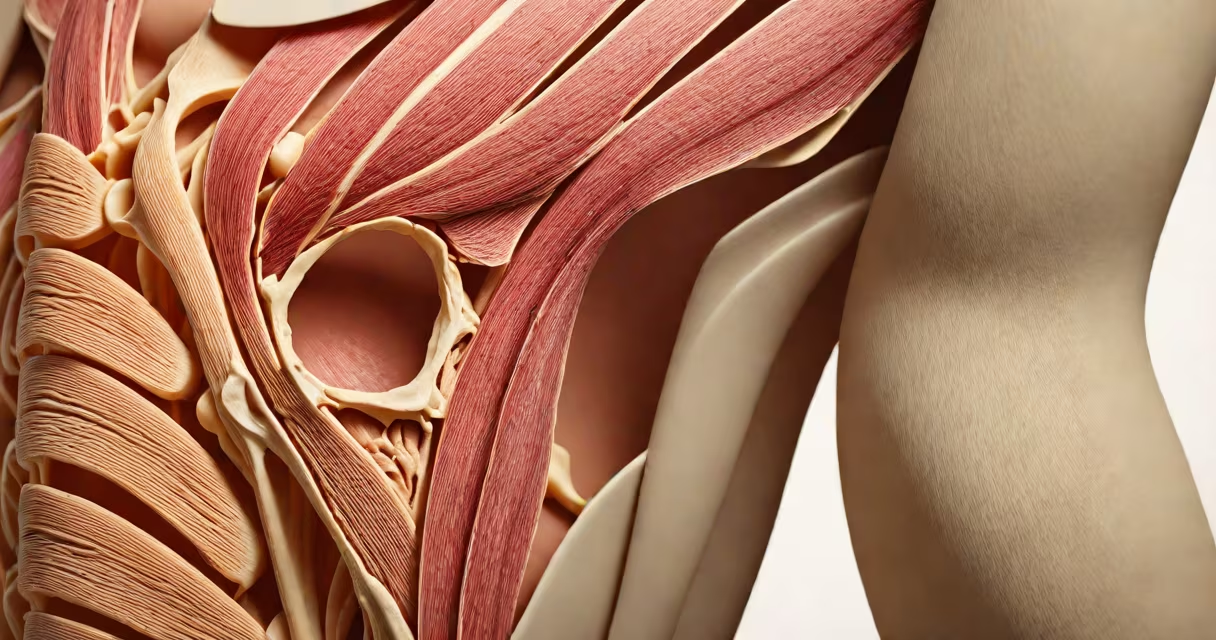
The rotator cuff is composed of four tendons and their associated muscles-supraspinatus, infraspinatus, teres minor, and subscapularis-that attach the scapula to the humerus, stabilizing the shoulder joint during movement.
These tendons are dense, fibrous connective tissues formed primarily from collagen fibers. They transmit force from muscle contractions to the bone, enabling precise control of arm motion. The tendons are not uniform; they vary in thickness and structure depending on their location and mechanical load. For example, the supraspinatus tendon is thinner and more prone to injury due to its position beneath the acromion process.
Each muscle originates from the scapula and inserts via a tendon onto the greater tubercle or lesser tubercle of the humerus. The supraspinatus initiates abduction (lifting the arm sideways), the infraspinatus and teres minor externally rotate the arm, and the subscapularis internally rotates it. Together, they form a functional unit that maintains the humeral head centered in the glenoid cavity during changing movement.
The tendons are primarily made of Type I collagen, which provides tensile strength and resistance to stretching. They also contain small amounts of elastin for limited elasticity and proteoglycans for hydration and nutrient diffusion. Blood supply to the tendons is limited, especially in the supraspinatus region-the "watershed zone"-making healing slow and injury-prone.
Microscopic analysis shows tendon fibers arranged in parallel bundles, with occasional crimp patterns that allow slight stretch. This arrangement optimizes force transmission while minimizing energy loss. The tendons are enveloped in a synovial sheath that reduces friction during repetitive motion, though this layer is thin compared to joint capsules.
A key structural feature is the insertion site on the humerus. The tendons blend into the bone's surface through a transitional zone called the enthesis, where fibrocartilage gradually transforms into bone. This interface withstands high shear forces but is vulnerable to degeneration over time, particularly in adults over 40.
Many assume the rotator cuff is a single muscle or a ligament. It is neither. It is a group of four tendons working together. Confusing it with the deltoid muscle is common-deltoid abducts the arm rapidly, while the rotator cuff controls fine motion and stability.
Another misconception is that rotator cuff tears always cause severe pain. Not true. Some people with full-thickness tears report minimal discomfort, especially if they have compensatory muscle activation. A 2021 study in the Journal of Shoulder and Elbow Surgery found that 36% of asymptomatic individuals aged 60+ had detectable rotator cuff tears on MRI scans.
Tendons are not muscles. Muscles contract; tendons transmit force. The rotator cuff's strength lies in this mechanical linkage. When a muscle contracts, the tendon pulls on the bone. Without intact tendons, even strong muscles cannot move the arm effectively.
Consider a baseball pitcher. During the wind-up phase, the infraspinatus and teres minor activate to externally rotate the shoulder. As the arm accelerates forward, the supraspinatus lifts the arm into abduction. The subscapularis engages during deceleration to prevent dislocation. All four tendons work in sequence to protect the joint under extreme loads.
For a daily-life example, lifting a suitcase overhead requires coordinated action. The supraspinatus initiates the lift, the infraspinatus prevents the humeral head from impinging on the acromion, and the subscapularis keeps the joint centered. Failure in any tendon leads to instability and pain.
Repetitive overhead tasks-like painting ceilings or throwing a ball-can lead to microtears in the tendons. Over time, these accumulate and result in tendinopathy. This condition involves degenerative changes in the tendon matrix, not inflammation, despite the name. The term "tendinopathy" is preferred over "tendonitis" because most cases lack inflammatory cells.
| Component | Origin | Insertion | Primary Action | Common Injury Risk |
|---|---|---|---|---|
| Supraspinatus | Supraspinous fossa | Greater tubercle (superior) | Abduction initiation (first 15°) | High-due to acromial compression |
| Infraspinatus | Infraspinous fossa | Greater tubercle (posterior) | External rotation | Medium-overhead athletes |
| Teres minor | Lateral border of scapula | Greater tubercle (posterior) | External rotation | Low-often injured alongside infraspinatus |
| Subscapularis | Subscapular fossa | Lesser tubercle | Internal rotation, stabilization | Low-rarely torn unless trauma |
I once observed a patient with a partial tear in the supraspinatus tendon during a physical exam. He reported pain only when raising his arm above eye level. Ultrasound confirmed a 30% tear. Despite this, he maintained near-normal strength, likely due to compensation by the deltoid and remaining intact tendons. This illustrates how the rotator cuff functions as a system-not as isolated parts.
Signs of rotator cuff damage include persistent shoulder pain, weakness during overhead tasks, and difficulty sleeping on the affected side. If symptoms last more than two weeks, medical evaluation is recommended. Imaging such as ultrasound or MRI can confirm tendon integrity.
Understanding what the rotator cuff is made of clarifies why it's both essential and fragile. Its composition-dense collagen-based tendons anchored to bone-allows precision and stability, but limits repair capacity. Protecting it through proper technique and avoiding overuse reduces long-term risk.