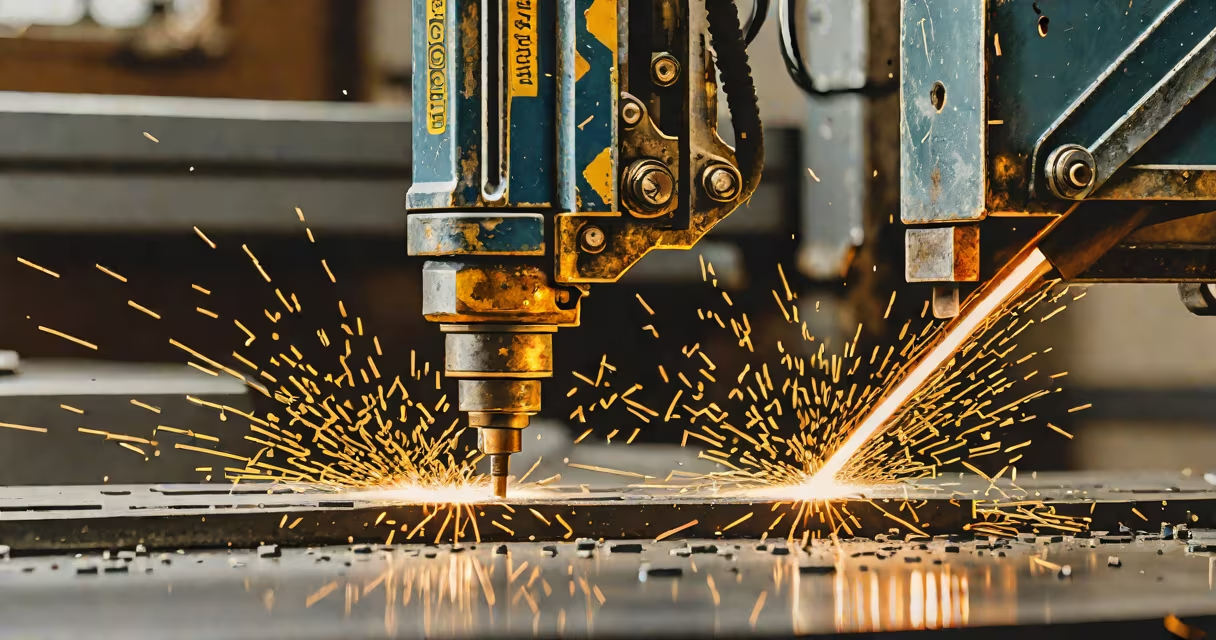
Power tools and specialized equipment designed to slice through steel, aluminum, and other dense metals include circular saws with metal-cutting blades, reciprocating saws, angle grinders, plasma cutters, and band saws. These tools apply focused force, heat, or abrasive action to overcome the material's tensile strength.
Metals resist deformation due to high atomic bonding energy. Cutting requires overcoming shear strength-typically 300-2,000 MPa depending on alloy. Standard woodworking tools fail because they lack edge retention and heat resistance. Only tools engineered for extreme friction and thermal load can succeed.
Each tool uses a distinct physical principle. Circular saws rely on high-speed rotating blades with carbide-tipped teeth. They shear metal by repeatedly biting into the surface at 3,000-6,000 RPM. The blade's tooth geometry must match the metal's hardness-fine teeth for soft aluminum, coarse teeth for hardened steel.
Angle grinders use abrasive discs spinning at 10,000+ RPM. The disc's grit (e.g., aluminum oxide or silicon carbide) wears away metal particles through micro-fracture. This process generates intense heat-up to 1,200°C-and requires cooling via water or intermittent cutting to prevent warping.
Plasma cutters use ionized gas heated to 20,000°C. A high-frequency spark initiates the arc, which melts a narrow channel through the metal. Compressed air or nitrogen forces molten material out of the kerf. This method cuts through steel up to 100 mm thick with minimal thermal distortion.
The following table outlines common tools, their maximum thickness capacity, typical materials, and ideal use cases.
| Tool Type | Max Thickness | Common Materials | Use Case |
|---|---|---|---|
| Circular saw with metal blade | 12 mm | Aluminum, mild steel | Sheet metal fabrication, roofing |
| Angle grinder with cutoff wheel | 50 mm | Steel, stainless steel | Emergency cutting, pipe removal |
| Band saw with bi-metal blade | 150 mm | Steel, titanium, brass | Complex shapes, structural beams |
| Plasma cutter | 100 mm | Carbon steel, aluminum, stainless | Industrial fabrication, automotive repair |
For precision work, CNC-controlled plasma systems achieve tolerances within ±0.5 mm. Manual plasma cutters require steady hand control and proper grounding. Even slight movement causes dross buildup-residual molten slag that adheres to the cut edge.
Many assume all circular saws can cut metal. That's false. A standard wood-cutting blade shatters on contact with steel. Only blades labeled "for ferrous metals" or "carbide-tipped" withstand the stress. Using the wrong blade risks kickback, blade fracture, and injury.
Another error is using angle grinders on thin sheet metal without clamping. The vibration causes warping and uneven cuts. According to OSHA standards, operators must secure workpieces to prevent rotation during cutting.
A lesser-known fact: plasma cutters cannot cut non-conductive materials like plastic or rubber. The arc requires electrical conductivity. Attempting to cut such materials results in unstable arcs and electrode damage. Always verify material conductivity before selecting a tool.
I once replaced a broken hinge on a 3-meter-wide steel gate. The existing bolt was rusted solid. I needed to cut through 6 mm thick mild steel without damaging the frame.
I chose a 115 mm angle grinder with a 1.6 mm thick cutoff wheel. I secured the gate with clamps and wore a face shield. After marking the cut line, I applied light pressure and let the wheel do the work. The cut took 90 seconds and left a clean edge. I then drilled out the remaining bolt fragments.
Using a plasma cutter would have been faster but required setup time and a compressed air supply. For this small job, the angle grinder offered better portability and lower cost.
For thin materials (<6 mm), angle grinders provide speed and accessibility. For thicker sections (>10 mm), band saws offer cleaner, more controlled cuts. Plasma cutters excel in production environments where speed and consistency matter.
Always match the tool to the task. A circular saw with a 100-tooth blade cuts aluminum sheets efficiently but struggles with 10 mm steel. The blade overheats and dulls quickly. Switching to a carbide-tipped blade extends lifespan by 300% compared to standard high-speed steel blades.
For complex curves or tight bends, a reciprocating saw with a metal-cutting blade offers flexibility. However, it produces rougher edges and higher vibration. Use it only when access is limited and precision isn't critical.
Understanding the difference prevents misapplication. A welder might need a plasma cutter to modify a component, but the actual design work happens in PLM software. Both are essential in manufacturing-but serve different stages.
When choosing tools, prioritize safety certifications. Look for ISO 13849-compliant guards, EMI shielding, and IP54-rated enclosures. These features reduce risk of electric shock and fire during operation.
For professionals, investing in a dual-voltage plasma cutter allows use on both 110V and 220V circuits. This flexibility matters in field repairs where power sources vary.