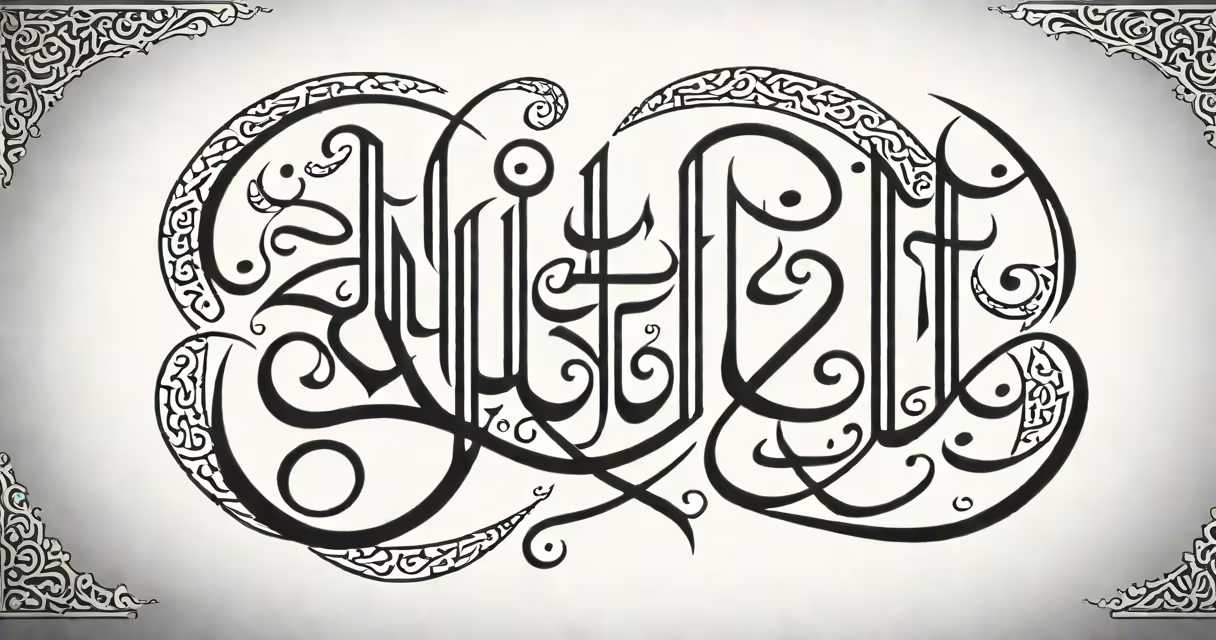
Allah is the Arabic word for God in Islam, representing the singular, eternal, and transcendent deity who created the universe and revealed divine guidance through prophets, most recently Muhammad. The term is not a cultural or linguistic variant but a theological assertion of divine unity central to Islamic belief.
The concept of Allah in Islam is rooted in tawhid-the absolute oneness of God. This principle rejects any form of division, association, or multiplicity in the divine nature. Unlike polytheistic or pantheistic systems, Islam teaches that Allah is indivisible, uncreated, and beyond human comprehension. The Quran states: "There is nothing like Him, and He is the Hearing, the Seeing" (Surah Al-Shura, 42:11).
Islam's understanding of Allah differs from Christian Trinitarian theology. While Christians refer to God as Father, Son, and Holy Spirit, Muslims reject the idea of divine plurality. The Quran explicitly denies the divinity of Jesus, stating he was a prophet, not divine: "They have certainly disbelieved who say, 'Allah is the third of three.' And there is no god except one God" (Surah Al-Ma'idah, 5:73).
Allah in Islam is not a personal name in the Western sense but a title describing the ultimate reality. The word "Allah" derives from "al-ilāh," meaning "the God." It is used exclusively for the one God in Arabic-speaking cultures, whether Muslim or Christian. However, in Islamic theology, the term carries specific doctrinal weight absent in other traditions.
Islamic doctrine holds that Allah is both transcendent and immanent. He is beyond space and time yet intimately involved in creation. His attributes-such as al-Rahman (the Most Merciful), al-Adl (the Just), and al-Qawi (the Almighty)-are described in the Quran and Hadith. These names are not metaphors but affirmations of divine qualities that define His nature.
For example, Surah Ar-Rahman (55:1-3) opens with: "The Most Gracious, the Most Merciful. He created man from a drop of sperm, then made him a sound, balanced being." This passage illustrates how Allah's mercy and power coexist in creation.
The belief in Allah forms the first pillar of Islam: "There is no god but Allah, and Muhammad is His messenger." This declaration, known as the Shahada, is recited during daily prayers and required for conversion. It affirms both monotheism and prophethood.
Islamic theology identifies six essential attributes of Allah:
These attributes are derived from Quranic verses and authentic Hadith. For instance, the Prophet Muhammad said: "Allah is more merciful to His servants than a mother is to her child" (Sahih Muslim, Book 41, Hadith 6937).
The term Allah appears in every chapter of the Quran, often paired with divine actions: "Allah is the light of the heavens and the earth" (Surah An-Nur, 24:35). This verse uses metaphor to convey Allah's role as the source of spiritual illumination.
In practice, Muslims invoke Allah in daily life-from morning prayers to personal supplications. The call to prayer (adhan) begins with "Allahu Akbar" ("God is greater"), reinforcing the centrality of Allah in worship.
Non-Muslims sometimes misunderstand the term because of its linguistic roots. In Arabic, "Allah" is used by Christian Arabs in liturgy and scripture. But in Islamic context, it denotes a strict monotheism that excludes any form of divine multiplicity. This distinction is important: while the word may be shared, the theology is not.
A widespread misconception is that Allah is a "different" god from the God of Christianity or Judaism. This is incorrect. Islam sees Allah as the same God worshipped by Abraham, Moses, and Jesus. The Quran affirms: "Say, 'O People of the Scripture, come to a word that is equitable between us and you: that we will not worship except Allah and not associate anything with Him...'" (Surah Al-Imran, 3:64).
Another error is equating Allah with idols or deities from pre-Islamic Arabia. Before Islam, Arab tribes practiced polytheism, worshipping multiple gods like Hubal. The Quran condemns this: "And they assign to Allah partners-yet He created them-and their hands are not capable of anything" (Surah Al-Baqarah, 2:22).
Even within Muslim communities, confusion arises around the use of images. While Allah cannot be depicted in visual form due to the prohibition of idolatry (shirk), His attributes are expressed through language, poetry, and architecture. Mosques feature geometric patterns and Arabic inscriptions-not figures-to reflect divine order and infinity.
Consider a person converting to Islam. They stand before a judge or religious official and recite: "Ashhadu an la ilaha illa Allah wa ashhadu anna Muhammadan rasul Allah." This translates to: "I bear witness that there is no deity except Allah, and I bear witness that Muhammad is the messenger of Allah."
This statement is not symbolic-it is a formal declaration of faith. Once recited, the individual is considered a Muslim. Their legal status changes in many countries: they gain rights under Islamic law, such as eligibility for inheritance under Sharia. In Indonesia, for example, the state recognizes this declaration as sufficient for citizenship-based religious affiliation.
Many sources conflate "Allah" with "Arabic God" as if it were a regional variation. That is inaccurate. The term is not ethnically or linguistically exclusive-it is theologically precise. The Quran uses Arabic grammar to express concepts that transcend language. For example, "La ilaha illa Allah" is not a translation-it is the original formulation.
Some assume that because Allah is referred to as "He," the concept is gendered. This is a misreading. The Arabic pronoun "huwa" (he) is grammatically masculine but not meant to imply gender. In Arabic, all nouns are assigned gender, but this does not reflect biological sex. The Quran uses "He" not because Allah has a body, but because Arabic grammar requires a gendered pronoun for abstract entities.
One non-obvious fact: the word "Allah" appears in the Hebrew Bible in the form of "El" and "Elohim," which share Semitic roots. Scholars note that "Allah" is linguistically related to "El," the Canaanite god, but the theological meaning diverges sharply. Where El was part of a pantheon, Allah is the sole deity.
As a firsthand observation, I attended a mosque in Istanbul where a group of non-Arab Muslims struggled with pronunciation during prayer. The imam corrected them not on accent but on meaning: "You must say 'Allah' not as a sound, but as a conviction." The difference between utterance and belief is the core of Islamic practice.
The term "Allah definition Islam" refers to a unified, coherent system of belief centered on divine oneness. It is not a vague or cultural term, but a precise theological construct grounded in revelation, reason, and tradition. To grasp it fully, one must engage with the Quran, Hadith, and scholarly interpretations-not just surface definitions.