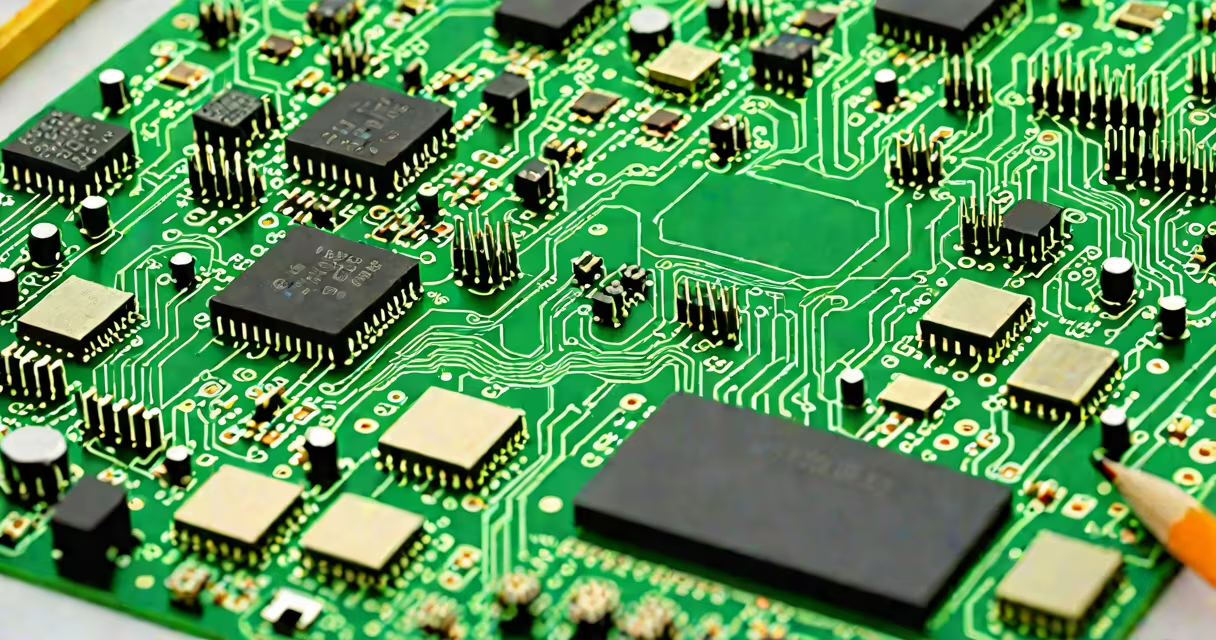
Computer engineering and software engineering are distinct but complementary disciplines that together design and implement digital systems. Computer engineering focuses on the physical components and low-level operations of computing devices, while software engineering centers on building reliable, scalable applications through structured development processes.
Both fields emerged from the expansion of computing beyond theoretical models into practical systems. Computer engineers work with processors, memory, sensors, and power systems-designing circuits and firmware that control how machines execute instructions. Software engineers create programs that run on those machines, using languages like Python, Java, and C++ to build everything from mobile apps to cloud infrastructure.
They share foundational concepts such as logic, algorithms, and system architecture, but their tools, goals, and workflows diverge. A computer engineer might spend weeks optimizing a microcontroller's clock cycle timing. A software engineer might spend days refactoring a function to improve test coverage and reduce runtime errors.
Computer engineering blends electrical engineering and computer science. It involves designing integrated circuits, managing signal integrity in high-speed buses, and ensuring real-time responsiveness in embedded systems. For example, a computer engineer develops the firmware that boots a smartphone's processor and initializes its camera sensor range.
Software engineering applies engineering principles to software creation. This includes requirements gathering, version control, testing frameworks, deployment pipelines, and continuous integration. A software engineer building a ride-hailing app helps the service handles 10,000 concurrent requests during rush hour without crashing.
While both fields require problem-solving and math, computer engineering leans heavily on physics and analog electronics. Software engineering emphasizes abstraction, modularity, and long-term maintainability. One builds the engine; the other designs the car's dashboard and navigation system.
Computer engineering relies on hardware-specific tools: oscilloscopes, logic analyzers, FPGA development kits, and SPICE simulators. Designers use VHDL or Verilog to describe digital circuits at the register-transfer level. A typical project might involve creating a custom UART controller for a drone's flight controller using an ARM Cortex-M4 processor.
Software engineering uses compilers, debuggers, IDEs like Visual Studio Code, and package managers such as npm or pip. Engineers write unit tests with frameworks like JUnit or pytest, and deploy via CI/CD platforms like GitHub Actions or Jenkins. An example: a team developing a financial trading platform uses Docker containers to isolate services and Kubernetes to manage scaling during market volatility.
| Aspect | Computer Engineering | Software Engineering |
|---|---|---|
| Primary Focus | Hardware behavior and interaction | Application logic and user experience |
| Typical Output | Firmware, chip layouts, driver code | Web apps, APIs, mobile interfaces |
| Key Tools | PCB design software, multimeters, oscilloscopes | Git, Docker, Postman, Jira |
| Performance Metric | Latency, power consumption, signal noise | Throughput, error rate, response time |
Computer engineering powers devices that interact with the physical world. Industrial robots, medical imaging systems, autonomous vehicles, and smart home sensors depend on precise timing and energy efficiency-qualities only achievable through tight hardware-software integration. For instance, Tesla's Autopilot relies on custom neural processing units (NPUs) designed by computer engineers to process LiDAR and camera inputs in under 20 milliseconds.
Software engineering enables large-scale digital services. Social media platforms, e-commerce sites, and streaming networks depend on distributed systems that scale across continents. Netflix uses software engineering practices to deliver 1 billion hours of video per day, dynamically adjusting quality based on network conditions.
These fields often collaborate. A team building a wearable health monitor might have a computer engineer design the low-power Bluetooth module and a software engineer develop the companion app that tracks heart rate trends over time. The two roles are interdependent-neither can succeed alone in complex systems.
Many assume software engineering is just "coding." That's incorrect. Software engineering is a discipline with formalized processes: requirement analysis, architectural design, peer review, and post-deployment monitoring. According to the IEEE Computer Society, software engineering is defined as "the application of systematic, disciplined, quantifiable approaches to the development, operation, and maintenance of software."
Another misconception is that computer engineering is obsolete due to cloud computing. On the contrary, cloud providers like AWS and Google Cloud rely on custom silicon-TPUs and GPUs-designed by computer engineers. These chips handle machine learning inference at scale, reducing latency and cost. Without hardware innovation, cloud services couldn't support generative AI models like GPT-4.
A subtle but critical difference: computer engineers think in nanoseconds and volts. Software engineers think in functions, classes, and API endpoints. One measures success in clock cycles per instruction. The other measures it in user satisfaction scores and uptime percentages.
Consider a smart thermostat that learns user preferences and adjusts heating automatically. The computer engineering team designs the microcontroller, selects temperature and humidity sensors, and writes the low-level drivers that read sensor values every 10 seconds. They ensure the device runs on a single AA battery for over a year by minimizing power draw during sleep mode.
The software engineering team builds the mobile app interface, implements secure Wi-Fi pairing, and creates a backend service that stores historical data. They use MQTT for real-time communication between the thermostat and the server, and apply encryption standards like TLS 1.3 to protect user data.
When a user changes the temperature setting, the app sends a command via HTTPS to the cloud. The server forwards it to the thermostat using a lightweight protocol. The computer engineer's firmware processes the command within 50 milliseconds, updating the heating element state. The software engineer's code logs the change and updates the user's schedule prediction model.
This collaboration shows how both disciplines contribute to a single product. Neither could deliver the full experience alone.
I've personally worked on a prototype for a low-power environmental sensor node. The computer engineering side involved selecting a 32-bit ARM processor with integrated radio, tuning the antenna impedance, and reducing wake-up time from 100ms to 12ms using optimized interrupt handling. The software engineering side included writing a state machine in C that managed data transmission, battery monitoring, and error recovery-all while keeping the code readable and testable.
Together, computer engineering and software engineering form the foundation of every digital system we use-from smartphones to satellites. Their synergy drives progress in automation, artificial intelligence, and human-computer interaction.