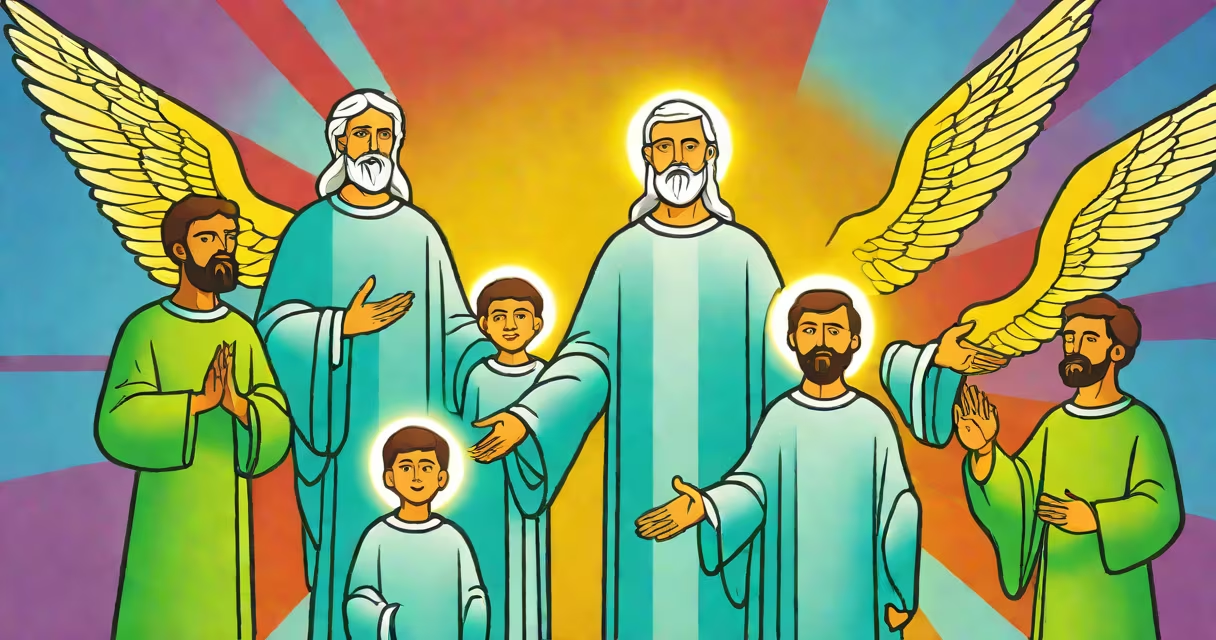
The Father, Son, and Holy Spirit are the three distinct persons in the Christian doctrine of the Trinity-three co-eternal, consubstantial persons in one divine essence. This concept defines God as both unified and relational, revealed through Scripture and affirmed by early church councils.
Christian theology holds that God exists as three persons: the Father, who is the source of all creation; the Son, Jesus Christ, who became incarnate to redeem humanity; and the Holy Spirit, who empowers believers and sustains the Church. These are not three gods, nor three parts of one being, but three distinct expressions of the same divine nature.
Scripture presents this reality through statements like Matthew 28:19: "Go therefore and make disciples of all nations, baptizing them in the name of the Father and of the Son and of the Holy Spirit." This verse is foundational for Trinitarian baptismal practice across Christian denominations.
The Trinity operates as a unity of will and purpose despite the distinction of persons. The Father sends the Son; the Son obeys and completes redemption; the Holy Spirit proceeds from the Father and the Son (in Western Christianity) and applies salvation to believers.
Each person performs unique functions while remaining fully God. The Father initiates salvation. The Son accomplishes it through death and resurrection. The Holy Spirit reveals it, convicts of sin, and sanctifies believers. These roles are not hierarchical in rank but sequential in mission.
For example, during Jesus' baptism in the Gospels, all three persons appear simultaneously: the Father speaks from heaven ("This is my beloved Son"), the Son is immersed in the Jordan River, and the Holy Spirit descends like a dove (Matthew 3:16-17). This moment illustrates the Trinity's simultaneous presence and interrelation.
The doctrine of the Trinity developed over centuries through scriptural interpretation and ecumenical councils. The Council of Nicaea (325 AD) affirmed that the Son is "begotten, not made, of the same substance as the Father." The Council of Constantinople (381 AD) added that the Holy Spirit is "the Lord, the giver of life, who proceeds from the Father."
These creeds established that each person is fully divine, not a lesser manifestation. The term "hypostasis" (Greek for "person") was used to describe the individuality within the one God. The term "ousia" (essence or nature) described their shared divinity.
A common misunderstanding is that the Trinity implies three gods. But Christian orthodoxy insists on monotheism: there is one God in three persons. As theologian Thomas Aquinas wrote in the *Summa Theologica*, "The Trinity is not three gods, but one God in three persons."
Some confuse the Trinity with modalism-the idea that God appears in different modes rather than existing as three persons. Modalism denies eternal distinctions between Father, Son, and Spirit. It was rejected at the Council of Nicaea because it undermines the biblical witness to Jesus' preexistence and the Spirit's personal agency.
Another error is viewing the Holy Spirit as an impersonal force. But Scripture describes the Spirit as having intellect (Romans 8:27), emotions (Ephesians 4:30), and will (1 Corinthians 12:11). The Spirit speaks (Acts 13:2), teaches (John 14:26), and guides (Galatians 5:18).
Even within Christian traditions, interpretations vary. Eastern Orthodox theology emphasizes the Holy Spirit's procession from the Father alone, while Roman Catholic doctrine includes the "filioque" clause stating the Spirit proceeds from both Father and Son. This difference contributed to the Great Schism of 1054.
The Trinity shapes Christian worship, sacraments, and ethics. Baptism is performed in the name of the Father, Son, and Holy Spirit. Liturgical prayers often address all three persons. The Nicene Creed, recited in churches worldwide, affirms belief in "one God, Father Almighty, maker of heaven and earth... and in one Lord Jesus Christ... and in the Holy Spirit."
Churches use Trinitarian language to express God's relational nature. For example, the hymn "Holy, Holy, Holy" draws from Isaiah 6:3 and Revelation 4:8, echoing the heavenly throne where seraphim cry "Holy, holy, holy is the Lord of hosts." This liturgical tradition underscores the divine holiness shared by all three persons.
Understanding the Trinity informs how Christians relate to God. Believers pray to the Father through the Son in the power of the Spirit. Paul writes in Romans 8:15-16: "For you did not receive the spirit of slavery to fall back into fear, but you have received the Spirit of adoption as sons, by whom we cry, 'Abba! Father!'"
While the Trinity is one doctrine, different Christian traditions emphasize aspects of it:
| Tradition | Emphasis | Key Difference |
|---|---|---|
| Eastern Orthodox | Father as source; Spirit proceeds from Father alone | Rejects filioque; sees Trinity as changing communion |
| Roman Catholic | Trinity as mystery; filioque included | Teaches the Spirit proceeds from Father and Son |
| Protestant (Reformed) | Scriptural authority; functional roles | Focuses on God's revelation in Christ and Spirit's work in believers |
| Oneness Pentecostal | Unitarian view; God manifests as Father, Son, Spirit | Denies eternal Trinity; sees Jesus as God in flesh |
Oneness Pentecostalism, though small, challenges mainstream Trinitarianism. They cite passages like John 14:9 ("Whoever has seen me has seen the Father") to argue that Jesus is the fullness of God. However, this view lacks support from early church fathers and ecumenical consensus.
In a typical Protestant church service, a child is baptized. The pastor says: "I baptize you in the name of the Father, and of the Son, and of the Holy Spirit." The congregation hears this phrase not as a ritual formula but as a declaration of faith in the triune God.
Before immersion, the pastor may explain: "The Father created you. The Son died for you. The Holy Spirit now lives in you." This connects the doctrine to personal identity and spiritual transformation.
Afterward, the family receives a certificate with the child's name, date, and the Trinitarian formula. This document becomes a record of entry into the community of faith, rooted in the belief that God is three persons in one essence.
I attended a baptism in a small rural church where the pastor paused before speaking the Trinitarian formula. He looked at the parents and said, "This is not just words. This is who God is-Father, Son, and Spirit. You're not just naming a baby. You're inviting them into a relationship with the living God." That moment made the abstract doctrine feel immediate and personal.
Despite the centrality of the Trinity in Christian belief, the word "Trinity" does not appear in the Bible. The concept is derived from cumulative scriptural evidence, not a single verse. Early Christians used terms like "God the Father," "Lord Jesus Christ," and "Holy Spirit" in parallel ways, leading to the theological formulation over time.
As scholar N.T. Wright notes in *The New Proof and the People of God*, "The early church didn't invent the Trinity-it discovered it in the way the Bible spoke about God."
The Father, Son, and Holy Spirit form the core of Christian belief in God's nature. This doctrine is not speculative philosophy but a response to Scripture, shaped by centuries of reflection and worship. Understanding it requires engaging with both biblical texts and historical theology.