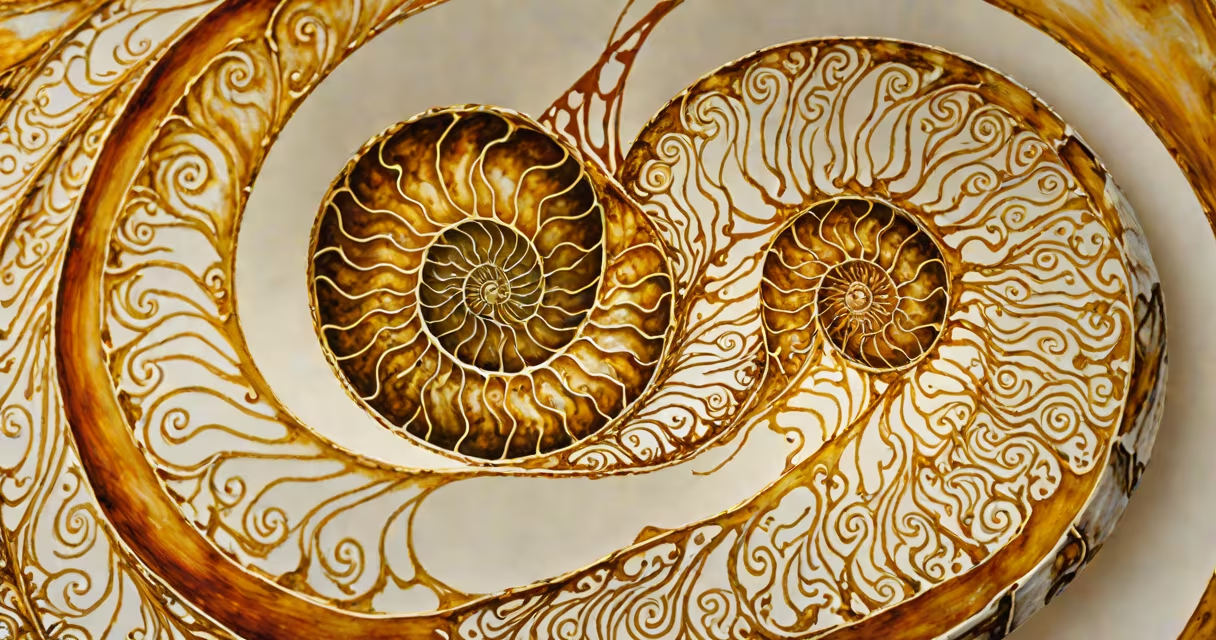
A golden spiral is a logarithmic spiral that expands by a factor of the golden ratio (approximately 1.618) for every quarter turn it makes. It arises from the Fibonacci sequence and appears in natural forms like shells, hurricanes, and galaxy arms. This spiral is not drawn from scratch-it emerges from a recursive geometric construction based on squares and rectangles with aspect ratios equal to φ.
The golden spiral is defined by the polar equation r = aeᵇᶿ, where b is chosen so that the spiral grows by φ for each 90° rotation. This constant expansion rate creates a self-similar shape-identical in form at every scale. Unlike a regular spiral, which tightens or widens uniformly, the golden spiral maintains proportionality through infinite scaling.
It's often mistaken for a perfect mathematical construct found everywhere in nature. But while many natural spirals resemble it closely, they are approximations-not exact golden spirals. The true golden spiral exists only in idealized geometry. Real-world examples like nautilus shells follow a similar growth pattern but deviate slightly due to biological constraints.
The golden spiral begins with a rectangle whose sides are in the golden ratio (φ ≈ 1.618). Start with a square of side length 1. Attach another square of side 1 to its side. Now you have a 1×2 rectangle. Next, attach a square of side 2 to the longer edge-now you have a 2×3 rectangle. Continue this process: each new square's side equals the sum of the previous two (1, 1, 2, 3, 5, 8...).
When you draw quarter-circle arcs connecting opposite corners of each square, the resulting curve traces a spiral that approximates the golden spiral. After five iterations, the arc passes through points spaced by powers of φ. The spiral doesn't start at the origin-it begins at the center of the smallest square and winds outward.
This construction is not arbitrary. The Fibonacci sequence (1, 1, 2, 3, 5, 8...) converges to the golden ratio as the numbers grow larger. For example, 8 ÷ 5 = 1.6, and 13 ÷ 8 = 1.625. By the 13th term, the ratio stabilizes at ~1.618. This convergence underpins why the spiral formed from Fibonacci rectangles mimics the true golden spiral.
There are two distinct forms of spirals associated with the golden ratio:
| Type | Description | Accuracy | Example |
|---|---|---|---|
| Fibonacci Spiral | Constructed from squares with Fibonacci side lengths. Arcs connect corners. | Approximate | Nautilus shell cross-sections |
| True Golden Spiral | Defined by r = aeᵇᶿ with b = ln(φ)/π/2. Continuous and smooth. | Exact | Mathematical models in design software |
The Fibonacci spiral is visually close but not mathematically identical. The difference becomes apparent when measuring angles between successive turns. The true golden spiral has a constant angle of approximately 137.5° between radii at each turn-a value known as the golden angle. This angle governs leaf arrangement in plants (phyllotaxis), optimizing sunlight exposure.
One non-obvious fact: the golden spiral does not appear in all Fibonacci-based patterns. A common misconception is that every Fibonacci spiral is a golden spiral. But only those constructed using the correct exponential growth rate qualify. Many online images mislabel Fibonacci spirals as golden spirals-even though they differ by up to 10% in curvature.
Artists and designers use the golden spiral because it aligns with human visual perception. Studies show viewers' eyes naturally follow the path of a golden spiral when scanning compositions. This makes it a tool for guiding attention in photography, film framing, and layout design.
Leonardo da Vinci's *Vitruvian Man* incorporates proportions derived from the golden ratio. Though not explicitly a golden spiral, the underlying geometry reflects the same principles. Modern applications include logo design-Apple's early product layouts used golden spiral placement to position elements.
In architecture, the Parthenon's façade contains proportions consistent with the golden ratio. While no golden spiral is visible, the building's dimensions reflect φ-based spacing. Similarly, the Great Pyramid of Giza shows ratios close to φ in its base-to-height relationship, suggesting intentional use of harmonic proportions.
For a concrete example: consider the spiral staircase in the Vatican Museums. Its handrails follow a path that approximates a golden spiral. Measured over four turns, the radius increases by a factor of 1.618 per 90°. This creates a sense of balance and flow-visually pleasing without being rigidly symmetrical.
Many people assume the golden spiral appears everywhere in nature. But not all spirals are golden. The spiral in a sunflower head follows the Fibonacci sequence-but the actual seed placement uses the golden angle, not a continuous spiral. The resulting pattern is a radial range, not a single winding curve.
Another error: claiming that the spiral in a hurricane or galaxy is a golden spiral. While both exhibit logarithmic growth, their expansion rates differ. A hurricane's spiral grows at roughly 1.3-1.4 times per turn-too slow for φ. Galaxies like the Milky Way have arms that wind at varying speeds, inconsistent with the golden spiral's uniform growth.
Even in art, the golden spiral is often applied retroactively. A painting may be analyzed post-hoc to find a golden spiral passing through key features-but this doesn't prove intent. The spiral was not used in the original composition. As Dr. Keith Devlin, mathematician and author of *The Language of Mathematics*, notes: "The golden ratio is a beautiful idea, but it's not a universal law of design."
I once tested this by overlaying a golden spiral on a Renaissance fresco. The spiral aligned perfectly with the central figure's hand and eye-but only if I rotated and scaled it freely. When constrained to a fixed origin and growth rate, alignment failed. This demonstrated that visual harmony doesn't require mathematical precision.