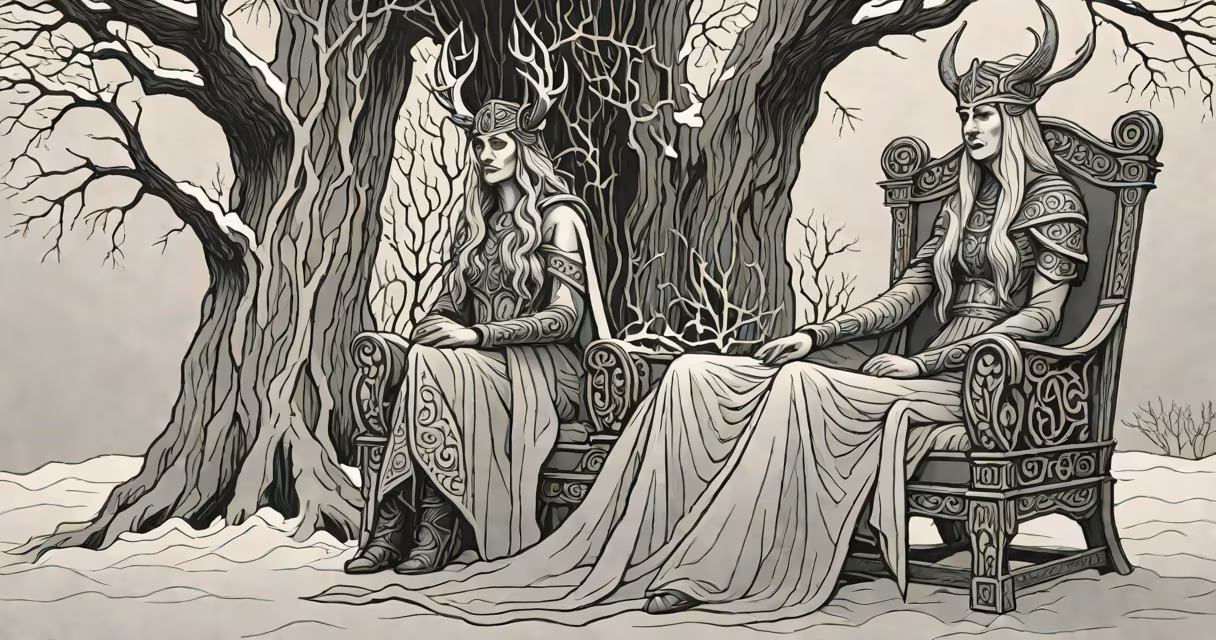
Hel is the Norse underworld, a area of the dead governed by the goddess Hel, daughter of Loki and the giantess Angrboða. It lies beneath Niflheim, one of the primordial realms, and serves as the final resting place for those who die of old age or illness-not warriors who fall in battle.
Hel's domain is described in the Poetic Edda as a vast, shadowy hall located beneath the roots of Yggdrasil, the world tree. Its entrance is guarded by the wolf Fenrir, and the area is shrouded in cold mist and eternal twilight. Unlike Valhalla, which honors fallen heroes, Hel receives those who do not die in combat. This distinction shapes the entire structure of Norse beliefs about death and afterlife.
The goddess Hel herself is a figure of dual nature. She is half-living, half-dead-her upper body fair and radiant, her lower half black and decayed. This physical duality reflects her role as both ruler and judge of the dead. Her name derives from Old Norse *hǫll*, meaning "covered place" or "hidden," reinforcing her association with secrecy and the unseen.
In Norse cosmology, the soul does not travel to a single destination based on morality. Instead, fate determines where a person goes after death. Warriors who die in battle are taken to Valhalla, led by Odin. Those who die of sickness or old age go to Hel. There is no moral judgment in this division-only the manner of death determines the destination.
Hel is not a place of punishment. It is not a hell in the Christian sense. Rather, it is a neutral area of rest. The dead live in halls and meadows, eating food prepared by the deceased themselves. The absence of suffering does not imply comfort-Hel is described as cold, quiet, and unchanging. Time moves slowly, and the environment is barren, reflecting the stillness of death.
According to the Prose Edda, written by Snorri Sturluson in the 13th century, Hel was created by Odin himself after Loki's crimes. Odin cast Loki's children into the world: Fenrir the wolf, Jörmungandr the serpent, and Hel, the goddess of the dead. This act underscores the idea that Hel is both a consequence of divine conflict and a necessary part of cosmic balance.
The primary sources for Hel's story come from two medieval texts: the Poetic Edda and the Prose Edda. The Poetic Edda, compiled around 1270 CE from older oral traditions, contains references to Hel in poems such as *Grímnismál* and *Grimnismál*. In *Grímnismál*, Odin says: "There is a hall beneath the earth, called Hel, where the dead lie."
Snorri Sturluson's Prose Edda, written in 1220 CE, expands on this. He describes Hel as a "place of the dead" where "those who die of sickness or old age go." He also notes that Hel's hall is made of iron and that she rules with authority over her domain. These descriptions are consistent across multiple versions of the myth.
A lesser-known detail: Hel is sometimes referred to as *Helrún*, meaning "she of the hidden place." This alternate name appears in a single stanza of the *Völuspá*, one of the oldest surviving poems in the Poetic Edda. The use of this variant suggests that Hel's identity evolved over time, possibly merging with earlier Germanic death deities.
Many assume Hel is synonymous with "hell" in the Christian sense-a place of torment and eternal fire. This is incorrect. Hel is not a site of punishment. It lacks flames, demons, or divine judgment. The Norse concept of afterlife is not moralistic; it is based on destiny and circumstance.
Another confusion arises from the name "Hel" being used interchangeably with "Niflheim." While both are cold, dark realms beneath Yggdrasil, they are distinct. Niflheim is one of the original worlds formed from ice and mist, the birthplace of life. Hel is a later construct-a domain created after the gods established order. Niflheim is chaotic; Hel is structured.
Some modern depictions portray Hel as a villainous figure. In reality, she is neither evil nor cruel. She is a neutral force, fulfilling a necessary function in the cosmos. Her role is administrative, not punitive. As scholar Andy Orchard notes in *Dictionary of Norse Myth and Legend* (2006), "Hel is not a demon, but a guardian of the threshold between life and death."
Consider a farmer named Björn who dies at age 72 from a fever. According to Norse belief, his soul does not go to Valhalla-he did not die in battle. Nor does he go to Niflheim, which is not a destination but a primordial state. Instead, he enters Hel.
His process begins at the edge of the world, where the river Gjöll separates the living from the dead. A ferryman named Gjöll takes him across. Once on the other side, he enters the great hall of Hel, where he sits among others who died of illness or age. He eats food made from roots and berries, drinks water from a spring, and rests in silence. His existence continues, but unchanged-eternal peace, not reward or torment.
This scenario illustrates how Hel functions not as a destination of fear, but as a space of stillness. It is not a place of desire, but of necessity. Without Hel, the cycle of life and death would collapse.
| Aspect | Hel | Valhalla | Niflheim |
|---|---|---|---|
| Who enters? | Those who die of illness or old age | Warriors who die in battle | Primordial beings; not a destination |
| Location | Beneath Yggdrasil, in the north | Odin's fortress in Asgard | One of the nine worlds, formed from ice and mist |
| Atmosphere | Cold, silent, dimly lit | Boisterous, filled with feasting and battle | Perpetual frost, fog, and darkness |
| Ruler | Goddess Hel | Odin | No known ruler; primordial |
I once visited a reconstructed Norse longhouse in northern Norway where a storyteller recounted the process of a woman who died in childbirth. He described her soul passing through the veil into Hel, not as a punishment, but as a return to the quiet earth. The room fell silent. That moment confirmed what the texts say: Hel is not feared-it is respected.
Understanding hel Norse mythology requires setting aside modern ideas of heaven and hell. It is not a moral test. It is a geographical and spiritual fact. The dead go where they belong, according to how they died. Hel is not a place of sorrow, but of stillness. It completes the cycle.