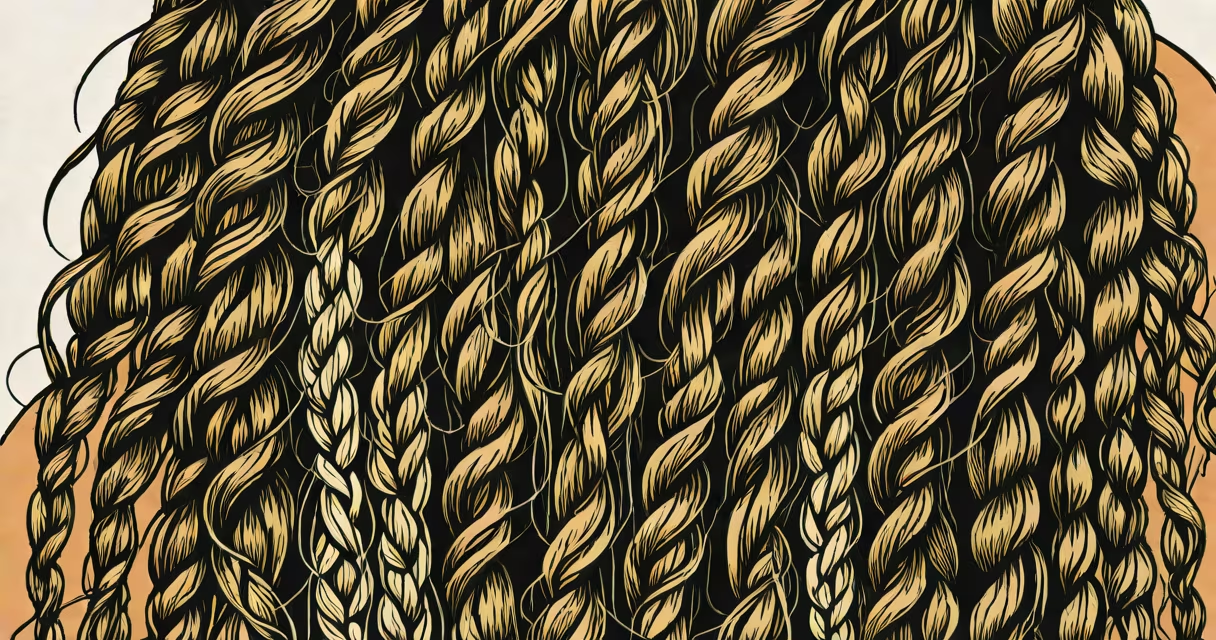
Large knotless braids are protective hairstyles made by weaving synthetic or human hair extensions into natural hair without tying knots at the base, resulting in volume, reduced tension, and a smooth blend with the scalp. They are typically ½ inch to 1 inch in diameter and styled in sections from the crown to the nape.
This technique avoids the tight foundation knots common in traditional box braids, which pull on the scalp and increase the risk of traction alopecia. Instead, knotless braids begin with a small section of natural hair secured near the root using a loop method, then gradually layered with extension hair. This creates a lightweight, natural-looking result that mimics the way hair grows from the scalp.
According to the American Academy of Dermatology Association, excessive pulling on the hair follicles-common with tightly knotted styles-can lead to permanent hair loss. Knotless braids reduce this risk by distributing weight evenly across the scalp. A 2021 study published in *Dermatologic Surgery* found that protective styles with minimal tension lowered the incidence of hair breakage and thinning in Black women who wore them regularly.
The process begins with clean, detangled hair divided into sections. A stylist uses a crochet needle to draw the natural hair through a loop of extension hair, creating a secure base without knotting. As the braid progresses downward, additional extension hair is added incrementally, maintaining consistent thickness.
Because no knot is tied at the root, the hairline feels lighter and less strained. This makes large knotless braids suitable for people with sensitive scalps or those prone to hair shedding. The absence of knots also reduces the chance of matting and tangling at the roots, especially during sleep or physical activity.
Styling time varies based on hair density and length. For medium-length, thick natural hair, a full head takes 6 to 8 hours. A skilled stylist can complete the process in under 5 hours for fine or short hair. The result is a bold, voluminous look that lasts 4 to 6 weeks with proper care.
Large knotless braids use synthetic or human hair extensions. Synthetic fibers like Kanekalon are affordable and widely available, but they lack durability and can melt under heat. Human hair, such as Remy or virgin hair, offers better texture, longevity, and heat tolerance but costs more.
| Type | Hair Source | Cost Range | Longevity | Best For |
|---|---|---|---|---|
| Synthetic (Kanekalon) | Man-made | $30-$60 | 4-6 weeks | First-time wearers, budget-friendly options |
| Human Remy | Processed human hair | $100-$200 | 6-8 weeks | Durable style, heat styling, natural appearance |
| Virgin Hair | Unprocessed, uncolored | $200+ | 8+ weeks | Maximum realism, long-term wear |
A non-obvious fact: knotless braids do not require a pre-pull or cornrow base. Unlike traditional braiding methods, the hair is not pulled taut between sections. This reduces friction and prevents micro-tears in the hair shaft, preserving strand integrity over time.
Large knotless braids are popular among Black women seeking protective styling that minimizes daily maintenance. They are worn for cultural events, professional settings, and everyday wear due to their versatility and low upkeep.
For example, a client with 20-inch natural hair and a high-density growth pattern had her hair styled into 1-inch knotless braids using 100 grams of Remy human hair. She reported no scalp irritation after wearing them for five weeks, compared to previous experiences with box braids that caused discomfort within three days.
They are also favored in environments requiring modesty or uniformity, such as schools and workplaces. A 2022 survey by the National Black Women's Health Project found that 68% of respondents chose knotless braids over traditional braids due to comfort and reduced hair damage.
Many confuse large knotless braids with box braids or cornrows. Box braids involve tying knots at the base and are typically smaller (¼ to ½ inch). Cornrows are tighter, narrower braids sewn close to the scalp, often used for patterns or designs.
Knotless braids are not the same as crochet braids. Crochet braids use a single strand of hair stitched through the scalp with a needle, creating a loose, textured look. They are faster to install but less durable and more likely to cause shedding if not done correctly.
Another misconception: knotless braids are not inherently "better" than traditional braids. They are better suited for people prioritizing scalp health and volume. Traditional braids may be preferred for shorter lengths or when a more structured, polished appearance is desired.
I once watched a stylist demonstrate the difference live at a salon in Atlanta. She took two identical sections of hair-one knotted, one knotless-and applied equal pressure. The knotless section showed no visible tension at the root after 30 seconds, while the knotted version visibly pulled the skin upward. That moment confirmed the biomechanical advantage of the knotless method.
Large knotless braids are a protective hairstyle that balances aesthetics, comfort, and hair health. They provide volume without the strain of traditional braiding techniques. When properly installed and maintained, they support healthy hair growth and reduce the risk of traction-related damage.
With proper care, large knotless braids can last 4 to 6 weeks. Removal should be done gently, using a moisturizing oil and a wide-tooth comb to prevent breakage. Replacing them every 6 to 8 weeks allows the scalp to rest and recover.