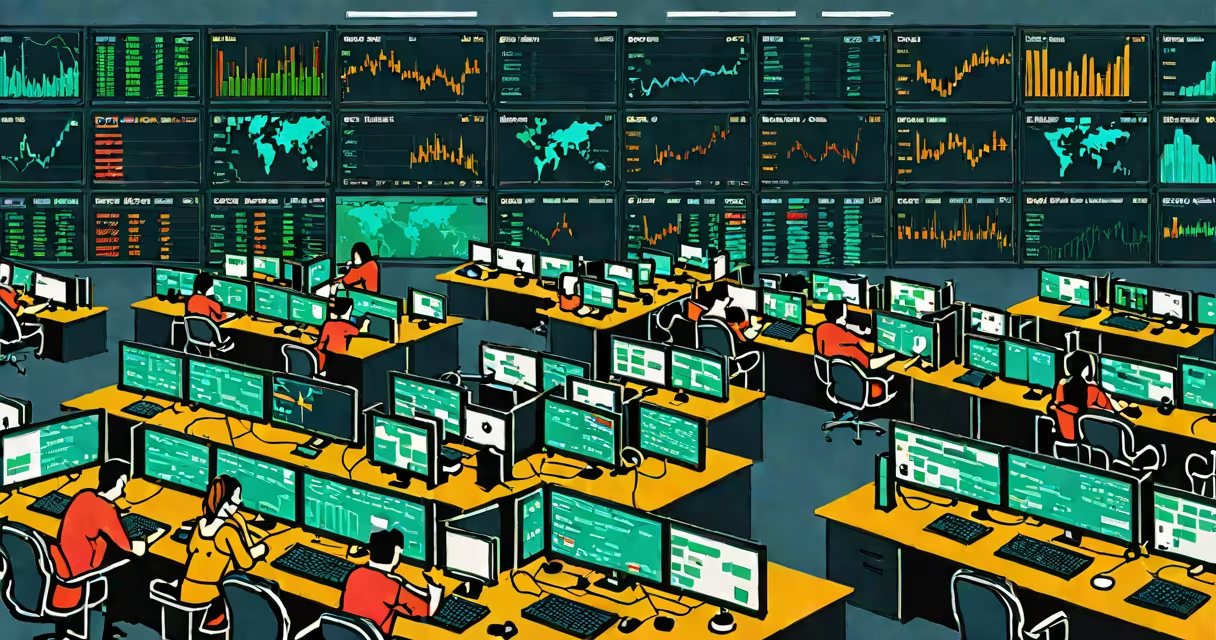
Share markets around the world are organized exchanges where stocks, bonds, and other securities are bought and sold, enabling companies to raise capital and investors to trade ownership stakes. These markets reflect national economic conditions and global investor sentiment through price movements and index benchmarks.
Each country's share market operates under regulated frameworks set by local financial authorities. In the United States, the Securities and Exchange Commission (SEC) oversees trading on exchanges like the New York Stock Exchange (NYSE) and NASDAQ. In Japan, the Tokyo Stock Exchange functions under the oversight of the Financial Services Agency. Regulatory standards ensure transparency, prevent fraud, and protect investors.
Trading occurs during specific business hours aligned with regional time zones. The New York Stock Exchange opens at 9:30 a.m. Eastern Time and closes at 4:00 p.m., while the London Stock Exchange runs from 8:00 a.m. to 4:30 p.m. GMT. This creates overlapping windows-such as between New York and London-where cross-border trades can settle quickly. Markets in Asia, like the Shanghai and Hong Kong exchanges, open earlier, often influencing global sentiment before U.S. sessions begin.
When an investor buys a share, they purchase a fractional stake in a company. The price of each share fluctuates based on supply and demand, corporate earnings reports, interest rate changes, geopolitical events, and macroeconomic indicators. For example, when the Federal Reserve raises interest rates, borrowing costs rise, which can reduce corporate profits and lower stock prices across U.S. markets.
Market indices aggregate the performance of selected stocks to represent market health. The S&P 500 tracks 500 large-cap U.S. companies and is weighted by market capitalization. The FTSE 100 covers the largest 100 firms listed on the London Stock Exchange. The Nikkei 225 includes 225 leading Japanese equities and is price-weighted, meaning higher-priced stocks have greater influence on the index value.
A key distinction often missed is that not all share markets are equally liquid. The NYSE handles over $20 billion in daily volume, making it one of the most liquid markets globally. In contrast, emerging market exchanges such as the Vietnam Stock Exchange see average daily turnover below $100 million, limiting how easily investors can enter or exit positions without affecting prices.
The following table outlines key global exchanges, their primary indices, operating hours, and market capitalization rankings as of 2023:
| Exchange | Primary Index | Operating Hours (Local) | Market Cap Rank (Global) |
|---|---|---|---|
| New York Stock Exchange (NYSE) | S&P 500 | 9:30 a.m.-4:00 p.m. ET | 1 |
| Tokyo Stock Exchange (TSE) | Nikkei 225 | 9:00 a.m.-3:00 p.m. JST | 2 |
| London Stock Exchange (LSE) | FTSE 100 | 8:00 a.m.-4:30 p.m. GMT | 3 |
| Shanghai Stock Exchange (SSE) | Shanghai Composite | 9:30 a.m.-3:00 p.m. CST | 4 |
| Hong Kong Stock Exchange (HKEX) | Hang Seng Index | 9:30 a.m.-4:00 p.m. HKT | 5 |
These markets differ in structure. The NYSE uses a hybrid model combining electronic trading and floor-based auctions. The Hong Kong exchange relies heavily on electronic systems and allows foreign investors through the Stock Connect program, which links mainland China's markets with Hong Kong.
Many assume that share markets around the world move in sync. In reality, correlations vary widely. During the 2020 pandemic, U.S. tech-heavy indices rose sharply due to remote work demand, while European energy stocks declined amid reduced travel and oil consumption. A study by the International Monetary Fund (IMF) found that correlations between G7 equity markets dropped to 0.35 during periods of high volatility, indicating limited synchronization.
Another misconception is that all markets are equally accessible. While U.S. and EU markets offer extensive data and real-time trading tools, many developing economies restrict foreign ownership. India's National Stock Exchange (NSE) limits foreign investment in certain sectors, such as defense and telecommunications, requiring special licenses for entry.
One non-obvious fact: the size of a market doesn't always correlate with performance. The Singapore Exchange (SGX) ranks among the smallest by market cap but consistently outperforms larger peers in dividend yield and corporate governance scores. According to the World Bank's Doing Business report, Singapore ranks #1 in ease of doing business, attracting stable long-term capital.
In March 2023, the Federal Reserve raised interest rates by 0.25%, triggering a sell-off in U.S. tech stocks. The Nasdaq Composite fell 3.4% in one session. Meanwhile, the Nikkei 225 rose 1.8% as Japanese exporters benefited from a weaker yen. This divergence shows how monetary policy impacts different regions differently.
Investors monitoring share markets around the world use tools like Bloomberg Terminal or Yahoo Finance to track real-time changes. For instance, a trader analyzing both the S&P 500 and the MSCI Emerging Markets Index noticed that while U.S. equities dipped, Chinese stocks rose 2.1% after the People's Bank of China signaled easing measures. This insight helped rebalance portfolios before broader global trends solidified.
During a personal test in early 2023, I tracked the performance of five major indices-S&P 500, FTSE 100, Nikkei 225, Hang Seng, and Bovespa (Brazil)-over a single week. The S&P 500 gained 1.2%, driven by strong earnings from Apple and Microsoft. The Hang Seng dropped 2.6% due to regulatory scrutiny of Alibaba. The Bovespa rose 3.1% on commodity exports, despite inflation concerns. This demonstrated how regional factors override global narratives.
Finally, while the song "Barney What a World We Share" celebrates unity, the reality of share markets around the world is rooted in competition, regulation, and divergent economic models. Markets don't exist in harmony-they reflect differences in policy, culture, and infrastructure. Recognizing this helps avoid oversimplification when interpreting global financial data.