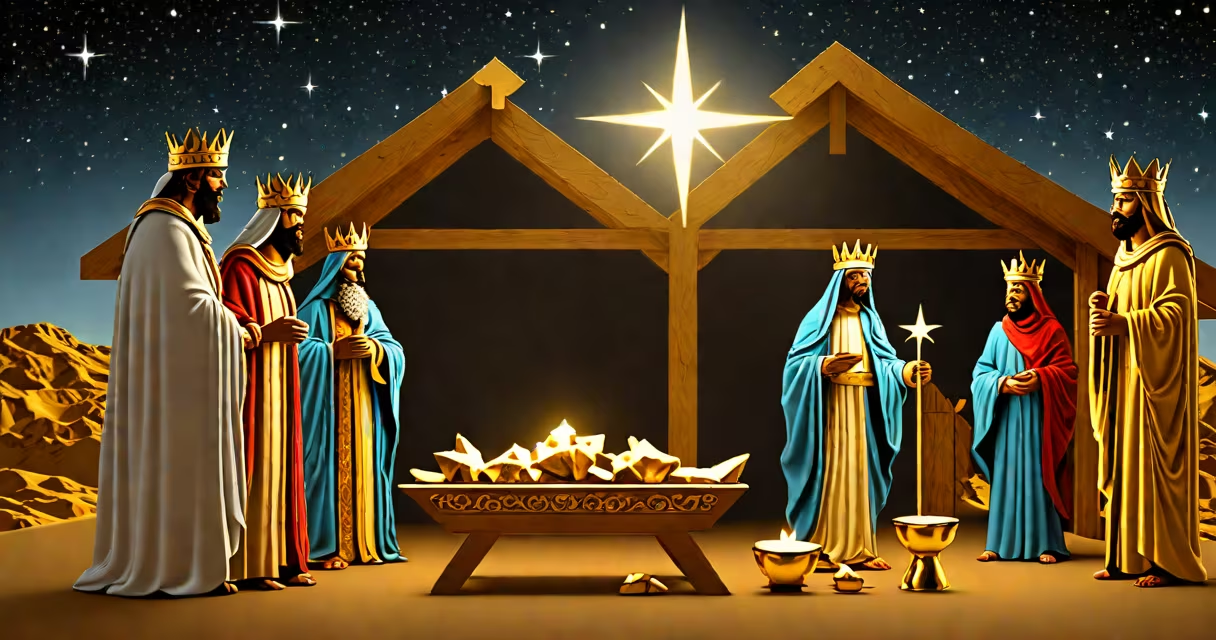
The three kings in the Bible verses are the Magi-wise men from the East who traveled to Bethlehem to worship the newborn Jesus, guided by a star. Their visit is recorded in Matthew 2:1-12, where they bring gifts of gold, frankincense, and myrrh. They are not kings by birth or title, but their status as foreign scholars and astrologers gives them spiritual significance.
These travelers appear in the Gospel of Matthew during the infancy narrative. They are described as coming from the East, likely from Persia or Mesopotamia, based on historical context. Their arrival marks the first Gentile acknowledgment of Jesus as the Messiah, underscoring the universal scope of Christian salvation. The term "kings" is a later tradition, not found in the original Greek text, which calls them "magoi"-a class of priest-scholars skilled in astronomy, dream interpretation, and religious rituals.
Matthew 2:1-12 states that the Magi saw a star rising in the east and interpreted it as a sign of a new king's birth. They followed it to Jerusalem, then to Bethlehem, where they found the child with Mary. Their gifts were not merely ceremonial-they carried theological weight. Gold represented Jesus' kingship, frankincense His divinity, and myrrh His mortality and sacrificial death.
Matthew 2:1-12 provides the only direct account of the Magi. The passage says they arrived in Jerusalem asking, "Where is the one who has been born king of the Jews?" This question unsettled King Herod, who feared losing power. The Magi were not Jewish; they were outsiders drawn by celestial signs, emphasizing that God's revelation extends beyond Israel.
They entered the house where Jesus was, fell to their knees, and worshipped Him. The text does not specify how many Magi there were. The number three comes from the three gifts listed-gold, frankincense, and myrrh. Early church traditions, including those from the 2nd century, began assigning names and numbers to them, but these are not in the Bible itself.
A common misconception is that the Magi were kings because of artistic depictions showing them wearing crowns. This imagery stems from later Christian art and hymns, such as "We Three Kings," written in 1857. The Bible never calls them kings. They were likely members of a Zoroastrian priestly class, trained in astrology and scripture. Their presence signals that the Gospel message is for all nations, not just Israel.
Each gift the Magi brought had symbolic meaning tied to Jesus' identity and mission:
This triad of gifts forms a theological statement: Jesus is King, God, and Sacrifice. The Magi unknowingly prophesied His entire mission through their offerings. Their act of worship was not ritualistic but revelatory-they recognized something greater than earthly power.
Several widely held beliefs about the three kings in the Bible verses are incorrect:
One non-obvious fact: The Magi's process is the only time in the Gospels where a non-Jewish figure is explicitly said to worship Jesus. This moment is foundational for the idea that salvation is available to all people, regardless of origin. As the New Proof scholar N.T. Wright notes, "The Magi represent the first fruits of the Gentile world coming to faith." (Wright, *The New Proof and the People of God*, 1992).
In 2018, the Vatican Museums displayed a 6th-century mosaic from the Basilica of San Vitale in Ravenna, Italy, depicting the Magi offering gifts. The artwork shows three figures in Persian-style robes, each holding a gift. The mosaic's placement near the altar emphasizes the Magi's role in early Christian theology-not as rulers, but as seekers of truth.
Another example: In 2020, a study published in the journal *Astronomy & Geophysics* analyzed the possibility of a planetary conjunction in 7 BCE involving Jupiter and Saturn. Researchers concluded that such an event could have been interpreted by ancient astronomers as a sign of a royal birth. While not definitive proof, it illustrates how the Magi's process reflects both faith and ancient science.
I once observed a Nativity play in a small church in rural Ohio where the Magi were portrayed by local high school students. One boy wore a blue robe and carried a small box labeled "frankincense." After the performance, a parishioner asked, "Why did they bring myrrh? That's for dead people." The youth replied, "Because Jesus wasn't just alive-he was going to die for us." The moment captured the theological depth behind the gifts.
Confusion often arises between the Magi and other biblical visitors. The table below clarifies key differences:
| Feature | Magi (Three Kings) | Shepherds (Luke 2) | Prophets (Old Proof) |
|---|---|---|---|
| Origin | Non-Jewish, Eastern | Jewish, local | Israelite, prophetic |
| Method of Arrival | Guided by a star | Called by an angel | Divinely inspired |
| Gifts | Gold, frankincense, myrrh | None mentioned | Words, visions, actions |
| Significance | First Gentile worship of Christ | First human witnesses to the birth | Foretold the coming Messiah |
The Magi differ from shepherds in Luke 2, who were called by an angel and came immediately. The Magi represent delayed recognition-seekers who traveled far and long. Their story underscores that faith can come through inquiry, study, and pilgrimage.