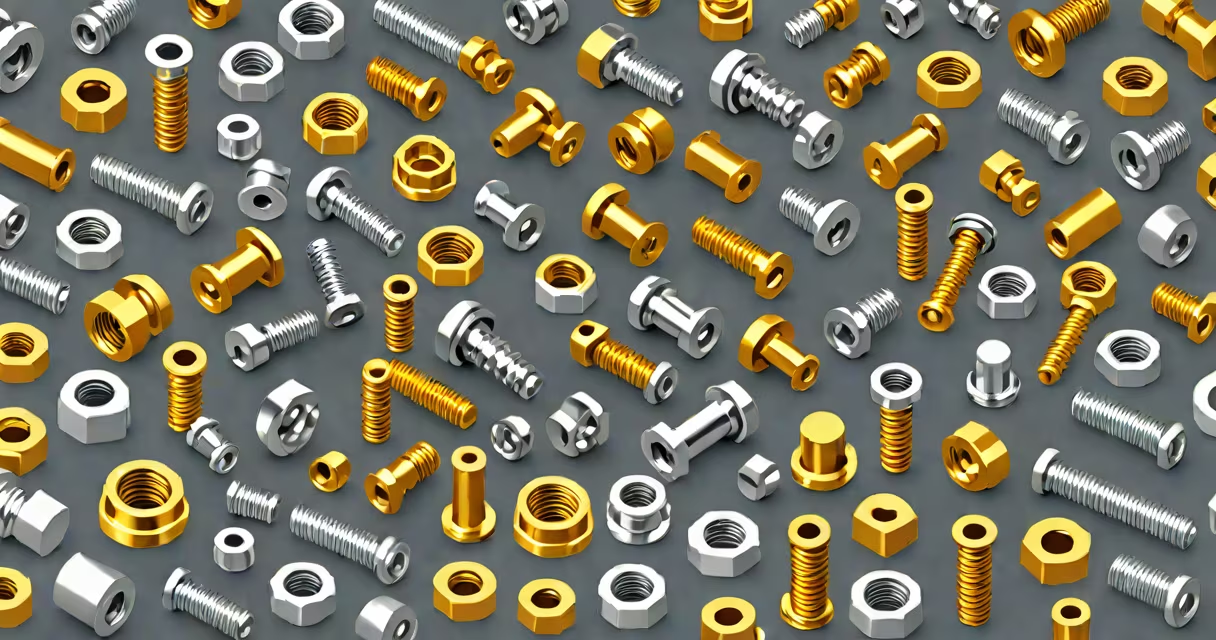
Fasteners are mechanical devices that join or affix two or more components together through physical force, typically without requiring welding, adhesive, or permanent alteration. They enable disassembly, adjustment, and maintenance across industries including automotive, aerospace, and residential building.
Fasteners rely on friction, clamping force, or interlocking geometry to hold parts in place. Common forms include bolts, screws, nails, rivets, and specialized connectors like anchors and toggle bolts. Their function is not limited to joining-they also transmit load, resist vibration, and maintain alignment under stress.
The International Organization for Standardization (ISO) defines over 1,200 fastener types across 26 categories, with ISO 898 covering mechanical properties of steel fasteners. The American Society for Testing and Materials (ASTM) publishes standards for material grades, thread tolerances, and testing protocols used in industrial applications.
Fasteners operate by creating a compressive joint between parts. When tightened, the bolt or screw stretches slightly while the clamped materials compress. This generates friction between surfaces, resisting shear and pull-out forces. The preload-the tension applied during tightening-is critical: too little and the joint slips; too much and the fastener yields or fractures.
For example, a M10×1.5 metric bolt tightened to 120 N·m produces approximately 45 kN of clamping force. This value depends on thread pitch, material hardness, and lubrication. Without proper torque control, joints fail prematurely-studies show 30% of mechanical failures stem from improper fastener installation.
Thread engagement matters. Minimum engagement length should be 1.5 times the nominal diameter for steel-to-steel connections. A M10 bolt requires at least 15 mm of thread into the nut or tapped hole. Undercut threads or damaged taps reduce effective strength by up to 40%.
Fasteners fall into several functional groups based on design and purpose. The table below outlines major categories, their typical uses, and material specifications.
| Type | Use Case | Material Standards | Typical Load Capacity |
|---|---|---|---|
| Bolt | High-strength structural joints | ASTM A325, ISO 898-1 Grade 10.9 | Up to 120 kN (M16) |
| Screw | Sheet metal, wood, plastic assembly | ANSI B18.6.1, ISO 1478 | Up to 25 kN (M6) |
| Nut | Securing bolts in assemblies | ISO 4032, ASTM F568M | Matches bolt grade |
| Rivet | Aircraft, ship hulls, roofing | ASME B18.11.1, MIL-STD-1312 | Up to 50 kN (1/2" diameter) |
| Toggle Bolt | Wall mounting in drywall or hollow studs | UL 2043, ANSI/ICC-ES AC39 | Up to 500 lb (2.2 kN) |
Each type serves distinct environments. Structural bolts in bridges require high tensile strength and fatigue resistance. Wood screws feature sharp threads and tapered shanks to bite into porous materials. Toggle bolts expand behind drywall to distribute load across weak substrates.
Non-obvious fact: Not all fasteners are metallic. Polymer fasteners like nylon inserts or PTFE-coated bolts are used in corrosive environments. A 2022 study by the National Institute of Standards and Technology (NIST) found that polymer-coated fasteners reduced galvanic corrosion by 87% in marine applications compared to bare steel.
Fasteners appear in nearly every manufactured product. In automotive assembly, over 10,000 fasteners secure engine components, chassis, and interior panels. The average passenger vehicle contains 15,000 to 20,000 individual fastening points.
Construction relies heavily on fasteners for framing, roofing, and electrical conduit. A single residential home may use 50,000 fasteners during build. Steel beams in skyscrapers are joined with high-strength bolts rated to withstand seismic loads. The 2011 Christchurch earthquake revealed that improperly torqued fasteners contributed to 12% of structural collapses in non-engineered buildings.
Manufacturers select fasteners based on environment, load, and service life. For example, aircraft use titanium bolts with self-locking features to prevent loosening at altitude. Marine vessels use stainless steel or bronze fasteners to resist saltwater degradation. Industrial machinery often integrates lock washers or thread-locking compounds to counteract vibration-induced failure.
Many assume all screws are the same. In reality, screw types differ by thread form, drive style, and application. A machine screw has a uniform thread and flat head, designed for tapping into pre-drilled holes. A wood screw has a tapered shank and coarse thread to grip fibrous material. Using a wood screw in metal causes thread stripping-failure occurs at 60% of expected load.
Another misconception: "bolt" and "screw" are interchangeable. They are not. A bolt passes through a clearance hole and is secured with a nut. A screw is driven directly into a material or tapped hole. This distinction affects load distribution and failure mode. In a 2019 test by the Society of Automotive Engineers (SAE), bolts failed under shear at 2.3 times higher load than equivalent screws in similar joints.
I once installed a custom aluminum frame using M6 cap screws. After six months, one joint loosened. Inspection showed the washer was missing. Without the washer, pressure concentrated on a small area, causing localized deformation. Adding a flat washer restored clamping integrity. This taught me that fasteners depend on complete systems-not just the bolt itself.
When selecting fasteners, verify compatibility with mating materials. Aluminum parts can gall when paired with steel fasteners under load. Use anodized or coated fasteners to prevent this. Always consult manufacturer torque tables-over-tightening is a leading cause of joint failure.
Understanding what are fasteners begins with recognizing they are not generic hardware. They are engineered solutions tailored to specific loads, environments, and assembly methods. A single mistake in selection or installation can compromise safety and performance.