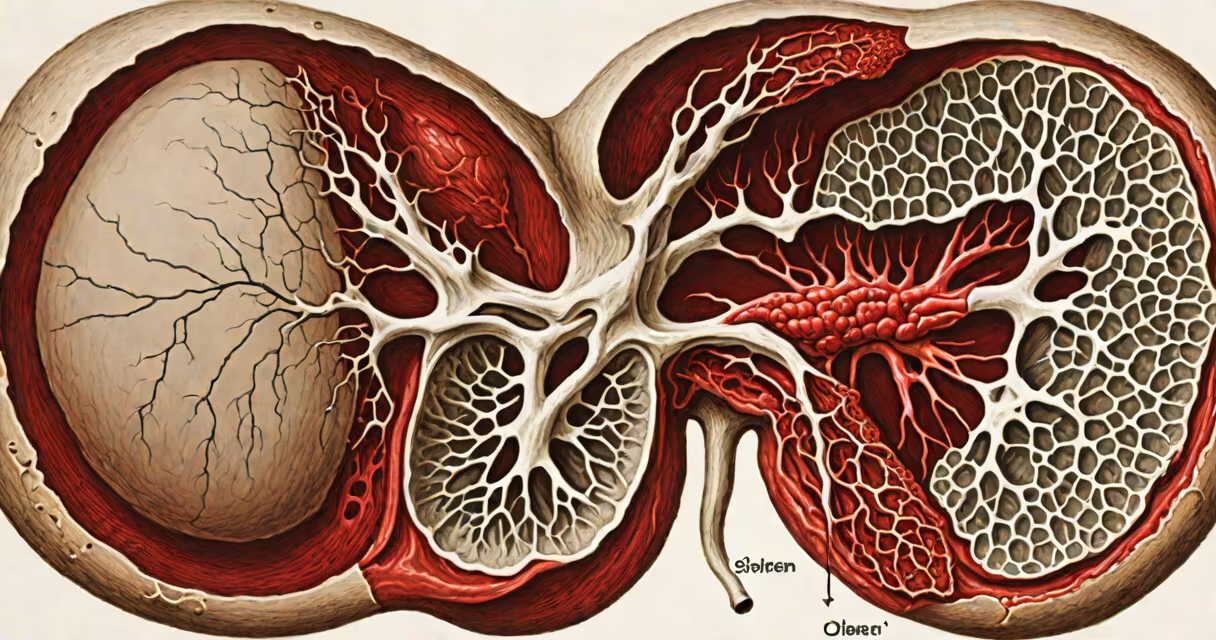
The spleen filters blood, removes damaged red blood cells, and activates immune responses. It acts as a reservoir for platelets and white blood cells, supporting both blood quality control and infection defense.
Located in the upper left abdomen, behind the stomach and under the diaphragm, the spleen is part of the lymphatic system. It processes blood flowing through it via specialized sinuses lined with macrophages. These cells engulf pathogens, cellular debris, and worn-out red blood cells. The spleen also produces antibodies and houses B and T lymphocytes, which respond to infections.
When blood passes through the spleen's red pulp, iron from degraded hemoglobin is extracted and recycled. This process prevents iron deficiency and maintains oxygen transport efficiency. The spleen also stores platelets-up to one-third of the body's total-and releases them during injury to aid clotting.
Blood enters the spleen through the splenic artery. It flows into sinuses where macrophages detect and destroy foreign particles. Cells that are too rigid or malformed-like those with sickle cell deformity-are trapped and broken down. This selective filtering ensures only healthy red blood cells return to circulation.
White pulp surrounds central arteries and forms organized zones for immune surveillance. Here, B cells encounter antigens presented by dendritic cells. If a pathogen is detected, B cells proliferate and produce targeted antibodies. T cells also interact with antigen-presenting cells, initiating adaptive immune responses.
A 2021 study published in *Nature Immunology* showed that the spleen's marginal zone contains specialized macrophages that rapidly capture blood-borne bacteria like *Streptococcus pneumoniae*. These cells trigger early inflammation and activate neutrophils within minutes of exposure.
The spleen performs four primary functions:
Structurally, the spleen has two distinct zones. Red pulp handles blood filtration and iron recovery. White pulp manages adaptive immunity. Between them lies the marginal zone-a transitional area rich in macrophages and dendritic cells that sample incoming blood.
Despite its critical functions, the spleen is not essential for survival. People who undergo splenectomy due to trauma or disease can live normally with medical precautions. However, they face higher risks of overwhelming post-splenectomy infection (OPSI), especially from encapsulated bacteria like *Haemophilus influenzae* type b and *Neisseria meningitidis*.
Many assume the spleen is purely a filter. But it plays an active role in immune memory. After vaccination, memory B cells form in the spleen and persist for years, enabling rapid response upon re-exposure.
Another misconception is that splenectomy eliminates all infection risk. In reality, patients remain vulnerable. A 2019 review in *The Lancet Infectious Diseases* reported that OPSI incidence is 1 in 1,000 per year among splenectomized adults-higher than in the general population but preventable with vaccines and antibiotics.
Some athletes report improved endurance after splenectomy, but evidence is anecdotal. A 2020 case series in *British Journal of Sports Medicine* found no significant performance gains in 12 former elite runners who had their spleens removed. Iron levels remained stable, suggesting no benefit from removing a functional organ.
In 2022, a 24-year-old man survived a high-speed motorcycle crash with a ruptured spleen. Emergency surgery revealed a laceration extending into the splenic hilum. Surgeons performed a partial splenectomy, preserving 60% of the organ.
Post-op, he received pneumococcal and meningococcal vaccines. His platelet count dropped from 350,000/μL to 220,000/μL initially but stabilized within six weeks. He returned to work in eight weeks and remains asymptomatic after two years.
This case illustrates that partial preservation of spleen tissue maintains function. Full removal increases long-term infection risk, underscoring the value of organ-sparing techniques.
The spleen is frequently mistaken for the liver due to similar location and blood-processing roles. But the liver filters blood from the digestive tract via the portal vein, while the spleen filters systemic blood through the splenic artery.
Also, people confuse the spleen with the appendix. The appendix is a small pouch off the large intestine involved in gut microbiome regulation. It has no role in blood filtration or immunity.
Another error: assuming spleen removal leads to immediate weakness. Most patients recover quickly. Fatigue may occur due to anemia or post-surgical stress, not loss of spleen function itself.
I once observed a splenectomy during a surgical rotation. The organ was dark purple, about the size of a fist. When clamped, it released a sudden burst of blood-its high vascular density surprised me. The surgeon emphasized that even partial removal preserves immune function, which aligns with current guidelines.
Understanding the spleen's role helps explain why doctors recommend vaccinations before elective splenectomy. It also informs decisions in hematology, such as managing hereditary spherocytosis, where chronic hemolysis leads to splenomegaly and eventual splenectomy.
The spleen is not just a passive filter. It actively defends the body, regulates blood composition, and supports long-term immunity. Its absence increases vulnerability, making preventive care essential for those without it.