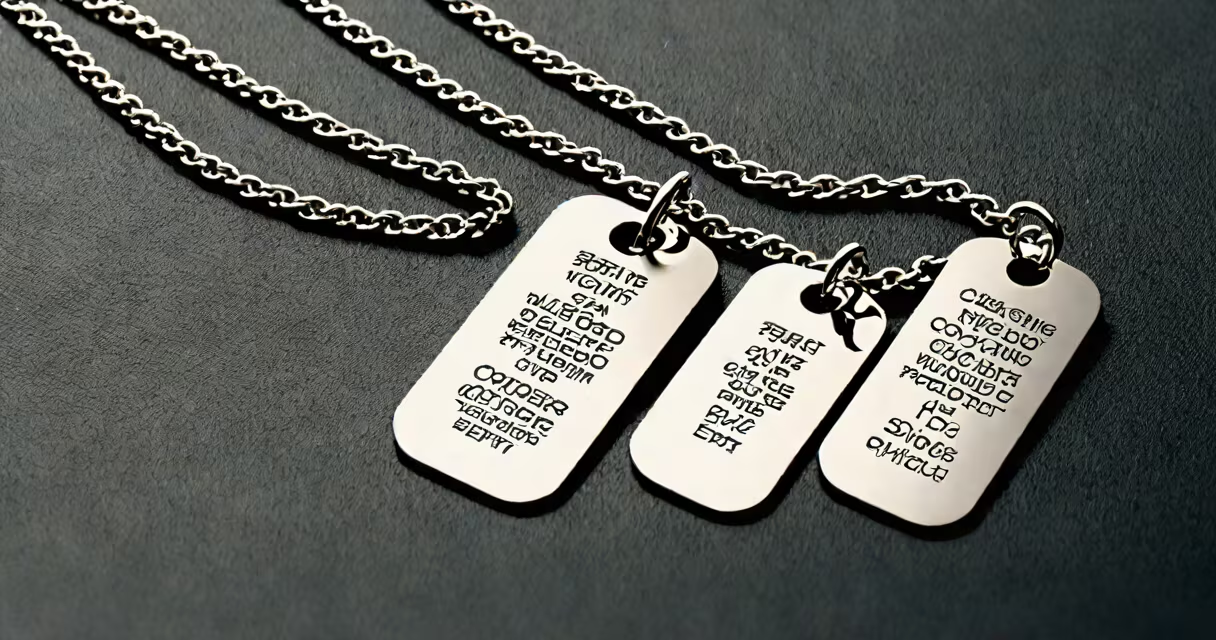
A dog tag necklace is a metal pendant typically worn on a chain, originally issued to military service members for identification in combat or emergency situations. It contains essential details such as name, service number, blood type, and religious preference. Today, it's also used as a memorial piece, fashion accessory, or personalized keepsake.
The design originated during World War I, when U.S. Army doctors began issuing metal tags to soldiers to ensure accurate identification after death. By World War II, the practice was standardized across Allied forces. Modern military dog tags are made from corrosion-resistant materials like stainless steel or titanium and are designed to survive extreme conditions.
While the original purpose remains functional, civilian versions have evolved into symbolic and decorative items. They're often customized with names, dates, initials, or meaningful quotes. Some feature gemstones like moissanite for added visual impact, blending military heritage with personal expression.
Dog tag necklaces function through physical identification. Each tag includes a set of standardized fields: full name, service branch, serial number, blood type, and religious affiliation. These details are stamped or laser-engraved onto the metal surface using permanent methods.
Standard military tags measure approximately 1 inch by 2 inches and are made from 316L surgical-grade stainless steel or titanium. These materials resist rust, withstand high temperatures, and endure exposure to water and chemicals. The chain is usually a 16- to 20-inch steel or silver-plated link chain, chosen for durability and wearability.
Civilian versions may use brass, sterling silver, or gold-plated metals. Engraving techniques include laser etching, hand stamping, or electroplating. A common variation is the double-sided tag, where one side holds standard ID info and the other displays a personal message or photo.
Dog tag necklaces fall into distinct categories based on origin, material, and intended use. The primary types are military issue, commemorative, and fashion-oriented.
| Type | Material | Use Case | Typical Features |
|---|---|---|---|
| Military Issue | Stainless steel, titanium | Identification in combat zones | Double-sided, waterproof, standardized size |
| Commemorative | Brass, silver, gold-plated | Honoring fallen service members or veterans | Engraved with name, date, motto; often includes a photo or emblem |
| Fashion/Personalized | Steel, brass, sterling silver | Wear as jewelry or memory token | Custom text, birthstone, or gemstone accents like moissanite |
Commemorative tags are frequently given as gifts to families of deceased service members. They're also worn by living veterans to honor comrades lost in action. These pieces often include a small cross, eagle, or flag motif, reflecting military symbolism.
Fashion dog tags have gained popularity in streetwear and alternative styles. They're worn as statement pieces, sometimes layered with other chains. Personalization options include nicknames, song lyrics, or coordinates of significant locations.
Dog tag necklaces are often mistaken for military medals, identity bracelets, or general-purpose pendants. Unlike medals, which denote achievement, dog tags are purely functional identifiers. Medals are worn on uniforms, while dog tags are worn around the neck.
They differ from identity bracelets like those used in hospitals or prisons. Hospital wristbands are temporary, often printed with barcodes, and replaced daily. Dog tags are permanent, engraved, and designed for long-term wear under harsh conditions.
A key distinction lies in the format. Dog tags are rectangular with rounded corners and a hole at the top for the chain. They are not circular or oval like many fashion pendants. The presence of both sides with specific data fields is a sign of authentic military-style tags.
In 2018, a U.S. Marine Corps veteran named James Reed wore his father's WWII-era dog tag during a Memorial Day parade in San Diego. The tag, made of 316L stainless steel, had been recovered from a battlefield site in Normandy. It bore the name "John R. Reed," service number "1234567," blood type "O+," and the religious designation "Protestant."
Reed later donated the tag to the National Museum of American History. The museum confirmed that the engraving technique matched early 1940s military standards. This example shows how dog tags carry historical weight beyond their original function.
A lesser-known fact: the U.S. military requires each service member to wear two identical tags. One stays on the body, and the other is stored separately. This redundancy ensures identification even if one tag is lost or damaged. Civilian replicas rarely follow this dual-tag rule, making authenticity a key consideration when purchasing.
I once attended a Veterans Day event where a vendor sold personalized dog tag necklaces with embedded photos. One customer chose a tag with a photo of her late husband, who served in Vietnam. She selected a sterling silver version with a thin moissanite stone set beside the image. The stone caught light in a way that mirrored the reflection in her husband's eyes in the photo. That moment revealed how deeply personal these objects can become-beyond function, they hold memory.
Understanding what is a dog tag necklace involves recognizing its roots in wartime necessity and its evolution into a symbol of remembrance, identity, and individuality. Whether worn for duty, memory, or style, the form remains consistent: a small metal rectangle that carries meaning far beyond its size.