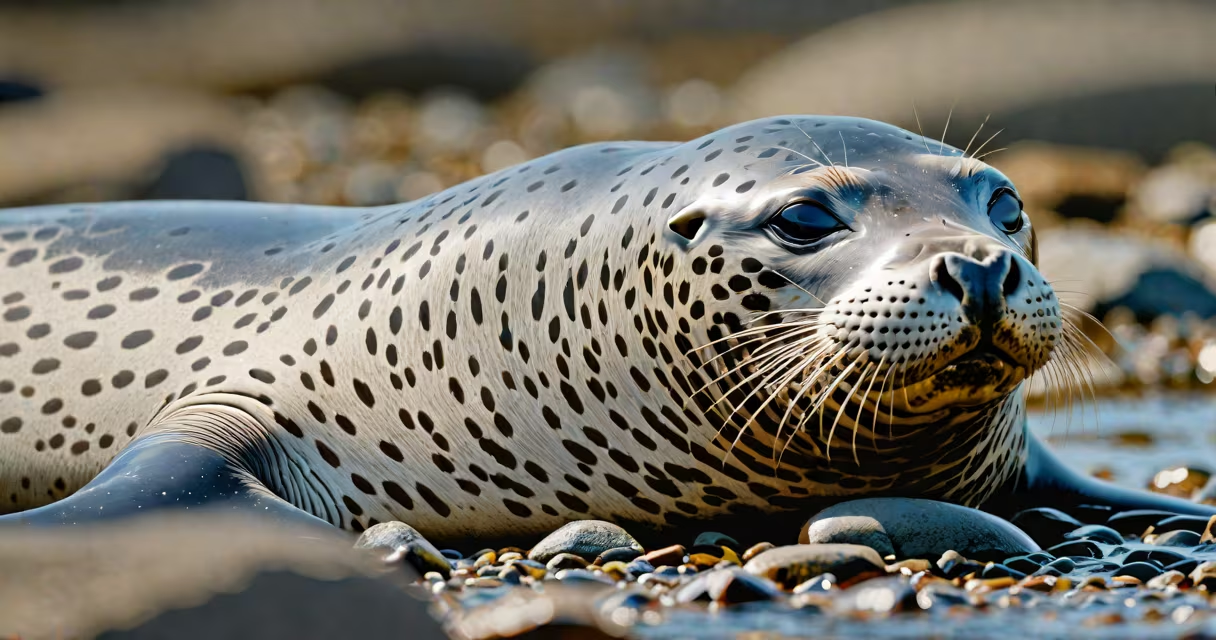
A pinniped is a semiaquatic marine mammal characterized by flippers adapted for swimming and walking on land. This group includes seals, sea lions, and walruses, all of which evolved from terrestrial carnivores and now spend significant time in water. Their streamlined bodies, dense underfur, and specialized circulatory systems enable survival in cold ocean environments.
Pinnipeds belong to the order Carnivora and are divided into three families: Phocidae (true seals), Otariidae (eared seals, including sea lions and fur seals), and Odobenidae (walruses). They are found in Arctic, Antarctic, and temperate waters worldwide, ranging from shallow coastal zones to deep offshore regions. All species are carnivorous, feeding primarily on fish, squid, and crustaceans.
According to the American Society of Mammalogists, pinnipeds are distinguished by their hydrodynamic bodies, reduced hindlimb mobility, and reliance on foreflippers for propulsion in water. Their ability to dive deeply-some species reach depths exceeding 1,000 meters-relies on high myoglobin levels in muscles and efficient oxygen conservation during breath-holding.
Pinnipeds swim using useful movements of their foreflippers. True seals (Phocidae) move on land by wriggling their bodies in a caterpillar-like motion, dragging themselves forward with their front flippers. In contrast, eared seals (Otariidae) rotate their hind flippers forward and walk upright on all four flippers, enabling faster movement on land.
Walruses (Odobenidae) use their large tusks to haul out onto ice floes and to dig for clams on the seafloor. Their thick blubber layer-up to 10 cm in some species-provides insulation and energy storage during long fasting periods, especially during breeding seasons.
One key adaptation is their diving physiology. Weddell seals (Leptonychotes weddelli), native to Antarctica, routinely dive to 600 meters and remain submerged for over 80 minutes. Their blood contains high concentrations of hemoglobin and myoglobin, allowing extended oxygen retention. This capability is supported by bradycardia (slowed heart rate) and peripheral vasoconstriction during dives, conserving oxygen for important organs.
The three families of pinnipeds differ in physical structure, behavior, and habitat preferences. The table below outlines key differences:
| Family | Common Names | Ear Structure | Hind Flipper Orientation | Locomotion on Land | Example Species |
|---|---|---|---|---|---|
| Phocidae | True seals | Internal ears only | Cannot rotate hind flippers forward | Wriggling, belly-crawling | Harbor seal (Phoca vitulina) |
| Otariidae | Eared seals | Visible external ear flaps | Can rotate hind flippers forward | Walking on all four flippers | California sea lion (Zalophus californianus) |
| Odobenidae | Walruses | External ear flaps | Can rotate hind flippers forward | Walking with flippers and tusks | Atlantic walrus (Odobenus rosmarus) |
Despite shared ancestry, these groups diverged around 20 million years ago. Molecular phylogenetic studies published in *Nature* confirm that otariids and phocids split early, while odobenids form a sister lineage to otariids, suggesting walruses share a more recent common ancestor with sea lions than with true seals.
True seals are often silent on land and rely heavily on scent and hearing. Sea lions, however, vocalize frequently-using barks, growls, and whistles to communicate within colonies. A single male California sea lion can produce over 20 distinct call types, each serving a different social function.
Pinnipeds inhabit coastal and subarctic regions across the Northern and Southern Hemispheres. Harbor seals breed along North American and European coastlines, while elephant seals (Mirounga spp.) migrate thousands of kilometers between breeding grounds in Baja California and feeding areas near the equator.
Arctic ringed seals (Pusa hispida) depend on stable sea ice for pupping and protection. Satellite tracking shows that females travel up to 1,200 km annually to reach breeding sites. Climate change threatens their habitat: Arctic sea ice extent has declined by 13% per decade since 1979, according to NASA's Earth Observatory.
These animals play critical roles in marine ecosystems. As apex predators, they regulate fish and invertebrate populations. Their fecal matter contributes nitrogen and phosphorus to nutrient-poor waters, supporting plankton growth. A 2021 study in *Ecology Letters* estimated that pinniped colonies in the Bering Sea contribute over 100 tons of nutrients annually to coastal food webs.
Many people confuse pinnipeds with fish or reptiles due to their streamlined shapes and aquatic habits. However, they are mammals-warm-blooded, give live birth, and nurse their young with milk. Unlike fish, they breathe air and must surface regularly.
Another misconception is that all pinnipeds are aggressive. While walruses can be dangerous when provoked, most species avoid humans. Harbor seals have been documented approaching boats calmly, sometimes curious rather than threatening. In 2018, researchers in Scotland observed a harbor seal swimming alongside a kayak for nearly 30 minutes without showing signs of fear.
Some assume pinnipeds are inefficient swimmers because they appear slow on land. But in water, they achieve speeds of up to 25 km/h. Northern elephant seals can maintain 15 km/h for sustained periods during long-distance migrations. Their efficiency stems from low drag and precise control of body posture during swimming.
In 2022, I spent two weeks observing gray seals (Halichoerus grypus) on Sable Island, Canada. During low tide, hundreds gathered on sandy beaches to rest and molt. Using binoculars and audio recorders, I noted that individuals formed loose social clusters based on age and sex. Males emitted low-frequency grunts to assert dominance, while pups responded with high-pitched squeals.
One afternoon, a juvenile seal attempted to cross a narrow tidal channel. It failed twice, then waited until the current slowed. On the third try, it surged forward with useful strokes of its foreflippers. Within 30 seconds, it reached the opposite bank. The entire sequence lasted less than a minute-a clear demonstration of their adaptive precision in changing environments.
A pinniped is a highly specialized marine mammal with flippers, a thick blubber layer, and adaptations for deep diving and efficient swimming. These traits evolved over millions of years, allowing them to thrive in some of Earth's most extreme aquatic environments. From the icy coasts of Antarctica to the kelp forests off California, pinnipeds occupy diverse niches and serve essential ecological functions.
Understanding what is a pinniped requires recognizing both their biological uniqueness and their vulnerability to human-driven changes. Conservation efforts must account for migration patterns, breeding site protection, and climate impacts. For instance, the International Union for Conservation of Nature lists the Hawaiian monk seal (Neomonachus schauinslandi) as critically endangered, with fewer than 1,400 individuals remaining.
As marine ecosystems face increasing pressure, protecting pinnipeds means safeguarding biodiversity, nutrient cycles, and ocean health. Their presence signals the resilience-and fragility-of life in the world's oceans.