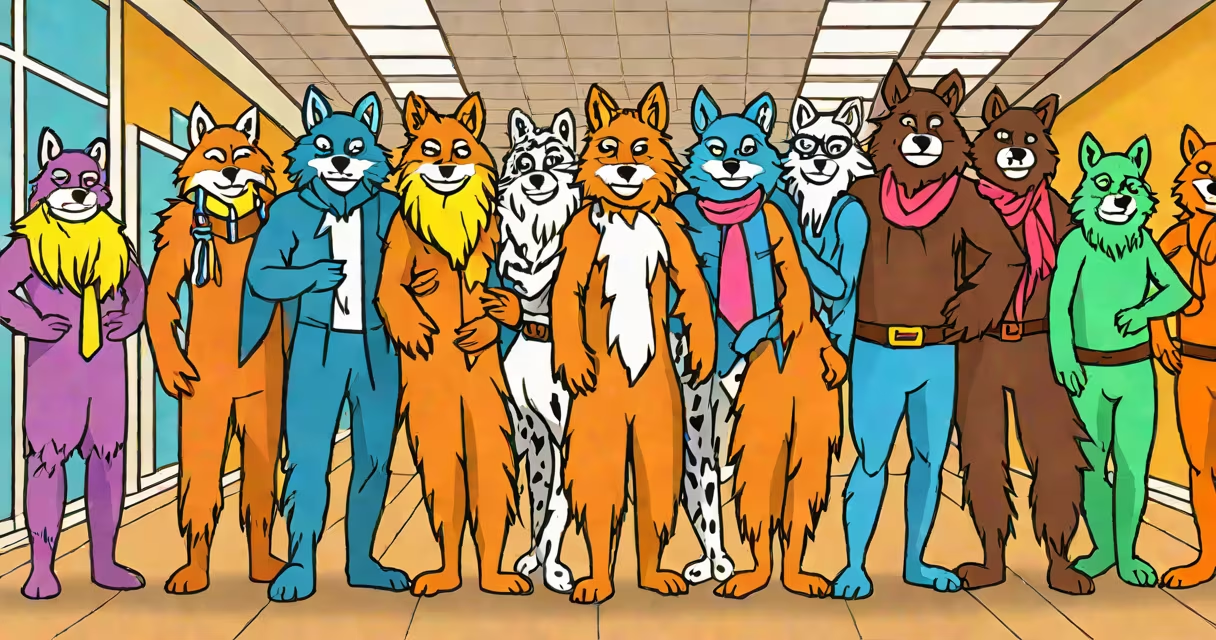
The term "furry" refers to a subculture centered around fictional anthropomorphic animals-humanoid creatures with animal features such as fur, tails, and ears-who serve as characters in art, storytelling, and social interaction. Members of the furry fandom create and engage with original or existing animal-based personas, often expressing identity through visual art, roleplay, and costume performance.
Furry emerged in the late 1970s and early 1980s as a niche interest among fans of science fiction and fantasy, particularly those drawn to anthropomorphic characters in comics, animation, and literature. The movement gained momentum through fanzines, early internet forums, and conventions. Today, it spans over 100 countries and includes millions of participants who identify with the culture through creative expression, online communities, and live events.
Unlike broad cultural movements, the furry fandom operates primarily through voluntary participation and shared creative values. It is not a religion, political ideology, or lifestyle choice, but a community built around artistic creation and personal identification with fictional animal characters. The core activity involves designing and portraying a "fursona"-a personalized animal avatar-often used in digital art, roleplaying, or attending conventions in full costume.
Participants develop a fursona as a representation of themselves or an idealized version of their personality. This character may have a species (e.g., fox, wolf, dragon), a name, a unique appearance, and a backstory. Fursonas are not meant to represent real animals but are symbolic constructs shaped by individual imagination and cultural influences.
Art is the primary medium of communication within the community. Digital artists share original illustrations, animations, and 3D models of fursonas on platforms like FurAffinity, DeviantArt, and Instagram. These works often depict characters in narrative scenes, emotional moments, or humorous situations. The emphasis is on creativity, not realism-many pieces feature exaggerated proportions, stylized features, or fantastical settings.
Online interactions occur through forums, Discord servers, and social media groups. Members discuss art techniques, share stories, participate in collaborative projects, and host virtual events such as themed art challenges or livestreamed roleplay sessions. Real-world gatherings, known as cons (short for conventions), happen annually in cities worldwide, including Anthrocon in Pittsburgh, Midwest FurFest in Chicago, and Eurofurence in Europe.
The furry community encompasses multiple forms of engagement, ranging from passive appreciation to active participation. The following table outlines common categories based on involvement level and focus:
| Type | Description | Examples |
|---|---|---|
| Art Creator | Produces original artwork featuring fursonas or fictional animal worlds. | Illustrations on FurAffinity, animated shorts on YouTube. |
| Costume Wearer (Fursuit Member) | Wears a full-body costume representing a fursona at events or photoshoots. | Performing at a convention, posing for photos at a park. |
| Storyteller | Writes narratives involving fursonas, often in serialized formats or webcomics. | Web series like "The Furry Adventures of Captain Fluff," published on Tapas. |
| Community Participant | Engages in discussion, supports creators, attends events without creating content. | Commenting on posts, joining Discord channels, attending panels. |
Not all members create art or wear suits. Many simply enjoy consuming content, sharing favorite pieces, or discussing themes like identity, ethics, and mental health. Participation levels vary widely, and there is no formal hierarchy or requirement to contribute.
One widespread misconception is that the furry fandom is inherently sexual. While adult-themed content exists-especially on private platforms-this is not representative of the entire community. According to a 2021 survey by the University of Washington's Center for Communication & Technology, 68% of furry participants reported that their involvement was focused on art, friendship, or self-expression, not sexuality.
Another error is equating furry with bestiality or zoophilia. These are distinct concepts. Zoophilia involves romantic or sexual attraction to real animals, while furry is a form of imaginative roleplay involving fictional characters. The American Psychological Association (APA) explicitly states that "furry identity is not clinically associated with paraphilic disorders" and that "the majority of individuals in the furry community report positive psychological outcomes, including reduced loneliness and increased self-esteem."
A lesser-known but important distinction is between "furry" as a cultural label and "furry" as a personal identity. Some people adopt the label because they enjoy the art or attend events, while others identify deeply with the community, using their fursona as a consistent part of their online and offline persona. This spectrum ranges from casual interest to long-term commitment, much like fandoms around anime, gaming, or music.
In 2019, I attended Midwest FurFest in Rosemont, Illinois. Over three days, I observed over 300 attendees in custom fursuits, many of whom had spent months crafting their costumes. One man wore a detailed red fox suit with articulated claws and a tail that moved via motorized linkage. He described his fursona as "a guardian spirit from a forest area," blending mythology with personal symbolism.
During a panel on mental health, a participant shared that creating a fursona helped her process trauma from childhood bullying. She said, "My fursona has a scar on its ear-same place I got hurt. But now it's part of my story, not just pain." Her experience reflects findings from a 2020 study published in *New Media & Society*, which found that 72% of furry participants reported improved emotional regulation through creative expression.
Another example is the "Furries Helping Furries" initiative, launched in 2022 by a nonprofit called Furry Outreach Network. The program connects members with counseling services, job training, and peer support networks. Since its launch, it has supported over 1,200 individuals across North America and Europe, demonstrating how the community functions beyond entertainment.
What is furry? It is a global, creative subculture rooted in imagination, identity exploration, and mutual support. Its members express themselves through art, storytelling, and costume, forming connections across borders and backgrounds. While misconceptions persist, the reality is a diverse, inclusive community where self-expression is valued above all. Whether through a single drawing or a full-fledged fursuit, the act of creating a fursona is a personal declaration of presence, belonging, and possibility.