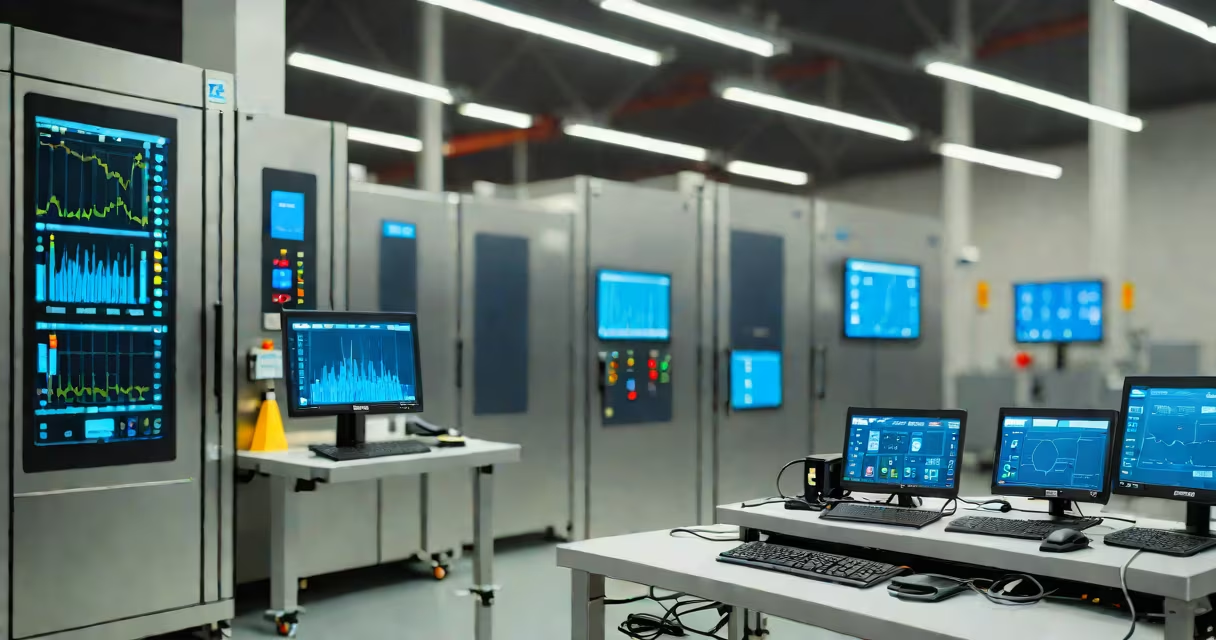
Industrial Internet of Things (IIoT) refers to the integration of physical machinery in manufacturing and industrial settings with networked sensors, software, and data analytics to enable real-time monitoring, automation, and predictive decision-making. It extends traditional industrial automation by connecting machines, systems, and people through secure, scalable networks.
IIoT operates by embedding sensors and actuators into industrial equipment-such as conveyor belts, CNC machines, and robotic arms-to collect operational data. This data flows through gateways to cloud platforms or on-premise servers where it's processed using algorithms to detect anomalies, forecast failures, and improve workflows. Unlike consumer IoT, IIoT prioritizes reliability, low latency, and security due to the critical nature of industrial operations.
The foundation of IIoT lies in machine-to-machine (M2M) communication, where devices exchange data without human intervention. For example, a temperature sensor on a motor detects overheating and automatically triggers a shutdown before damage occurs. This capability reduces unplanned downtime, improves energy efficiency, and enhances worker safety. According to the International Data Corporation (IDC), global spending on IIoT solutions reached $156 billion in 2023, reflecting growing adoption across sectors like automotive, oil & gas, and pharmaceuticals.
IIoT functions through a layered architecture: sensing, connectivity, data processing, and application. At the edge, sensors capture data such as vibration, pressure, temperature, and flow rates. These signals are digitized and transmitted via wired or wireless protocols like MQTT, OPC UA, or 5G private networks.
Data then moves through a network layer to a centralized or distributed processing system. Edge computing plays a important role here-processing data locally near the source to reduce latency and bandwidth use. For instance, a packaging line might analyze motion patterns in real time to adjust speed based on product weight, preventing jams without waiting for cloud feedback.
Advanced analytics engines apply machine learning models to historical and live data. A model trained on past bearing failures can flag early signs of wear in a turbine rotor, allowing maintenance teams to replace parts during scheduled downtime rather than facing sudden breakdowns. The U.S. Department of Energy reports that predictive maintenance enabled by IIoT can reduce maintenance costs by up to 30% and extend asset life by 20-40%.
IIoT systems consist of hardware, software, and network infrastructure. Core components include:
There are three primary deployment models for IIoT:
| Type | Deployment | Use Case Example | Latency |
|---|---|---|---|
| On-Premise | Local servers in factory | Real-time control of assembly robots | Sub-10ms |
| Hybrid | Edge + cloud | Predictive maintenance with remote alerts | 10-100ms |
| Cloud-Only | Remote data centers | Monthly production trend analysis | 100ms+ |
Manufacturers often choose hybrid architectures to balance responsiveness and scalability. For example, a steel mill may run real-time temperature control at the edge while sending historical data to the cloud for long-term optimization.
IIoT is frequently confused with general IoT or enterprise IT systems. While both involve connected devices, IIoT targets industrial-grade performance under harsh conditions-high vibration, extreme temperatures, and electromagnetic interference. Consumer devices like smart thermostats are not designed for continuous 24/7 operation in a foundry.
A common mistake is assuming that IIoT requires full cloud migration. Many successful implementations use edge-only processing. A semiconductor fab in Taiwan reduced defect rates by 18% by running AI inference on local GPUs instead of sending raw wafer images to the cloud, cutting latency from 2 seconds to under 100 milliseconds.
Another misconception is that IIoT replaces human workers. Instead, it augments roles. A plant supervisor at a beverage bottling facility told me during a site visit that IIoT dashboards helped her identify a recurring misalignment issue in the labeling machine-something she had missed for months because visual inspection was too slow. The system didn't take her job; it gave her better insight.
One of the most impactful uses of IIoT is predictive maintenance. In a wind farm in Texas, turbines equipped with vibration and pitch sensors transmit data every 15 seconds. An anomaly detection algorithm flagged a blade imbalance six days before failure. Engineers replaced the blade during routine service, avoiding a $2 million repair and 14-day downtime.
Another example is smart logistics. A logistics provider in Germany uses IIoT-enabled pallets with RFID and GPS trackers. When a shipment exceeds a 2°C threshold during transit, the system alerts the warehouse team. Over one year, this reduced spoilage of perishable goods by 27%, saving €1.3 million in losses.
Energy management is another area where IIoT delivers measurable results. A paper mill in Finland deployed IIoT to monitor steam usage across 12 boilers. By adjusting setpoints based on real-time load data, they cut fuel consumption by 12% annually-equivalent to 1,200 tons of CO₂ reduction.
These cases illustrate that IIoT is not just about connectivity-it's about actionable intelligence derived from continuous data streams. The value emerges not from collecting data, but from turning it into decisions that improve efficiency, safety, and sustainability.
Understanding what is iiot begins with recognizing it as a system of intelligent, interconnected industrial assets-not a single device or platform. Its success depends on integrating engineering, data science, and operational processes into a unified workflow. As manufacturing becomes increasingly digital, IIoT stands as the core of modern industrial resilience.