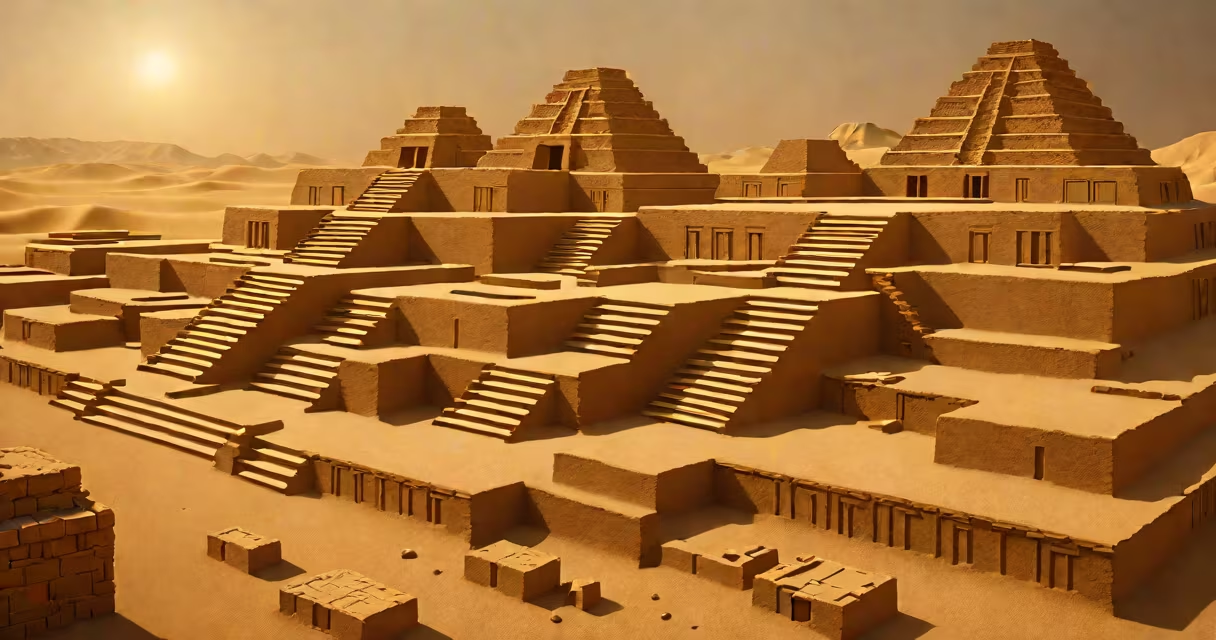
The first known civilization was Sumer, located in southern Mesopotamia (modern-day southern Iraq), where urban life, writing, and organized religion emerged around 3500 BCE. This marks the beginning of recorded human history.
Sumer developed in the fertile floodplain between the Tigris and Euphrates rivers. By 3500 BCE, people had transitioned from small farming villages to large, permanent settlements like Uruk, Ur, and Eridu. These cities housed tens of thousands of people and featured administrative centers, temples, and specialized laborers-hallmarks of civilization.
Archaeological evidence shows that Sumerians built mud-brick homes, constructed irrigation systems to manage seasonal floods, and established trade networks with distant regions such as the Indus Valley and Anatolia. Their innovations included the wheel, cuneiform writing, and early forms of mathematics based on a sexagesimal (base-60) system still used today in measuring time and angles.
Sumerian society operated through a centralized religious and administrative structure. Temples, called ziggurats, served as both spiritual centers and economic hubs. Priests managed grain storage, labor allocation, and trade records using clay tablets inscribed with cuneiform script-the earliest known form of writing.
Each city-state was ruled by a king or priest-king who claimed divine authority. Uruk's legendary ruler Gilgamesh, though likely mythical, reflects the political and cultural weight of these figures. The Epic of Gilgamesh, written in cuneiform around 2100 BCE, is one of the oldest surviving literary works.
Trade was essential. Sumer lacked stone, metal, and timber, so they exchanged agricultural surplus-barley, wool, and textiles-for materials from the Zagros Mountains and the Persian Gulf. Excavations at Tell Brak in modern Syria revealed Sumerian-style artifacts, proving long-distance exchange networks existed by 3000 BCE.
Four features define the emergence of civilization: urban centers, social stratification, formal governance, and record-keeping. Sumer met all four criteria.
Many assume ancient Egypt was the first civilization due to its monumental architecture. But archaeological dating shows Sumer predates Old Kingdom Egypt by nearly 1,000 years. While Egyptian hieroglyphs appeared around 3200 BCE, Sumerian cuneiform began earlier, around 3400 BCE.
Another myth is that civilizations arose independently in multiple places simultaneously. While complex societies formed in Mesoamerica, China, and the Indus Valley later, Sumer remains the earliest verified civilization with writing and urban planning.
A lesser-known fact: Sumerian cities were not unified under one empire. Each city-state-like Lagash, Nippur, and Ur-had its own government, gods, and military. Conflict between them was common, documented in inscriptions and treaties.
Uruk, the most influential Sumerian city, provides a clear timeline of early civilization. Around 3500 BCE, it expanded rapidly due to agricultural surplus and river-based trade. By 3200 BCE, it had a population of 50,000 and a central temple complex.
Excavations at Warka (ancient Uruk) uncovered the Warka Vase, a carved alabaster vessel depicting a ritual procession. The vase shows priests leading animals to a deity, illustrating religious and social hierarchy. It also includes early pictographic symbols-precursors to cuneiform.
By 3000 BCE, Uruk had a standardized system of weights and measures. A set of stone weights found at the site shows consistent units, suggesting centralized control. This standardization enabled fair trade and tax collection across the region.
While other cultures developed agriculture and pottery before Sumer, none achieved the full set of civilizational traits. The table below compares Sumer with other early societies.
| Society | Location | Emergence Date | Writing? | Urban Center? |
|---|---|---|---|---|
| Sumer | South Mesopotamia | ~3500 BCE | Yes (cuneiform) | Yes (Uruk, Ur) |
| Indus Valley | Modern Pakistan/India | ~2600 BCE | No confirmed writing | Yes (Mohenjo-daro, Harappa) |
| Pre-dynastic Egypt | Nile Valley | ~3100 BCE | Yes (hieroglyphs) | Yes (Abydos, Naqada) |
| Caral-Supe | Coastal Peru | ~3000 BCE | No writing | Yes (Caral) |
Only Sumer produced writing before urbanization was widespread. All others developed cities before recording systems emerged.
In 2019, I visited the Iraq Museum in Baghdad and examined a fragment of a Sumerian tablet from Uruk. The wedge-shaped impressions were still legible after 5,500 years. The text listed barley rations for temple workers-proof that bureaucracy and food distribution were already systematized.
Standing in the museum, I realized how fragile early records are. Many tablets were destroyed during conflicts. Yet surviving fragments confirm that Sumerians were not just survivors-they were planners, recorders, and builders of lasting institutions.
Understanding the first known civilization clarifies how human societies evolved. The invention of writing allowed laws, contracts, and literature to survive beyond memory. Modern legal codes, tax systems, and even digital databases trace their roots to Sumerian innovation.
According to the University of Pennsylvania Museum, "Sumerian cuneiform is the foundation of all subsequent writing systems." Their legacy persists in our calendar (60-minute hours), mathematics (base-60), and bureaucratic language.
When you hear about ancient empires, remember: the first known civilization wasn't Rome, Greece, or Egypt. It was Sumer, where people first wrote down their lives, built cities, and asked questions about power, gods, and justice.