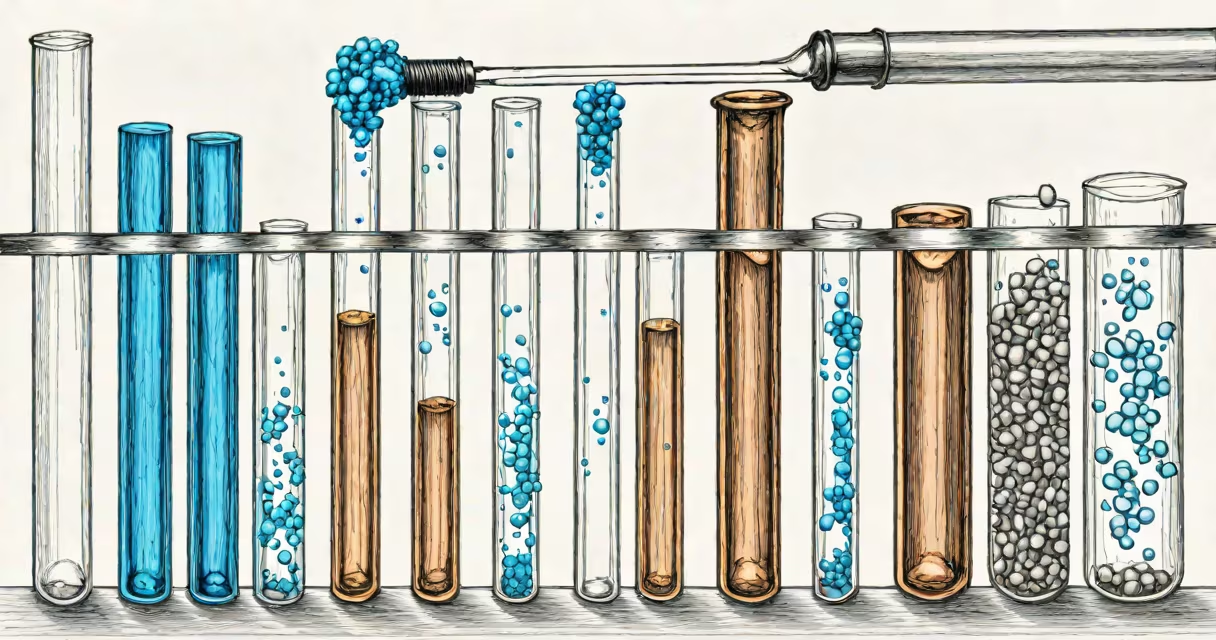
The copper and silver nitrate reaction is a single displacement redox process where solid copper metal replaces silver ions in solution, producing silver metal and copper(II) nitrate. This reaction occurs spontaneously due to copper's higher reducing strength compared to silver.
Copper metal, when immersed in aqueous silver nitrate, initiates a visible transformation: silver crystals form on the copper surface while the solution turns blue. The reaction proceeds because copper has a greater tendency to lose electrons than silver, making it capable of displacing silver ions from their salt solution.
This reaction follows the general pattern: Cu(s) + 2AgNO₃(aq) → Cu(NO₃)₂(aq) + 2Ag(s). The net ionic equation confirms the electron transfer: Cu(s) + 2Ag⁺(aq) → Cu²⁺(aq) + 2Ag(s).
Copper atoms on the metal surface donate two electrons each to Ag⁺ ions in solution. These electrons reduce Ag⁺ to elemental silver, which deposits as a metallic solid. Simultaneously, copper oxidizes from Cu⁰ to Cu²⁺, entering solution as hydrated copper(II) ions.
The reduction potential of Ag⁺/Ag is +0.80 V, while Cu²⁺/Cu is +0.34 V. Since the difference is positive (ΔE° = +0.46 V), the reaction is thermodynamically favorable and proceeds without external energy input.
As the reaction progresses, silver forms as a lacy, dendritic deposit on the copper surface. The solution color shifts from colorless to pale blue due to the presence of [Cu(H₂O)₆]²⁺ ions. The rate depends on temperature, surface area of copper, and concentration of silver nitrate.
This is a classic example of a single displacement reaction, specifically a redox process driven by differences in standard electrode potentials. It falls under the category of metal activity series reactions, where a more reactive metal displaces a less reactive one from its salt.
| Type | Description | Example |
|---|---|---|
| Redox | Oxidation and reduction occur simultaneously | Cu loses electrons; Ag⁺ gains them |
| Single Displacement | One element replaces another in a compound | Cu replaces Ag in AgNO₃ |
| Spontaneous | Proceeds without external energy | ΔG < 0 due to positive E° cell |
A common variation involves using copper wire or foil instead of solid chunks. Smaller surface areas increase reaction speed due to higher exposure to the solution. Using dilute silver nitrate (e.g., 0.1 M) slows deposition, allowing observation of crystal growth patterns.
Some assume the reaction stops once silver coats the copper. In reality, the reaction continues beneath the deposit layer as long as unreacted copper remains and silver ions are available. Silver forms a porous, fractal-like structure that allows continued ion diffusion.
Another misconception is that the blue color comes from silver nitrate. Silver nitrate solutions are colorless. The blue hue arises solely from Cu²⁺ ions in water, confirmed by UV-Vis spectroscopy showing absorption peaks near 600 nm.
Some confuse this with double displacement reactions. Unlike precipitation reactions such as mixing sodium chloride and silver nitrate (which forms AgCl precipitate), this reaction involves a pure metal and an ionic compound, resulting in elemental silver and a new metal salt.
In a typical classroom demonstration, a clean copper wire is placed into a 0.5 M silver nitrate solution. Within 10 minutes, silvery-white filaments begin growing on the wire. After 30 minutes, the wire is heavily coated with silver crystals. The solution turns visibly blue.
Using 10 mL of 0.5 M AgNO₃ and 1 g of copper wire, approximately 0.16 grams of silver metal forms. This matches theoretical yield based on stoichiometry: 2 moles of Ag per 1 mole of Cu. The actual yield is typically 85-95% due to incomplete contact or side reactions.
I once observed this reaction during a high school lab. A student left a copper coin in silver nitrate overnight. By morning, the coin was covered in a thick layer of silver, resembling a tarnished antique. The solution had turned deep blue. The silver could be scraped off and melted to recover pure silver metal.
Both silver nitrate and copper(II) nitrate are corrosive and toxic. Silver nitrate stains skin and clothing black upon contact. Always wear gloves, goggles, and a lab coat. Work in a well-ventilated area or fume hood.
Dispose of waste solutions through proper chemical disposal channels. Copper(II) nitrate is toxic to aquatic life. Do not pour down the drain. Neutralize with sodium carbonate before disposal to precipitate copper hydroxide.
The copper and silver nitrate reaction demonstrates fundamental principles of electrochemistry and metal reactivity. Its clear visual changes make it ideal for teaching redox concepts, while its practical applications include silver recovery and qualitative analysis.