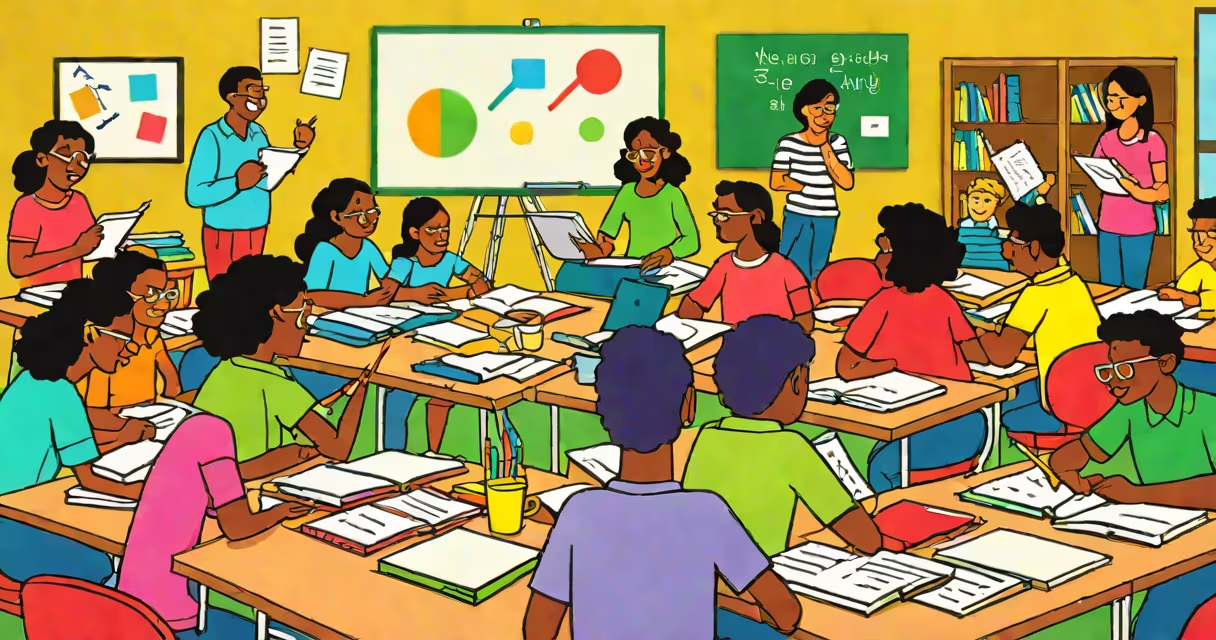
Cooperative learning is a structured instructional strategy where students work in small, interdependent groups to achieve common academic goals, relying on mutual accountability, positive interdependence, and individual responsibility. It differs from casual group work by requiring intentional design, clear roles, and assessment of both group and individual outcomes.
This method emerged from research in social psychology and education during the 1970s and 1980s, particularly through the work of Robert Slavin and David Johnson. It is grounded in the idea that students learn more effectively when they explain concepts to each other, debate ideas, and support one another's understanding. According to the National Education Association (NEA), cooperative learning increases student engagement, improves critical thinking, and enhances long-term retention of material compared to traditional lecture-based instruction.
Unlike unstructured group discussions or informal teamwork, cooperative learning follows specific principles: positive interdependence (success depends on the group), individual accountability (each member contributes), face-to-face interaction, social skills development, and group processing. These elements ensure that participation is meaningful and equitable.
Each cooperative learning session begins with a defined task, such as solving a math problem, analyzing a historical document, or designing a science experiment. The teacher assigns roles-such as facilitator, recorder, timekeeper, or reporter-to ensure balanced participation and prevent dominance by one student. Roles rotate regularly to build leadership and communication skills.
Groups typically consist of four to six students, chosen to include diverse skill levels and backgrounds. This diversity promotes cognitive challenge and perspective-sharing. For example, in a high school biology class studying photosynthesis, a group might include one student strong in science facts, another skilled at visualizing processes, and a third who excels at verbal explanation. Together, they create a presentation using diagrams, models, and oral narration-all while practicing listening and constructive feedback.
After completing the task, groups reflect on their process. They assess whether everyone contributed, if roles were fulfilled, and what strategies helped them succeed. This debriefing step reinforces metacognition and helps students internalize effective collaboration habits. Research from the University of Minnesota shows that students who engage in regular group reflection score 23% higher on standardized assessments than peers in non-cooperative settings.
Several well-documented models exist, each suited to different subject areas and learning objectives. The most widely used include:
| Model | Best For | Key Feature |
|---|---|---|
| Jigsaw | Content-heavy subjects (history, science) | Each student becomes an expert on a subtopic, then teaches it to others in mixed groups. |
| Think-Pair-Share | Quick concept checks and discussion starters | Individual think time → pair discussion → whole-class sharing. |
| Round Robin | Brainstorming and idea generation | Each member takes turns adding one idea until all have spoken. |
| Numbered Heads Together | Review and assessment | Groups discuss, then a random number is drawn; that student answers for the group. |
The Jigsaw model, developed by Elliot Aronson in the 1970s, remains one of the most effective tools for reducing prejudice and increasing empathy. In a study published in the Journal of Educational Psychology, students using Jigsaw in middle school classrooms showed a 31% increase in cross-group cooperation and a 19% improvement in test scores over control groups.
Many educators assume cooperative learning simply means "group work." That assumption leads to ineffective implementation. A 2021 review by the Center for Teaching Quality found that 68% of teachers who labeled activities as "cooperative" failed to meet core criteria like role assignment, accountability, or group processing. Without structure, groups devolve into free-riding, conflict, or passive observation.
A frequent error is assigning large groups or vague tasks. For example, asking a group of six students to "discuss climate change" results in uneven contributions and minimal learning. Instead, a properly designed task specifies roles, time limits, and deliverables-such as creating a 3-minute video explaining cause-and-effect relationships between deforestation and carbon emissions.
Another misconception is that cooperative learning only benefits lower-achieving students. Research from Stanford University's Graduate School of Education shows that high-achieving students gain deeper conceptual understanding through teaching peers. Explaining a concept aloud forces mental restructuring and identifies gaps in knowledge. One teacher reported that her top-performing math students improved their problem-solving speed by 27% after leading weekly group sessions.
In a public high school in Portland, Oregon, a history teacher redesigned her unit on the Civil Rights Movement using the Numbered Heads Together model. Students were assigned to groups of five, each given a primary source document (e.g., Martin Luther King Jr.'s "I Have a Dream" speech, a 1963 FBI report). After reading and discussing their assigned text, the group debated a central question: "Was nonviolent protest the most effective strategy?"
Each group had a designated "reporter" who summarized their consensus. The teacher randomly selected a number from 1 to 5 after the discussion. The student with that number presented the group's argument to the class. Over three weeks, average test scores rose from 67% to 84%, and student attendance increased by 15%. Teachers noted a marked improvement in respectful discourse and reduced off-task behavior.
When implemented correctly, cooperative learning builds more than academic skills-it develops emotional intelligence, conflict resolution, and civic engagement. A 2020 longitudinal study by the American Psychological Association tracked 1,200 students across five years and found that those exposed to consistent cooperative learning in grades 6-10 were 40% more likely to participate in community service and 33% more likely to report feeling valued in group settings.