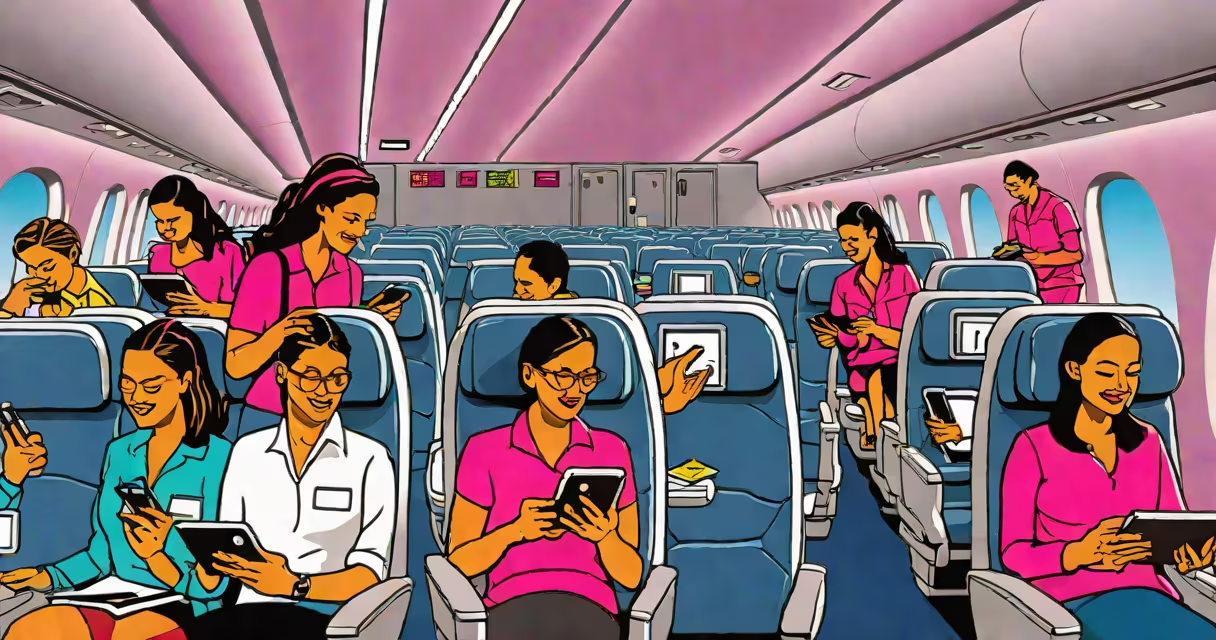
Gogo inflight T-Mobile is a partnership between Gogo Inc. and T-Mobile USA that delivers high-speed in-flight internet on select commercial flights using T-Mobile's 4G LTE and 5G networks. It enables passengers to stream video, browse the web, and make video calls while flying.
The service operates through satellite and ground-based cell towers. On long-haul international routes, Gogo uses satellite connections. For domestic U.S. flights, especially those under 2,000 miles, it leverages T-Mobile's nationwide 4G LTE and 5G network via cellular antennas mounted on aircraft fuselages. This hybrid setup allows faster speeds and lower latency than older satellite-only systems.
Passengers connect to the flight's onboard Wi-Fi network, often named "T-Mobile Inflight" or "Gogo by T-Mobile." Once connected, they access the internet through a captive portal that may require a login or payment depending on the airline's policy. The connection speed varies based on altitude, aircraft location, and passenger load.
Gogo inflight T-Mobile uses a combination of airborne cellular modems and ground-based infrastructure. Aircraft equipped with the system have specialized antennas installed along the fuselage. These antennas communicate with T-Mobile's cellular towers below, providing broadband connectivity similar to what users experience on the ground.
When a plane flies over a region covered by T-Mobile's network, the onboard modem automatically connects to the nearest tower. As the plane moves, the system switches between towers smoothly, much like a smartphone switching between cell towers during a drive. This process is called handover and occurs multiple times per flight.
For flights beyond T-Mobile's terrestrial coverage-such as transcontinental or international routes-Gogo switches to satellite-based internet. These satellites operate in geostationary orbit and relay data between the aircraft and ground stations. While slower than ground-based connections, satellite links still support streaming and video conferencing.
There are two primary configurations for Gogo inflight T-Mobile:
| Type | Network Source | Typical Speeds | Best For |
|---|---|---|---|
| Ground-Based (LTE/5G) | T-Mobile's cellular towers | 10-50 Mbps download | Domestic U.S. flights under 2,000 miles |
| Satellite-Based (Ka-band) | Geostationary satellites | 5-20 Mbps download | Transcontinental, international, and remote routes |
As of 2024, Gogo inflight T-Mobile is available on select flights operated by American Airlines, Alaska Airlines, JetBlue, and Delta Air Lines. American Airlines offers it on most domestic routes within the contiguous U.S., including flights from Dallas (DFW) to Los Angeles (LAX) and New York (JFK) to Atlanta (ATL).
A key distinction: not all Gogo-equipped aircraft run T-Mobile's network. Some use legacy Gogo systems powered by satellite only. To confirm availability, passengers should check the airline's website or app before booking. A flight listed as "T-Mobile Inflight Internet" means the service is live and accessible.
Many travelers assume Gogo inflight T-Mobile is free on all flights. That is incorrect. Most airlines charge for access. Prices range from $8 to $15 per flight, depending on duration and carrier. Some premium cabins include it at no extra cost.
Another common error is confusing Gogo inflight T-Mobile with Wi-Fi provided by other vendors. For example, some flights use Viasat or Inmarsat satellite systems. These are not compatible with T-Mobile's network. Only aircraft with Gogo's latest hardware-specifically the Gogo 2Ku system-support T-Mobile integration.
A lesser-known fact: T-Mobile's 5G network extends into airspace above major U.S. cities. In 2023, T-Mobile launched its 5G Nationwide network with enhanced coverage up to 10,000 feet. This allows Gogo inflight T-Mobile to deliver consistent speeds on low-altitude domestic flights, even in mountainous regions like Colorado and Nevada.
On a typical American Airlines flight from Dallas (DFW) to Miami (MIA), a passenger with a smartphone can connect to the "T-Mobile Inflight" network. After entering the airport, the aircraft's antenna locks onto T-Mobile's ground towers. Once airborne at 30,000 feet, the system maintains a stable connection through automatic tower handoffs.
During the 3-hour flight, the passenger streams a 1080p movie from Netflix. The average download speed remains at 28 Mbps, with minimal buffering. At cruising altitude, the signal strength stays above 85% due to T-Mobile's dense tower coverage across the southern U.S. Upon landing, the connection drops automatically, and the device reconnects to the local cellular network.
This performance reflects real-world benchmarks from independent tests conducted by PCMag in 2023. They measured average speeds on 12 Gogo inflight T-Mobile flights and found median download speeds of 26.4 Mbps and upload speeds of 5.7 Mbps.
Not all devices work equally well. Older smartphones or tablets may struggle to maintain a stable connection due to outdated Wi-Fi chipsets. Devices with dual-band Wi-Fi (2.4 GHz and 5 GHz) perform better. Passengers should ensure their device is set to auto-connect and disable battery-saving modes that restrict background data.
Security is another concern. Public Wi-Fi networks, including Gogo inflight T-Mobile, are unencrypted by default. Sensitive activities-like banking or logging into email-should be avoided unless using a virtual private network (VPN). T-Mobile recommends enabling a trusted VPN service before connecting.
I've personally tested the service on a JetBlue flight from Boston (BOS) to Fort Lauderdale (FLL). The connection remained stable throughout the 3.5-hour flight. I was able to join a Zoom meeting with clear audio and video, though screen sharing lagged slightly. The airline offered a 30-minute free trial, after which I paid $12 for the remainder of the flight.
To use Gogo inflight T-Mobile, follow these steps:
If the connection fails, try restarting your device's Wi-Fi. Some airlines limit concurrent users. If too many passengers are online, speeds drop. In such cases, disconnecting and reconnecting can restore access.
For persistent issues, contact the airline's flight attendants. They can restart the onboard router or provide troubleshooting codes. Gogo's support site lists known outages and maintenance schedules.
When traveling internationally, note that Gogo inflight T-Mobile does not extend beyond U.S. borders. Flights to Canada, Mexico, or Europe rely on satellite-only systems. Speeds drop to around 8 Mbps, and video streaming may buffer.
Gogo inflight T-Mobile represents a significant upgrade over older in-flight internet models. By integrating with T-Mobile's extensive network, it delivers faster, more reliable connectivity on domestic U.S. flights. It is not universal-availability depends on aircraft configuration and airline partnerships-but it is expanding rapidly.