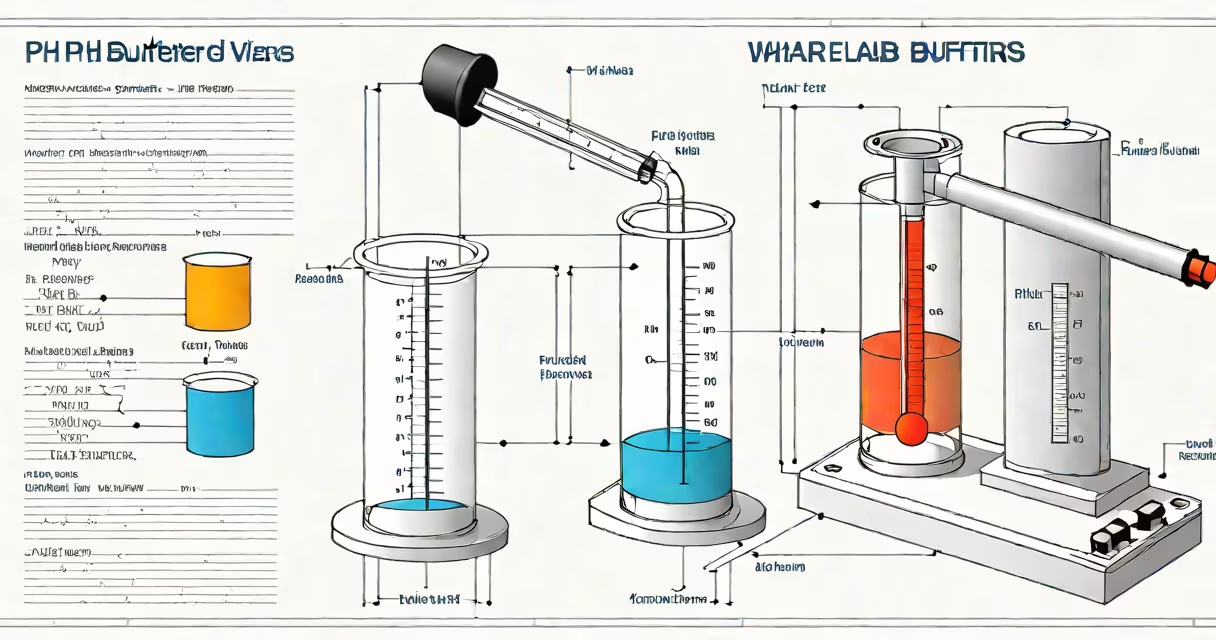
Ph buffers are chemical systems that resist changes in pH when small amounts of acid or base are added. They maintain stable acidity levels in solutions critical to life and industrial processes.
Buffers work by absorbing excess hydrogen ions (H⁺) or hydroxide ions (OH⁻) through equilibrium reactions. A typical buffer consists of a weak acid and its conjugate base, such as acetic acid and acetate. When acid enters the system, the base component neutralizes H⁺. When base enters, the weak acid donates H⁺ to restore balance.
The effectiveness of a buffer depends on its pKa-the pH at which it resists change most efficiently. Buffers are most effective within ±1 pH unit of their pKa. For example, a phosphate buffer with a pKa of 7.2 maintains stability near pH 6.2 to 8.2, ideal for mimicking human blood pH.
When an acid (H⁺ donor) is introduced into a buffered solution, the conjugate base (A⁻) reacts with H⁺ to form the weak acid (HA). This prevents a drop in pH. Conversely, adding a base (OH⁻) causes HA to dissociate and release H⁺, counteracting the rise in pH.
This changing equilibrium is described by the Henderson-Hasselbalch equation: pH = pKa + log([A⁻]/[HA]). The ratio of conjugate base to weak acid determines the resulting pH. Buffer capacity-the amount of acid or base a buffer can neutralize-depends on the concentrations of both components.
For instance, a 0.1 M acetic acid/acetate buffer at pH 4.76 (its pKa) can absorb up to 0.1 moles of strong acid per liter before significant pH change occurs. Once the buffer components are depleted, pH shifts rapidly.
Buffer systems vary based on their intended pH range and environment. The following table outlines major buffer types, their effective pH ranges, and applications.
| Buffer Type | Effective pH Range | Common Applications |
|---|---|---|
| Acetate (CH₃COOH/CH₃COO⁻) | 3.6 - 5.6 | Cell culture media, DNA extraction |
| Phosphate (H₂PO₄⁻/HPO₄²⁻) | 6.2 - 8.2 | Biological research, blood plasma mimicry |
| Carbonate (HCO₃⁻/CO₃²⁻) | 9.3 - 11.3 | High-pH industrial processes |
| Hepes (N-2-hydroxyethylpiperazine-N'-2-ethanesulfonic acid) | 6.8 - 8.2 | Cell biology experiments, enzyme assays |
Human blood uses a bicarbonate-carbonic acid buffer system to maintain pH between 7.35 and 7.45. Even slight deviations disrupt oxygen transport and enzyme function. The kidneys and lungs regulate this system: lungs expel CO₂ to reduce carbonic acid, while kidneys excrete H⁺ and retain bicarbonate.
Soil pH is regulated by organic matter and minerals. A buffer-rich soil maintains fertility by preventing rapid acidification from rain or fertilizers. Agricultural scientists often test soil pH and add lime (calcium carbonate) to boost buffering capacity in acidic soils.
In laboratories, buffers ensure consistent conditions during experiments. For example, PCR (polymerase chain reaction) requires precise pH for Taq polymerase activity. A Tris-HCl buffer at pH 8.0 is standard in DNA amplification protocols.
Pharmaceutical formulations rely on buffers to stabilize drugs. Insulin injections use zinc and phenol buffers to prevent degradation and maintain solubility. Without proper buffering, protein-based medications could denature or aggregate.
Industrial processes such as fermentation and dye production depend on pH control. In brewing, yeast thrives between pH 4.0 and 5.0. Brewers adjust mash pH using lactic acid or phosphoric acid to create optimal buffer conditions.
Many assume buffers can handle unlimited acid or base. That's false. A buffer's capacity is finite. Adding more acid than the conjugate base can neutralize causes pH collapse. For example, adding 0.2 moles of HCl to 1 liter of 0.1 M acetate buffer overwhelms the system, dropping pH below 3.5.
Another misconception is that all buffers are natural. Synthetic buffers like MOPS and PIPES are widely used in cell biology due to low metal ion interference and high solubility. These are designed for specific experimental needs, not biological origin.
Some confuse pH with buffer capacity. A solution can have a stable pH but lack buffering ability. Pure water has pH 7.0 but no buffer capacity-it changes instantly when acid is added. True buffers resist change; pH alone doesn't indicate resistance.
Consider a patient with diabetic ketoacidosis. Excess ketones (acids) lower blood pH. The body activates multiple buffering systems:
Without these buffer mechanisms, blood pH could drop below 7.0, leading to coma or death. Clinicians monitor serum bicarbonate levels to assess buffering status. A value below 18 mmol/L indicates metabolic acidosis requiring treatment.
I once observed a lab experiment where students prepared a phosphate buffer at pH 7.4. They added 0.1 mL of 1 M HCl and measured pH change. The buffer resisted change-pH shifted only 0.05 units. After adding 1 mL of HCl, pH dropped sharply to 5.2. This demonstrated buffer saturation and the limits of neutralization capacity.
Ph buffers differ from pH indicators. Indicators change color at specific pH values but do not stabilize pH. Phenolphthalein turns pink above pH 8.2 but offers no buffering. Buffers prevent pH change; indicators only report it.
Also, buffers aren't the same as alkalinity. Alkalinity measures a solution's ability to neutralize acid, often via carbonate species. It's a broader term used in environmental science. A buffer is a specific chemical system; alkalinity is a measurable property.
Understanding the difference matters in water quality testing. High alkalinity may suggest good buffering capacity, but only a known buffer system confirms it. Testing for both ensures accurate assessment of aquatic stability.