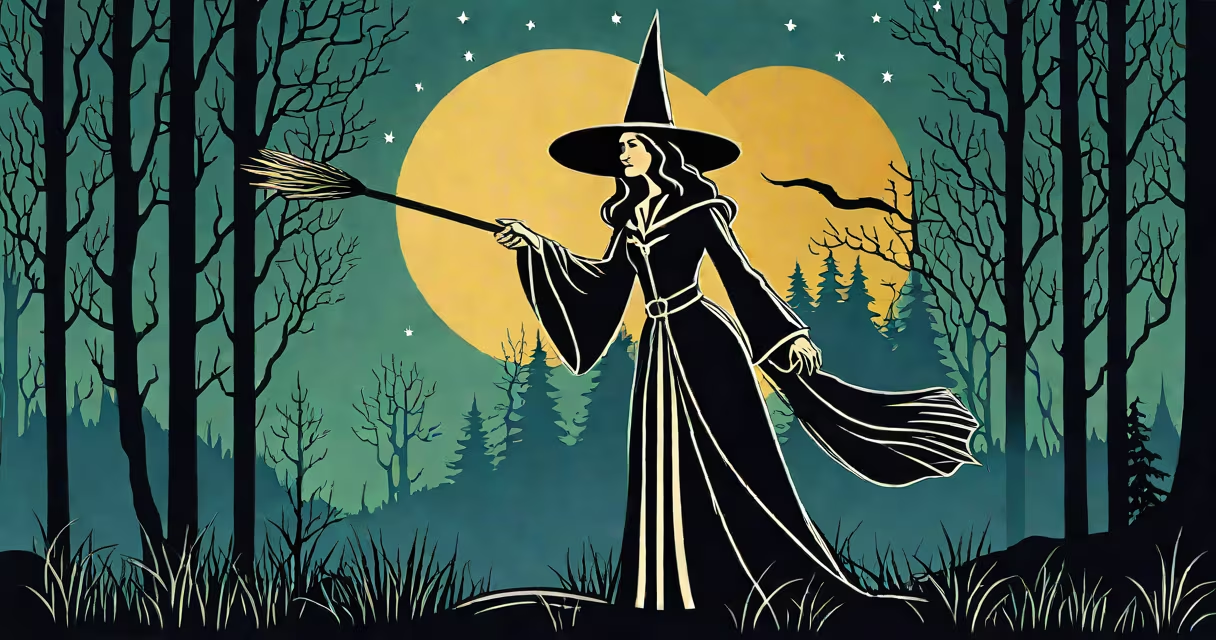
The word witch refers to a person, historically often a woman, believed to possess supernatural powers through magical practices, especially those linked to nature, healing, or cursing. This term has evolved across cultures and centuries, carrying meanings ranging from respected healer to feared sorcerer.
Etymologically, "witch" derives from Old English *wicce*, a feminine form of *wicca*, meaning a practitioner of magic. The root appears in Germanic languages, including Old High German *wizz* and Middle Dutch *wicke*. By the 15th century, the term became central to European witch hunts, where accusations were used to justify persecution of women, especially those who lived independently or possessed knowledge of herbs and remedies.
Modern usage retains both literal and metaphorical applications. In fantasy genres, witches are fictional characters with spellcasting abilities. In real-world contexts, the term is sometimes reclaimed by practitioners of Wicca, Druidry, or other neo-pagan traditions as a positive identity. However, the word still carries weight in historical and social discourse due to its association with fear, marginalization, and gendered violence.
Early European societies often viewed individuals skilled in herbal medicine, childbirth, or divination as intermediaries between the human and spirit worlds. These figures were not uniformly labeled "witches" but were sometimes called *wise women*, *healers*, or *cunning folk*. As Christian doctrine expanded, such roles were increasingly seen as heretical or demonic.
The peak of witch hysteria occurred between 1450 and 1750, particularly in Germany, Scotland, and New England. The *Malleus Maleficarum* (1487), a treatise written by Catholic inquisitors Heinrich Kramer and Jacob Sprenger, codified beliefs that women were more susceptible to Satan's influence. This text fueled trials and executions, with estimates suggesting 40,000 to 60,000 people-mostly women-were executed during this period, according to historian Brian Levack.
By the 18th century, Enlightenment ideals reduced belief in witchcraft among educated Europeans. Yet the idea persisted in rural areas and popular culture. The Salem witch trials in colonial Massachusetts (1692-1693) remain a well-documented example of mass hysteria, where 20 people were executed and many more imprisoned based on spectral evidence and accusations.
Witchcraft is not a monolithic concept. Different cultures assign varied roles and attributes to those labeled as witches. In West African traditions, for example, *wundu* or *sorcerers* may be seen as spiritual protectors or community healers, though they can also be accused of causing illness or misfortune. In parts of India, female practitioners known as *dakini* or *yogini* are revered in tantric traditions, while others face stigma.
A comparison of regional roles reveals significant differences:
| Culture/Region | Common Role | Perception | Historical Context |
|---|---|---|---|
| Medieval Europe | Healer, curse-worker | Evil, demonic | Linked to religious persecution (1450-1750) |
| West Africa (Yoruba) | Diviner, ritual specialist | Respected, feared | Part of spiritual leadership; not inherently evil |
| Indigenous North America | Medicine person, dream interpreter | Community elder, spiritual guide | Often misrepresented in colonial records |
| Modern Paganism (Wicca) | Ritual leader, nature priestess | Positive, empowering | Reclaimed identity since 1950s |
One non-obvious distinction: in many Indigenous American communities, the term "witch" was not used at all. Instead, spiritual roles were filled by *shamans*, *medicine men*, or *dreamers*. Colonizers imposed European frameworks onto these roles, equating them with "witches" to justify cultural erasure.
"Witch" is frequently conflated with "sorcerer," "warlock," or "wizard." While all involve magical practice, the terms differ in gender and origin. "Warlock" is a male equivalent in Scottish and English folklore, though it lacks roots in Old English. "Wizard" typically denotes a male figure in high fantasy, often trained in arcane arts rather than tied to nature or folk tradition.
Another misconception is that all witches practiced harmful magic. Historical records show most accused witches were not charged with harm but with "consorting with the devil"-a legal fiction used to justify punishment. In reality, many were poor widows, midwives, or outsiders whose autonomy threatened patriarchal structures.
I once attended a public lecture in Edinburgh where a historian presented court transcripts from 1650s Scotland. One woman, Agnes Sampson, was accused of using a "familiar spirit" and making a pact with the Devil. Her defense included detailed testimony about her herbal remedies and community care. She was executed. The trial documents reveal no evidence of actual harm-but the label "witch" carried enough weight to secure a death sentence.
Today, "witch" is used in multiple ways. In pop culture, characters like Sabrina Spellman (from *Chilling Adventures of Sabrina*) or characters in *Harry Potter* reflect a romanticized version of witchcraft. These portrayals often emphasize personal power, choice, and community-but rarely engage with historical trauma.
For modern practitioners, especially within Wicca and other neopagan paths, the term is reclaimed. The Church of Wicca, founded in 1964, defines a witch as someone who follows a nature-based spiritual path focused on ethics, ritual, and environmental stewardship. According to the Wiccan Rede, "An it harm none, do what ye will"-a principle emphasizing consent and responsibility.
However, the term remains politically charged. In 2020, a group of women in rural Oregon used the term "witch" to describe their collective resistance against land development. They held ceremonies, created altars from local materials, and published a manifesto titled *Witches of the Willamette*. Their actions drew media attention and sparked debate over whether reclaiming the word is empowerment-or co-optation.
Understanding what the word witch means requires acknowledging its layered past. It is not simply a synonym for "evil magician." It is a term shaped by religion, gender, class, and power. The word continues to evolve, reflecting both ancient fears and contemporary identities.